

A mercedes chauffeur service usually gets judged by the car.
That’s the wrong place to start.
The stress starts earlier. It starts when a flight changes, when LAX pickup rules shift, when the app keeps searching, and when nobody owns the problem. By the time the car arrives, the bad system has already done the damage.
In Orange County, that matters more than is generally understood. Travel to LAX, SNA, LGB, Disneyland, and the cruise terminal looks simple on a map. In real life, it’s a chain of small risks. One missed text. One wrong terminal. One driver who isn’t watching the flight. One price that changes after pickup.
A planned chauffeur system fixes those failure points before they reach you. That’s why executives, assistants, and families who want quiet control often move away from ad hoc rides and toward a scheduled mercedes chauffeur service with real accountability.
The Real Reason Your Airport Ride Is Stressful
The problem usually shows up at the worst hour.
Your phone lights up before sunrise. Your flight time changed. The pickup window is now tight. You open an app and hope the system understands what changed. It usually doesn’t.
Then the second problem starts. The app says a car is coming, then not coming, then maybe coming. At LAX, that can leave you standing in the wrong place, watching traffic stack up, while the system keeps asking you to wait a little longer.

The third problem is harder to measure and easy to feel. You don’t know much about the vehicle. You don’t know if the driver understands airport procedure. You don’t know if the cabin will be clean, quiet, and suitable for a call on the way to Orange County.
None of that means you planned poorly. It means the system was built for volume, not certainty.
On-demand systems react after the problem starts
Most ride apps are built around availability at that moment. That sounds efficient, and it works fine for low-stakes local trips. Airport transportation isn’t a low-stakes local trip for most executives, VIP travelers, or families moving between Orange County and major hubs.
The system often doesn’t know enough early enough. It doesn’t treat your transfer like a scheduled operation with assigned responsibility. It treats it like a live auction.
That’s where control starts to disappear.
Practical rule: If no one is assigned in advance, no one fully owns the result.
For airport travel, the weak point is often flight change handling. A verified note on flight tracking and airport reliability states that 27% of LAX flights face delays over 30 minutes, and most on-demand services don’t automatically adjust pickups. Professional chauffeur systems use flight APIs to remove that uncertainty.
That single issue creates a chain reaction. The passenger waits, the driver waits, or the ride is missed entirely. Then everyone starts texting from the curb.
LAX creates pressure that weak systems can’t absorb
LAX isn’t difficult because people don’t know how to travel. It’s difficult because the environment changes fast and because pickup logistics are unforgiving when the plan is loose.
A weak system usually fails in one of these ways:
- Pickup confusion: The passenger gets moved between curb, terminal, and designated pickup zones.
- Delay blindness: The driver heads in based on the original schedule and misses the actual arrival pattern.
- No human ownership: Customer support can see the booking, and nobody is actively managing the ride.
- Vehicle inconsistency: The car that arrives may fit the app category, and still feel wrong for the trip.
This is why airport transfers feel more draining than they should. The travel itself is already demanding. The ride to or from the airport should reduce noise, not add more of it.
Orange County travelers usually need certainty, not speed
Executives going from Newport Beach or Irvine to LAX often aren’t asking for something flashy. They want a quiet cabin, a clear pickup, and a person who already knows what happens if the flight moves, the terminal changes, or traffic shifts.
Families headed to Disneyland often need the same thing for a different reason. They may have luggage, children, strollers, timing windows, and very little patience for confusion after a long flight.
Cruise terminal transfers add another layer. Port days have hard timing. If the vehicle arrives late, the pressure doesn’t stay in the background. It becomes the whole morning.
A real mercedes chauffeur service handles those trips as scheduled logistics, not as random demand.
The true luxury isn’t a nicer seat. It’s not having to manage the ride yourself.
What ad hoc travel gets wrong
The common advice is simple. Book close to the time you need the car. Watch the app. Respond fast. Keep your phone on. Be flexible.
That advice sounds normal because the market got used to broken systems.
The hidden problem is that all of the effort moves onto the passenger. You become the dispatcher, the monitor, and the backup planner. If anything slips, your meeting, arrival window, or family schedule absorbs the hit.
That’s why ad hoc solutions often fail high-stakes airport travel.
❌ They depend on last-minute supply.
❌ They rarely give you one accountable person from booking to drop-off.
❌ They often don’t treat flight tracking as a core operating system.
❌ They can’t promise consistency in vehicle condition or driver standards.
A planned chauffeur system works differently.
✅ The trip is scheduled in advance.
✅ The chauffeur is part of an accountable operation.
✅ Flight changes are monitored as part of the service.
✅ Pickup and route decisions are managed before confusion reaches the client.
Why a Mercedes-based scheduled service changes the experience
The vehicle matters, and not for the obvious reason.
A Mercedes sedan, SUV, or Sprinter is useful because it supports the kind of ride airport travelers need. The cabins are quiet. The luggage space is predictable. The environment fits a call, a pause, or a simple drive without stress.
In Southern California, that matters on long airport corridors. LAX to Orange County can feel short or very long depending on the quality of the ride and the amount of uncertainty around it.
When people say they want a mercedes chauffeur service, they often mean something deeper. They want a transportation system that feels settled. They want someone else handling timing, access points, and route decisions. They want to stop watching their phone.
That’s what works.
Not more notifications. Not more app prompts. Not more algorithmic guessing.
A better plan.
The Difference Between a Driver and a Chauffeur
The gap isn’t about politeness alone. It’s about function.
A driver completes a trip. A chauffeur manages a movement.
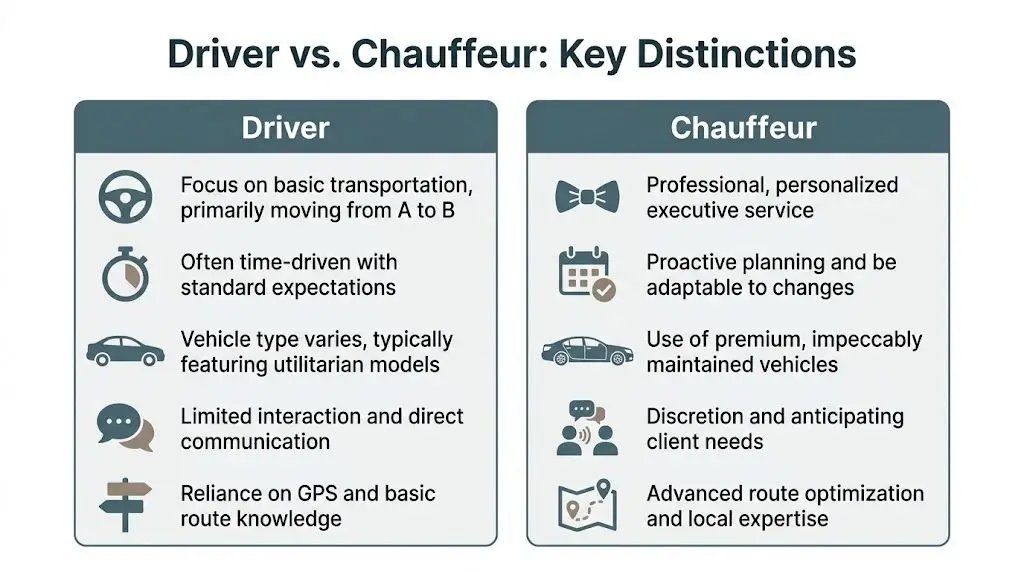
Two different job models
❌ Driver
Works inside a reactive app system. Assignment changes quickly. Standards can vary. The job is often limited to picking up and dropping off.
✅ Chauffeur
Works inside a managed service model. The ride is planned. Expectations are set in advance. The job includes timing, presentation, discretion, and problem prevention.
That difference becomes visible fast at airports.
❌ A driver may know the route and still have no ownership over changing flight details, terminal changes, or pickup complications.
✅ A chauffeur is expected to operate with context, not just directions.
There’s also the question of pricing clarity. Verified guidance on airport fee transparency for luxury transport notes that many services don’t disclose mandatory airport fees, including the average $15 to $35 per pickup at U.S. airports, and after-hours surcharges can create quote discrepancies of 15% to 30%. A professional service presents those costs clearly.
For a closer look at how a managed service is structured, this overview of chauffeured car services is useful.
A clean car and a polite hello are good. Real reliability starts earlier, in dispatch, planning, and accountability.
What to Expect During Your Mercedes Chauffeur Ride
Once the ride is planned correctly, the experience gets quiet.
That’s usually the first thing people notice. No guessing at pickup. No unclear car details. No need to keep checking whether the ride still exists.
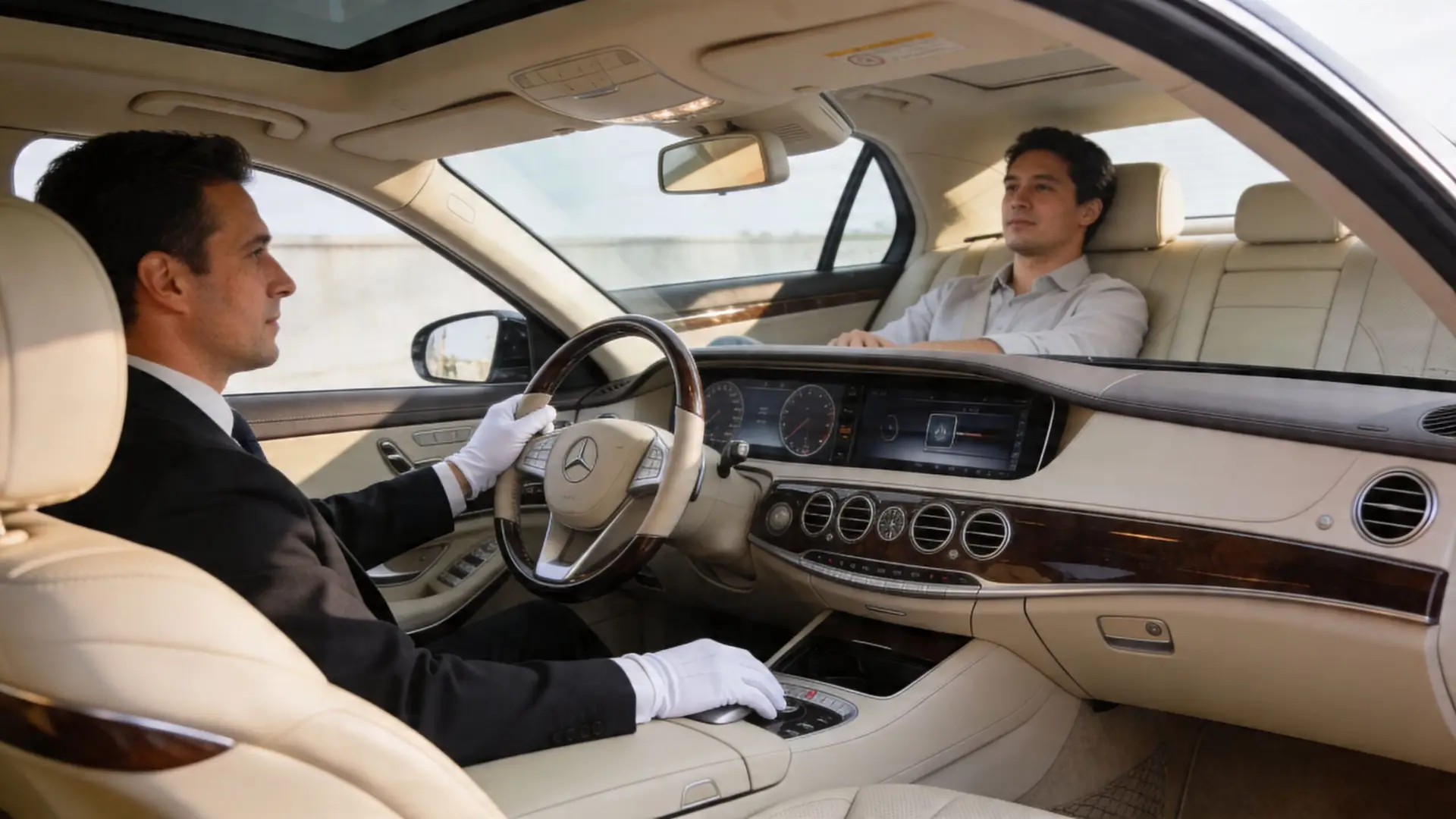
Before you get in
You should expect a clear pickup process and a vehicle that’s already prepared for the trip. For airport work in Orange County, LAX, SNA, and LGB, that means the car isn’t just available. It’s assigned and presented properly.
The cabin should feel orderly. Leather seating, charging access, room for bags, and a quiet interior matter because they reduce friction. If you need to answer email, sit in silence, or talk through the day with a colleague, the vehicle should support that without effort.
During the ride
A strong chauffeur ride feels calm because the small decisions have already been made. Route adjustments happen in the background. The pace is steady. The cabin doesn’t feel rushed.
That’s where the vehicle choice matters in a practical way. A Mercedes S-Class, often used in executive fleets, includes the PRE-SAFE® Plus system. According to this review of the Mercedes-Benz S-Class in executive chauffeur service, it detects impending rear collisions and tightens seatbelts, closes windows, and adjusts headrests. The feature has been shown to reduce whiplash injury risk by 27% in rear impacts.
That kind of engineering changes the feel of the ride even when nothing goes wrong. Passengers can settle in because the vehicle was designed with occupant protection in mind.
What the ride should leave you with
You shouldn’t arrive overstimulated.
You should arrive with your attention still available for what comes next. At LAX, that may mean reaching Orange County without needing a recovery period. At Disneyland, it may mean the family starts the visit in a decent mood. At the cruise terminal, it may mean the day begins on time and stays there.
That’s the point of a planned mercedes chauffeur service. Not drama. Not theater. Just a ride that stays under control.
Why Mercedes-Benz Is the Standard for Executive Travel
Mercedes-Benz became part of premium transport long before modern ride apps existed.
After World War II, the brand’s strong sales in the 1950s helped establish its models as the global standard for reliability and prestige in the emerging chauffeur market, as outlined in the company’s history from 1949 to 1960. That reputation didn’t come from image alone. It came from repeat use in settings where consistency mattered.
The vehicle is part of the operating system
For executive travel, a car is a working tool. It needs to deliver the same result again and again. Quiet ride quality, passenger comfort, and a stable cabin all matter because they help the traveler stay composed between stops.
Mercedes also has a long safety history. The brand pioneered the crumple zone in the early 1950s, and that kind of engineering legacy matters in chauffeur work where the passenger often isn’t driving and has to trust the platform completely.
A fleet choice also says something about standards. If a service uses vehicles known for comfort, protection, and professional presentation, the operation is usually built around consistency rather than improvisation. You can view examples of vehicle categories used for this kind of work on the Luxe Elite fleet page.
In executive transportation, reliability isn’t separate from comfort. Passengers feel reliability in the quiet, the stability, and the lack of surprise.
How Proactive Planning and Booking Works
A scheduled ride should remove guesswork at the start, not create more of it.
The process is simple on the client side. You choose the route or the time block, select the vehicle type, and receive confirmation. After that, the system should carry the load.
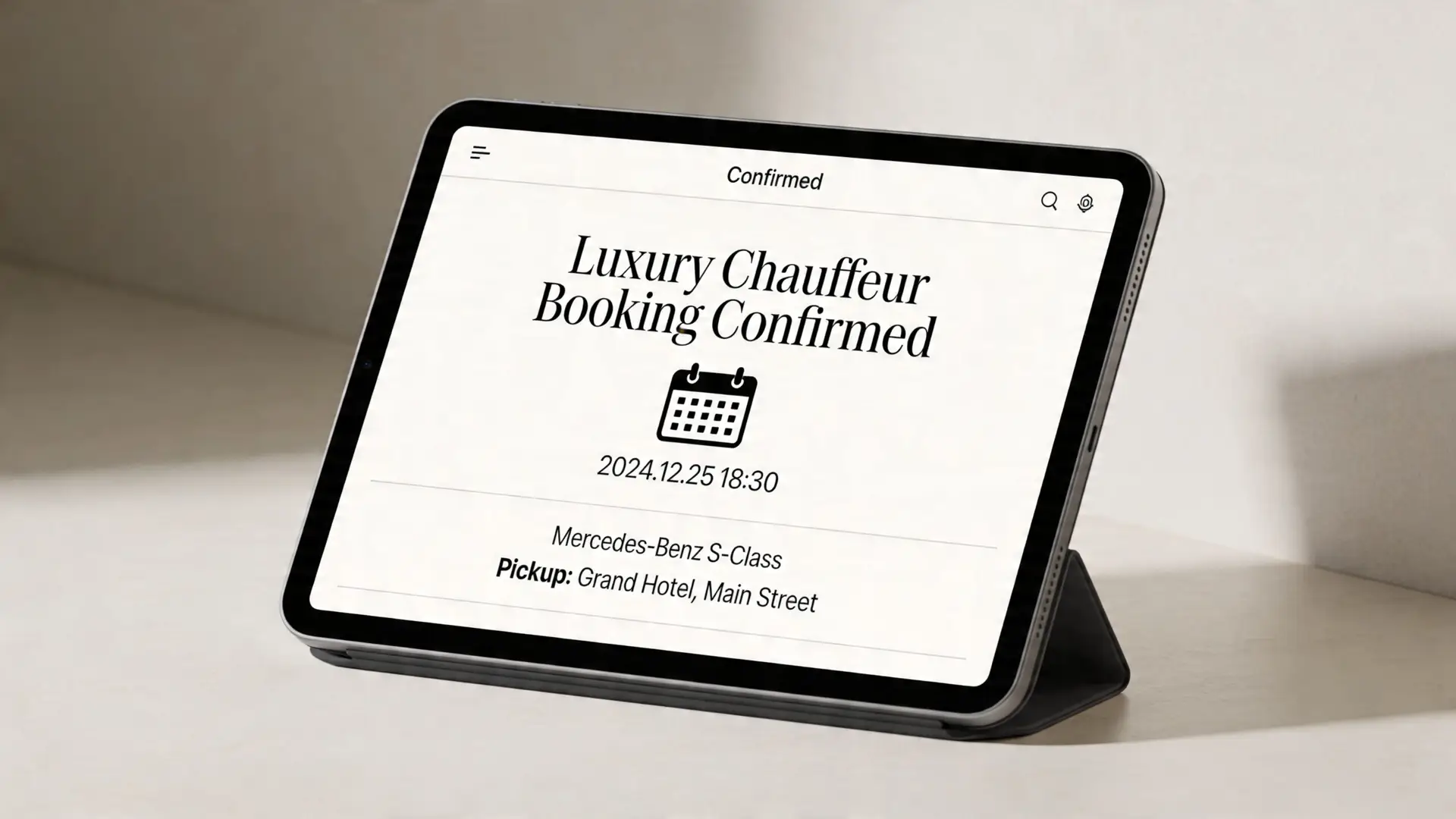
What happens behind the scenes
In a proper setup, the ride isn’t left open for whoever happens to be nearby. The chauffeur is assigned ahead of time, the route is reviewed, and the airport details are tied to the reservation.
That model fits where the market is going. The global chauffeur car market outlook says the market was valued at USD 54.2 billion in 2023 and is projected to reach USD 188.9 billion by 2033, growing at a 13.3% CAGR. It also notes that business travel services hold a 47.5% share. That points to a simple truth. Corporate travelers continue to value planned reliability.
What a client should look for
A booking system should make a few things clear:
- Confirmation: You know the trip is placed and recorded.
- Assignment: Responsibility sits with a real operation, not a live marketplace.
- Adjustment: Airport changes are handled inside the system.
- Communication: Updates are calm and direct.
One practical example is Luxe Elite Transportation’s transfer booking page, where the structure is based on scheduled private transportation rather than on-demand matching.
If you want to plan this properly, you can review options there and decide what level of coordination fits the trip.
Solutions for Corporate and VIP Transportation Needs
Corporate transportation usually breaks down when each ride is treated as a separate event.
That’s not how executive movement works in Orange County. One assistant may be managing an airport arrival at LAX, a hotel transfer near Disneyland, a dinner pickup in Newport Beach, and a next-day departure from SNA. If each leg runs on a different app, the whole schedule becomes fragile.
When one passenger becomes a moving schedule
For executives and VIP guests, transportation isn’t only about the road. It’s tied to privacy, timing, and presentation. A missed pickup can affect a meeting. A noisy or inconsistent vehicle can affect the hour before the meeting.
For group movements, the same logic applies. Mercedes Sprinter service is useful when several travelers need one coordinated arrival with luggage handled in one plan. That helps with airport teams, family groups, and cruise terminal departures where split vehicles often create confusion.
What a managed system solves
✅ Corporate arrivals: One plan for airport pickup, hotel transfer, and return timing.
✅ VIP handling: Discreet movement for guests who value low visibility and direct coordination.
✅ Leisure logistics: Disneyland and cruise terminal transfers that need structure, not guesswork.
✅ Group travel: Vehicle choices that fit the party size and baggage needs without last-minute changes.
For companies operating in the local executive community, the Orange County Business Council offers a useful view of the regional business environment that drives this kind of travel demand.
When the transportation system is calm, the rest of the day usually follows it.
If having this handled discreetly matters, you can review Luxe Elite Transportation and decide whether a planned mercedes chauffeur service is the right fit for your next trip.