

International chauffeur services stop feeling optional the moment an international arrival goes sideways.
You land at LAX after a long flight. Your phone wakes up before you do. The app says the driver is near Terminal 4. You’re standing at the wrong curb for that pickup flow, the driver has changed, your bags are late, and nobody owns the problem.
That stress isn’t caused by poor planning on your side. It comes from bad systems, fragmented vendors, and app logic that treats airport pickups like simple local errands.
For Orange County travelers moving through LAX, SNA, LGB, Disneyland, and cruise terminals, the job of international chauffeur services is simple. Remove uncertainty from the ground part of travel, and give one person clear accountability from pickup to drop-off.
The Unseen Anxiety of International Arrivals
A long-haul arrival has its own rhythm.
You clear the aircraft. Then immigration. Then bags. Then customs. Then curb space rules. Then traffic. By the time you reach the pickup zone at LAX, you aren’t looking for excitement. You want the next step to proceed smoothly.
That’s where weak ground systems tend to fail.
The driver is reassigned. The vehicle isn’t where the message said it would be. The phone number routes to a call center that can’t fix anything. The map shows movement, and that movement doesn’t help. The problem isn’t the traveler. The problem is a chain of handoffs with no real owner.
For Orange County executives, that breakdown matters more than people like to admit. Global business travel spending is expected to reach $1.48 trillion in 2024 and surpass $2 trillion by 2028. When travel sits inside work at that scale, a failed airport pickup isn’t a small inconvenience. It disrupts meetings, handoffs, family time, hotel timing, and the next day’s calendar.
Where the stress starts
International arrivals create pressure in a few predictable places:
- Terminal confusion. At LAX especially, pickup rules, airline locations, and traffic control patterns create friction fast.
- Communication gaps. A traveler may have Wi-Fi one minute and no signal the next.
- Late changes. Flight times move, bags take longer, and the original pickup plan goes stale.
- No single owner. One app handles dispatch, another person handles the ride, and nobody handles the outcome.
That’s why the return home often feels harder than the trip out.
A traveler leaving Newport Beach for LAX can still control the start of the day. A traveler landing from London, Tokyo, or Dubai is stepping back into a crowded airport system where fatigue and airport rules do the driving.
Practical rule: The more tired the passenger is, the less room there is for a reactive pickup system.
Why on-demand logic breaks at the airport
App-based rides work best when the trip is simple. One city. One pickup point. One short wait. One passenger who can keep moving if something changes.
International arrivals are the opposite.
At LAX, you may need the chauffeur to adapt to a delayed bag, a changed terminal flow, or a curbside instruction from airport staff. At SNA and LGB, the airport is easier to get around, and the standard still matters because a simple airport can still produce a bad handoff if nobody is tracking the details.
A scheduled airport transfer is meant to absorb those changes before they touch the traveler.
That’s why experienced travelers stop treating this as a “car service” question and start treating it as a travel coordination question. The ride itself is the easy part. The hard part is what happens before the vehicle door opens.
What calm looks like
A calm arrival has a different feel.
The traveler knows who is handling the ride. The pickup instructions make sense. The vehicle type fits the luggage and the route. The timing adjusts in the background. There’s no debate at the curb.
For Orange County travelers who want that handled properly, the practical benchmark is a planned airport transfer for international arrivals, not a last-minute search after landing.
That isn’t about luxury. It’s about reducing avoidable failure points.
A good arrival feels quiet because somebody did the noisy work before the plane landed.
What International Chauffeur Services Really Mean
When international chauffeur services are mentioned, it's often assumed to mean booking a black car in another country.
That’s only part of it.
A real international service is a managed network with one operating standard across cities. The client shouldn’t need a different process for London, Tokyo, Paris, LAX, or John Wayne. The system should carry the standard from one market to the next.
That’s why the category keeps growing. The global chauffeur service market reached USD 19.7 billion in 2024 and is projected to grow to USD 36.7 billion by 2033, driven by demand for reliable and standardized transport across major hubs.
It’s not a list of drivers
A weak international setup usually looks like this. Someone has contacts in many cities. Each ride gets passed to a local operator. The traveler gets a car, and the standards change every time.
That model creates familiar problems:
- Different communication rules in each city
- Different vehicle standards from one market to the next
- Different dispatch quality depending on local habits
- Different accountability when something goes wrong
A true system works differently.
There is one booking flow. One service expectation. One escalation path. One record of the traveler’s preferences. The local chauffeur still matters, and the management layer matters just as much.
What the word international should include
For Orange County executives, the useful definition is practical.
International chauffeur services should mean:
One point of contact
A travel manager in Irvine or Newport Coast shouldn’t need five separate numbers for five cities.Shared operating standards
The vehicle should be appropriate, the chauffeur should be vetted, and the handoff process should be consistent.Local execution with central oversight
You still need a chauffeur who knows the local airport, hotel access rules, and traffic habits. And someone also needs to oversee the full itinerary.Return-trip continuity
The service shouldn’t stop being organized once the traveler comes back through LAX, SNA, or LGB.
Why this matters in Orange County
Orange County travelers often move in a pattern that mixes local and global logistics.
A trip may start with a pickup in Laguna Beach, pass through LAX for an overseas departure, continue with a hotel transfer abroad, and end with a return to Costa Mesa or a meeting near Disneyland. That chain only works well when one standard follows the passenger through all legs.
A fragmented setup creates silence in the wrong places. Nobody updates the profile. Nobody notices the luggage count changed. Nobody asks whether the return needs a sedan, SUV, or Sprinter.
A managed global chauffeur service removes that friction by treating the ride as part of the itinerary, not as an isolated booking.
If every city requires the traveler to start over, it isn’t really an international system. It’s a collection of local guesses.
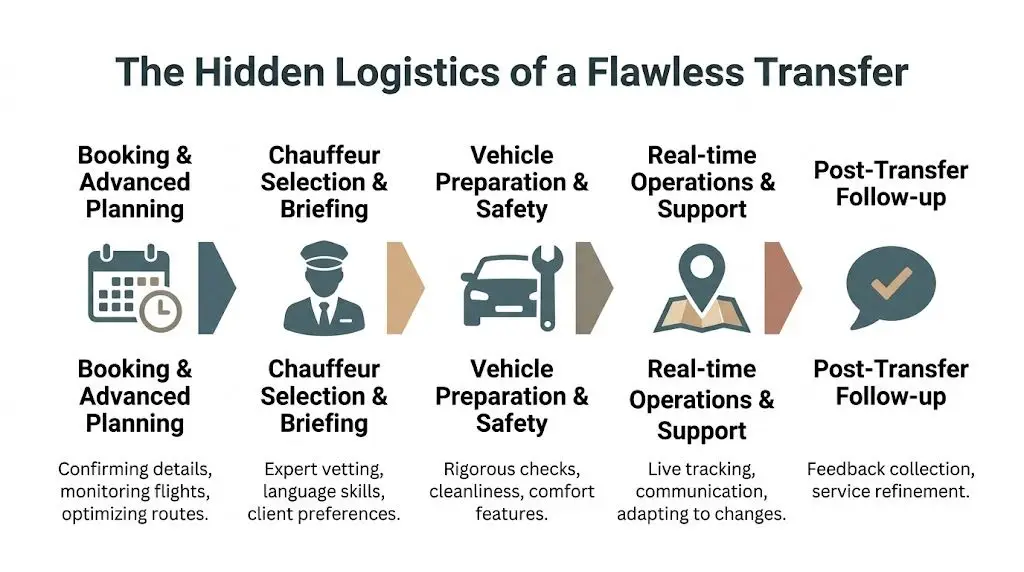
The Hidden Logistics of a Flawless Transfer
The best transfer usually looks easy from the back seat.
That’s because the key work happened earlier, inside dispatch, planning, fleet prep, and communication. International chauffeur services succeed when the system removes failure points one by one.
Flight tracking is not a nice extra
If a provider isn’t tracking the flight in real time, the pickup is already weak.
That matters most when the arrival doesn’t go as planned, which is common.
A delayed arrival changes the curb timing. An early arrival changes chauffeur staging. A gate change may alter the pickup path. Good dispatch teams adjust before the passenger reaches the phone.
The chauffeur should be assigned, not improvised
A strong transfer isn’t built around driver roulette.
When the chauffeur is assigned in advance, the entire trip gets steadier. The operator can brief that chauffeur on the passenger, the airport, luggage, route, destination, privacy needs, and any stop near Disneyland, a resort, or a cruise terminal.
That advance assignment changes the quality of execution in plain ways:
- The chauffeur knows the job, not just the address
- The vehicle matches the mission, not just availability
- Communication starts early, not after landing
- Accountability is clear, because one person owns the pickup
On-demand systems often fail here because the software solves for supply first. The traveler needs certainty first.
Field note: Airport transfers go wrong when dispatch starts searching after the plane lands.
Compliance is quiet work
Cross-border travel creates another layer that many providers barely discuss. Rules change by market. Airport access rules change. Local licensing and commercial requirements vary. For private aviation and VIP travel, even the handoff pattern can differ.
The passenger doesn’t need a lecture on regulations. The passenger needs the provider to have handled them.
That’s one of the biggest differences between local car booking and actual international coordination. A mature service checks whether the local partner is suitable before the traveler depends on that partner.
What happens behind the scenes
A reliable transfer usually follows a disciplined sequence:
| Stage | What good operators do |
|---|---|
| Before travel | Confirm flight details, passenger count, luggage, route, and contact method |
| Before arrival | Monitor the flight, review airport conditions, and stage the vehicle correctly |
| At handoff | Use clear pickup instructions and active dispatch support |
| During the ride | Adjust for traffic, route changes, and destination access needs |
| After drop-off | Log feedback and update the traveler profile for the next trip |
Notice what’s missing. There’s no dependence on luck.
There’s also no assumption that the passenger will fix gaps from the curb. Bad systems push problem-solving onto tired travelers. Good systems keep that work off the traveler’s plate.
Why this creates a different outcome
A flawless transfer is rarely about speed alone. It’s about predictability.
At LAX, that may mean timing the curb approach carefully. At SNA, it may mean preserving a smooth pickup even though the airport is smaller. At Long Beach, it may mean keeping the process discreet and simple. At a cruise terminal, it may mean building in extra patience for port timing and luggage flow.
The common thread is this. Planning beats improvisation, and human oversight beats reactive app logic when the itinerary matters.
Matching the Vehicle to Your Mission
The wrong vehicle creates its own kind of friction.
Too small, and luggage turns into a curbside puzzle. Too large, and a simple executive transfer feels clumsy. Vehicle choice works best when it follows the job, not the brochure.

The sedan for focused solo travel
A luxury sedan is usually the cleanest tool for one executive moving between home, airport, hotel, and meetings.
This works well for:
- Departures from Orange County to LAX
- Arrivals into SNA after a business trip
- Direct transfers to meetings in Irvine, Costa Mesa, or Newport Beach
The sedan’s value is control. Entry and exit are quick. The ride stays quiet. A single passenger can work, call, or reset after a long flight.
Use a sedan when the day is about concentration, not group movement.
The SUV for luggage, flexibility, and a second layer of space
An executive SUV handles the trips that stretch beyond a basic airport run.
It fits:
- Couples or small teams
- Travelers carrying larger luggage loads
- Families moving between Orange County hotels, Disneyland, airports, and port departures
- VIP travelers who want more separation from bags and gear
The main advantage is flexibility. Schedules shift. People add a stop. Shopping bags, presentation cases, and extra luggage appear. The SUV absorbs those changes without turning the ride into a packing exercise.
The Sprinter for teams and complex days
A Mercedes Sprinter belongs in the plan when the transportation itself needs to support the group.
This is often the right call for:
- Visiting executive teams arriving at John Wayne Airport
- Roadshows with several stops
- Corporate event movement around Orange County
- Group transport between hotels, Disneyland-area properties, airports, and cruise terminals
The point isn’t size for its own sake. It’s about reducing friction.
A group with separate cars creates staggered arrivals, split communication, and more chances for timing problems. One well-run Sprinter keeps the team together and the schedule easier to manage.
The vehicle should solve the day’s problem. It shouldn’t create a new one at the curb.
A simple way to choose
If the trip involves one traveler and a quiet schedule, a sedan is often the adult choice.
If the traveler needs more luggage room, more personal space, or room for a second passenger without compromise, choose the SUV.
If the day includes a team, multiple stops, or airport-to-meeting coordination for several people, the Sprinter usually wins.
Here’s a quick planning view:
| Travel need | Best fit |
|---|---|
| Solo executive airport transfer | Sedan |
| Small group or more luggage | SUV |
| Team movement or multi-stop day | Sprinter |
Vehicle matching isn’t glamorous work. It’s logistics.
And good logistics feel quiet because the right equipment showed up the first time.
How Corporate Programs Create Logistical Silence
Travel managers and executive assistants don’t need more ride options. They need fewer variables.
That’s where a corporate transportation program changes the experience. Preferences are stored. Billing is centralized. Airport patterns are already known. The next booking starts from a working system instead of a blank page.
That single point has greater significance than is often realized.
When one person or team owns the account, common issues stop spreading into emails, texts, and last-minute calls. The coordinator doesn’t need to repeat the same instructions for every LAX arrival, every SNA departure, or every transfer tied to Disneyland conventions or cruise terminal schedules.
What a stable program usually includes
- Passenger profiles with contact details and ride preferences
- Direct billing for cleaner reporting
- Recurring ride patterns for frequent travelers
- A known support contact when flights or schedules change
For teams that travel often, a planned recurring corporate chauffeur service creates the kind of silence that busy coordinators value. Fewer reminders. Fewer follow-ups. Fewer avoidable surprises.
That’s the primary benefit. The ride doesn’t demand attention because the system already has it.
The System That Replaces Chaos with Calm
The difference is simple.
One model reacts after problems appear. The other model is built to prevent them.
What usually fails ❌
- Algorithmic dispatch sends whoever is available, not whoever fits the job
- Driver changes break continuity and create curbside confusion
- Weak flight monitoring leaves timing to chance
- No single owner means the traveler ends up managing the problem
- On-demand thinking treats airport transfers like ordinary city rides
What usually works ✅
- Human oversight reviews the itinerary before the day begins
- Pre-assigned chauffeurs create accountability and context
- Planned pickup instructions reduce confusion at LAX, SNA, LGB, and cruise terminals
- Right-sized vehicles support the actual mission
- Clear contact paths keep one person responsible for the outcome
That’s why international chauffeur services are best understood as an operating system.
The car matters. The chauffeur matters. The deeper difference is that a planned service assumes travel will change and builds around that reality. App systems often assume the trip will stay simple, and that assumption is where the trouble starts.
Sample Itineraries for the Orange County Traveler
Transportation is best understood when one can see the day in motion.
These are the kinds of itineraries where international chauffeur services earn their place.

The CEO departure through LAX
The pickup starts at a home in Newport Beach before sunrise.
The route to LAX is planned early because the risk isn’t just freeway time. It’s terminal flow, departure timing, and the need to arrive calm enough to work. A sedan is usually the right tool here. Quiet cabin. Clean luggage fit. Direct movement.
A week later, the return flight lands late.
The system earns trust. The arrival shift doesn’t trigger panic. The dispatch team has already watched the flight move, adjusted timing, and kept the pickup alive. The traveler clears the airport and heads back to Orange County without negotiating with an app or explaining the delay from the curb.
The team roadshow from SNA
A visiting leadership group lands at John Wayne Airport for a day of meetings in Irvine and Costa Mesa.
This is not a series of separate rides. It’s one moving workday. The group has bags, presentation materials, and changing meeting lengths. A Sprinter usually handles this best because the team stays together and the schedule stays coherent.
The day may include:
- Airport pickup at SNA
- Hotel or office stop in Irvine
- Lunch transfer in Costa Mesa
- Late afternoon return to a hotel near Disneyland or back to the airport
If each person books their own car, timing starts to drift. One rider is late. Another is at the wrong curb. Another needs to change a stop. A single managed vehicle reduces that noise.
The discreet VIP arrival
A private traveler lands through an FBO and needs a low-friction transfer to Laguna Beach, Newport Coast, or a cruise terminal connection.
This kind of itinerary isn’t hard because of distance. It’s hard because of visibility, access, and sensitivity around timing. The traveler may not want a parade of calls. They may not want any confusion around the pickup location. They may not want to repeat their name and itinerary to multiple people.
That’s where a pre-briefed chauffeur and a known dispatch contact matter.
Quiet travel is usually the result of clear decisions made long before the wheels touch the ground.
The family-plus-schedule trip
Not every international transfer is corporate.
An Orange County family may arrive at LAX with luggage, children, and a resort stay near Disneyland before a later cruise departure. The ride needs room, patience, and an orderly handoff. The wrong setup creates strain immediately. The right setup gives the family one less thing to carry.
The pattern is the same across all these examples. Complexity isn’t the problem. Unowned complexity is.
A Practical Checklist for Your Next International Trip
An international arrival rarely falls apart because of one big mistake. It usually breaks at the handoff points. The wrong terminal note. No backup contact. A vehicle that fits the passenger count but not the luggage. That is why the best booking question is simple. Who owns the transfer once the flight lands and conditions change?

Questions worth asking before you book
Use this list for any provider handling international chauffeur services.
Is the chauffeur assigned in advance
A clear yes usually means the trip has already been reviewed. A vague answer often means dispatch is still solving the job close to arrival.How is the flight tracked
Ask what system is used, who watches it, and what triggers an update to the chauffeur.What happens if the flight is delayed or arrives early
Good operators can explain the decision path. Wait time, reassignment rules, and passenger contact should not be guesswork.Can I reach a human dispatcher at any hour during travel
International schedules do not respect office hours. Real support matters most when customs runs long or a phone fails after landing.Who handles partner quality in other cities
If affiliates are involved, ask how they are screened, briefed, and reviewed after the trip.What vehicle is right for this trip
The answer should be based on luggage, passenger count, airport type, and whether the day includes extra stops.
A short planning checklist for Orange County travel
For trips involving LAX, SNA, LGB, Disneyland, or cruise terminals, confirm these details before travel day:
Pickup address and timing
Build the schedule around actual congestion patterns, not map-app optimism.Airline and flight number
This gives dispatch a live reference point.Terminal or private aviation details
Commercial arrivals, international arrivals halls, and FBO pickups each require a different setup.Passenger count and luggage count
Bag volume changes vehicle selection fast, especially for long-haul arrivals.Destination access notes
Hotels, office towers, private residences, and port areas all have different entry rules and loading conditions.Primary and backup contact method
A traveler may have no signal, a dead battery, or delayed access to messages after landing.Billing and authorization details
Handle approvals before the trip so the arrival is focused on movement, not payment.
One final test
Run the trip through one stress scenario. The flight lands early, one checked bag is missing, and the airport pickup zone is crowded. If nobody can explain who adjusts the timing, contacts the passenger, and keeps the vehicle in position, the plan is incomplete.
Orange County travelers usually do better with a provider that runs on process, not app availability. Review the operating approach at Luxe Elite Transportation's international chauffeur service and compare your trip details with current entry guidance from U.S. Customs and Border Protection travel resources.
The goal is a predictable arrival. Clear ownership, clean communication, and fewer moving parts at the exact moment modern travel tends to create the most noise.