

You booked the airport ride early. You added the flight number. You left buffer time. And the pickup still feels uncertain.
That tension usually starts hours before the car arrives. The app changes the driver. The ETA shifts. The message thread goes quiet. You stop thinking about your meeting and start watching a map.
For Orange County travelers going to LAX, SNA, LGB, Disneyland, or the cruise terminal, the problem usually isn’t poor planning. The problem is a system built for volume, not accountability.
That’s where lux transportation matters. Not as a status symbol. As a way to remove noise, handoffs, and last-minute guesswork from important travel.
Meta description: Lux transportation in Orange County means more than a nice car. Learn how planned systems reduce travel chaos for LAX, SNA, LGB, Disneyland, and cruise terminal trips.
Why Your Airport Transfer Is Likely To Fail
The ride usually fails before anyone turns the key.
A traveler in Newport Beach needs to get to LAX for an early flight. The pickup is booked the night before through a ride-share app. The app confirms the trip. That feels fine for a while. Then the driver changes. Then the new driver is farther away. Then the route estimate moves again because the system is chasing supply, not protecting one passenger’s schedule.
The same thing happens on arrivals into SNA and LGB. A flight lands. Bags take longer than expected. The app driver circles, gets impatient, cancels, or takes another fare. Now the traveler is standing curbside, phone in hand, trying to solve a problem that should’ve been handled before the plane touched down.

The weak point is the handoff
On-demand apps are built around fast matching. That works for casual trips across town. It breaks down when timing matters, the airport is crowded, and the traveler can’t afford confusion.
A high-stakes airport transfer needs one thing above all else. It needs ownership.
When nobody owns the ride from start to finish, small failures stack up:
- Driver reassignment: The person who accepted the trip first may not be the person who arrives.
- Weak airport timing: Pickup timing often reacts after the problem appears.
- Split attention: The driver is following the app’s next move, not your schedule.
- No planning layer: Traffic, terminal flow, and flight timing are treated as live surprises.
Practical rule: If the trip matters, don’t rely on a system that can swap out the human responsible for it at the last minute.
Orange County makes small mistakes expensive
Orange County travelers often move through tight windows. A car to LAX may start calmly and then run into airport corridor congestion. A family heading to Disneyland after landing at SNA doesn’t want to juggle luggage, child seats, and curbside confusion. A cruise terminal departure needs the right pickup timing because luggage, check-in, and terminal access all move on a fixed clock.
These aren’t hard trips. They become hard when the system is reactive.
That’s why lux transportation works best when it’s treated as an operations model, not a vehicle category. The car matters, and the process matters more.
What the reader usually feels is normal
Travelers who’ve had one bad airport ride start over-managing the next one. They confirm twice. They leave too early. They keep checking their phone during dinner. They build stress into the day because the transport system hasn’t earned trust.
That isn’t overthinking. That’s a rational response to chaos.
The better answer is a service model where the ride is scheduled, assigned, and watched by people who treat timing as their job. If you want a clear example of how that differs from app-based airport pickups, this overview of airport transport planning shows the basic shift. Less guessing, more control.
What fails and what holds
A simple comparison helps.
| Approach | What usually happens |
|---|---|
| Reactive app ride | The system looks for available drivers and adapts after conditions change |
| Scheduled managed ride | The trip is planned ahead, the pickup is owned, and timing is adjusted before the passenger feels the problem |
That difference is the center of the issue.
Most airport rides don’t fail because the traveler did something wrong. They fail because the system was never designed to protect calm, control, and silence around an important trip.
The Hidden Costs of Relying on Ride-Share Algorithms
The obvious cost is annoyance.
The actual cost is what the bad system takes from the rest of the day.
When an executive leaving Orange County for LAX has to watch the app, text the driver, and wonder if the pickup will hold, that mental load replaces useful work. The same thing happens on arrival into SNA or LGB. A delayed pickup doesn’t just slow the ride. It changes how the traveler shows up for the next meeting, dinner, site visit, or family handoff.
The market tells you what travelers are trying to buy
This shift is bigger than one bad ride.
According to Grand View Research on the luxury travel market, the global luxury travel market was valued at USD 1.59 trillion in 2025 and is projected to reach USD 3.04 trillion by 2033. That growth reflects demand from travelers who want more reliable, discreet, and controlled movement.
That matters because the demand isn’t really for chrome trim or bottled water. It’s for fewer failure points.
The hidden bill shows up in four places
When ride-share systems are used for important trips, the cost often lands in areas that never appear on a receipt.
- Preparation time disappears: The rider spends the trip managing logistics instead of reading, calling ahead, or resting.
- Attention gets split: Even before pickup, the phone becomes a command center.
- Professional risk increases: Arriving flustered changes the tone of a meeting.
- Family coordination gets harder: Disneyland arrivals and cruise terminal departures often involve luggage, children, and fixed schedules. Confusion at pickup spreads fast.
If a traveler has to supervise the ride, the ride isn’t doing its job.
Why the app model keeps repeating the same problem
Ride-share platforms are efficient at matching supply and demand across thousands of trips. That’s useful for low-stakes transport. It doesn’t protect one important movement very well.
The algorithm is trying to solve for network flow. The traveler is trying to protect one exact outcome.
Those goals aren’t the same.
A car to LAX from Orange County may need a driver who understands terminal timing, corridor patterns, and the cost of arriving tense. A pickup from SNA for a board member may need a quiet handoff, no curbside confusion, and no surprises. The app isn’t built around those priorities. It’s built around broad marketplace movement.
What works in practice
The people who travel often don’t ask for extravagance first. They ask for predictability.
That usually means:
- A scheduled reservation, not a request thrown into a live marketplace.
- A known chauffeur, not a rotating assignment.
- Human oversight when conditions change.
- A service standard that values silence over improvisation.
The attraction of lux transportation in Orange County is simple. It removes hidden friction from important travel days. That’s why the adult choice often looks less glamorous from the outside and far more controlled on the inside.
What Is Lux Transportation Really
Lux transportation isn’t defined by leather seats alone. It’s defined by how the trip is managed.
An on-demand ride is built to find any available car. A managed ride is built to protect one traveler’s schedule. That’s the difference.
The short version
❌ What doesn’t work
- A live app request for a critical airport run
- Driver swaps close to pickup
- Timing that reacts after delays already caused stress
- No clear owner of the trip
✅ What works
- A reservation made in advance
- A chauffeur assigned ahead of time
- Active monitoring of the travel plan
- One accountable system from booking to drop-off
That’s why this category is often misunderstood. People think they’re choosing a nicer car. In reality, they’re choosing a different operating model.
For airport travel in Orange County, that model matters more than appearance. Certainty is the product. The vehicle supports it.
The 4 Operational Systems Behind a Calm Arrival
Calm travel doesn’t happen by personality. It comes from repeatable systems.
The strongest lux transportation providers around Orange County use a structure that prevents common breakdowns before the passenger sees them. That matters for LAX runs, SNA arrivals, LGB pickups, Disneyland transfers, and cruise terminal departures where timing can’t drift.
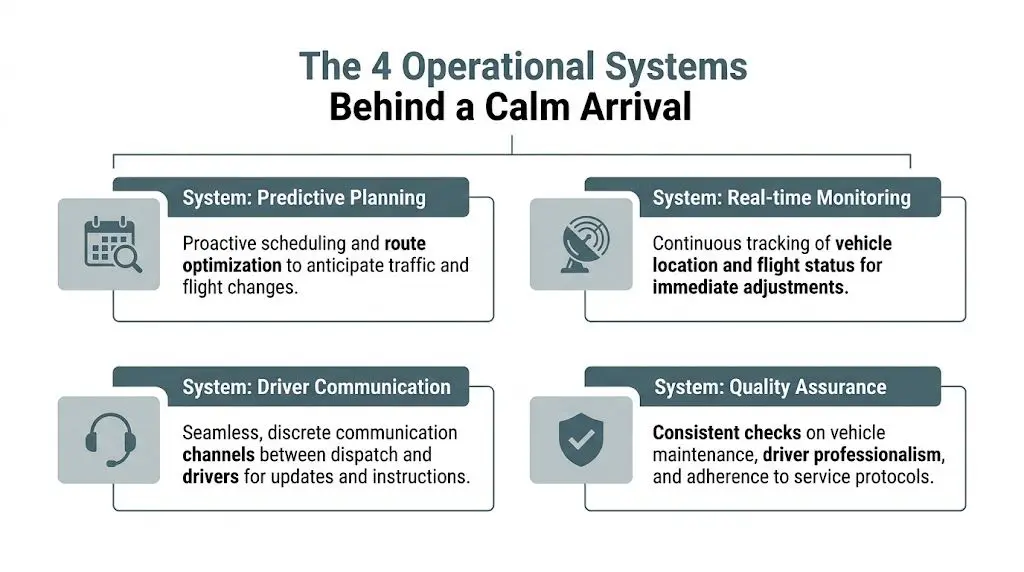
Pre-assigned chauffeur accountability
The first system is simple. One chauffeur is tied to one reservation ahead of time.
That changes behavior immediately. The trip isn’t floating inside a marketplace waiting for whoever is nearby. It belongs to someone.
Many app rides often falter. The rider sees a name in the app and assumes that means accountability. Often it only means a temporary match. A scheduled service works differently. The assignment exists before curbside pressure begins.
For readers comparing providers, one useful reference is Luxe Elite Transportation’s service model, which describes scheduled, pre-assigned airport and executive transportation in Orange County.
Real-time flight and traffic monitoring
The second system is live monitoring. This is the control layer that keeps a flight delay from turning into a pickup failure.
According to White Glove Transportation’s overview of professional chauffeur operations, flight tracking integration ensures punctuality rates exceeding 98% for airport transfers, and AI-driven route optimization can reduce travel time by 15-20% during peak hours. Those numbers matter because they show what planned oversight can do when the route or arrival time shifts.
Without monitoring, every flight change becomes the passenger’s problem. With monitoring, the timing changes inside the system first.
Operational note: Good airport service watches the flight, the road, and the terminal flow together. Watching only one of those is where gaps start.
Proactive route management
The third system is route control.
This isn’t just GPS. Any phone can offer directions. The useful part is deciding early, not late. If traffic builds toward LAX from Orange County, the route decision has to happen before the car gets trapped. If pickup pressure develops near Disneyland after a convention or park close, timing and staging have to be adjusted before the curb gets crowded.
Reactive systems wait for the map to turn red. Good transport teams read the day before the passenger pays for the delay.
A short comparison makes this clear:
| System | Behavior under pressure |
|---|---|
| Reactive routing | Waits for congestion to fully appear, then reroutes late |
| Proactive routing | Uses current conditions and schedule risk to move earlier |
Quiet safety and privacy standards
The fourth system is less visible, and it changes the experience a lot. This is the layer of conduct, discretion, vehicle readiness, and communication discipline that keeps a trip quiet.
For executives, that means no unnecessary chatter, no messy pickup confusion, and no public solving of private logistics. For families heading to the cruise terminal or Disneyland, it means a cleaner handoff with luggage, timing, and route expectations already understood.
The best providers treat safety and privacy as operating habits, not as marketing lines.
What these four systems prevent
- Missed curbside windows
- Late reactions to flight changes
- Driver confusion on high-pressure routes
- Unnecessary exposure of private schedules
- Noise around simple logistics
When these systems are in place, the ride feels uneventful. That’s the point.
A calm arrival usually looks ordinary from the outside. Underneath, someone planned the trip, tracked the variables, stayed in contact, and protected the schedule from chaos.
The Fleet A Quiet Space for Productivity or Relaxation
Once the systems are right, the vehicle starts doing what it should. It becomes a controlled space.
That matters more than is often realized. A traveler going from Orange County to LAX may need a quiet cabin to review notes. A parent arriving at SNA with children may just want the first calm moment of the day. A guest heading to the cruise terminal may want room for luggage and no friction. The vehicle should support the purpose of the trip, not distract from it.

The cabin should do useful work
People often talk about fleet quality as if it’s mainly visual. In practice, the useful parts are functional.
According to this overview of premium fleet standards, premium vehicle fleets can include noise insulation below 50 dB at highway speeds and onboard Wi-Fi achieving 50-100 Mbps. The same source notes that Advanced Driver-Assistance Systems can lower accident risk by up to 40% versus standard vehicles.
Those details matter because they affect how the rider arrives.
A quiet cabin supports calls, reading, and decompression. Strong connectivity gives the passenger one more working window. Safety systems add a layer of protection that often gets ignored until the road gets crowded.
Different trips need different space
Sedans, executive SUVs, and Sprinters aren’t interchangeable.
A solo executive heading to LAX may want a sedan for privacy and speed of entry. A team arriving at SNA with luggage may need an SUV. A family going to Disneyland, or a small group leaving for the cruise terminal, may need the extra room and easier loading of a Sprinter.
The trade-off is simple:
- Sedans feel private and efficient for one or two travelers.
- Executive SUVs handle more luggage and broader group needs.
- Sprinters create breathing room when people, bags, and timing all need space.
The right vehicle reduces friction before the ride starts. The wrong one creates small problems that follow the whole trip.
Comfort isn’t decoration
A well-kept cabin changes energy.
If the seat supports the rider well, the temperature is stable, the interior is quiet, and charging is easy, the passenger doesn’t spend the ride adjusting, searching, or waiting. That matters after a long flight into LGB. It matters before a meeting near South Coast Metro. It matters after a late return from LAX when the traveler is already carrying too much noise from the day.
The best fleet choice is the one that lets the traveler either work without interruption or rest without effort.
That’s what a vehicle should provide in lux transportation. Not spectacle. Controlled conditions.
Planning Transportation for Your Executive Team
Team travel gets messy when each person solves it alone.
One executive lands at LAX early. Another arrives at SNA late. A third needs a direct run from Orange County to a hotel near Disneyland. Someone has luggage for a cruise terminal departure. Someone else needs a quiet ride to prepare for a client dinner. The planning problem isn’t the road. It’s coordination.
Start with the trip type
A useful planning process starts by sorting the movement into categories.
Single executive transfer
One person, one firm schedule, high need for quiet and timing control.Multi-arrival coordination
Several travelers coming through LAX, SNA, or LGB on different schedules.Family or VIP leisure movement
Disneyland and cruise terminal trips often need extra luggage planning and a calmer handoff.Roadshow or meeting day service
Multiple stops, schedule protection, and a driver who stays aligned with changes.
When a planner names the trip type first, vehicle choice and pickup logic become easier.
What to ask before confirming a provider
For Orange County executive travel, a few questions usually expose whether the service is built on systems or improvisation.
- Who owns the ride: Is the chauffeur assigned ahead of time?
- How are delays handled: Is someone actively watching the flight and route?
- What vehicle fits the load: Will luggage, child needs, or presentation materials fit comfortably?
- What communication stays private: Who gets updates, and how are changes handled?
- What sustainability options exist: Can the provider support evolving vendor requirements?
That last point matters more now than many travel teams expect. A 2025 PwC survey summarized by My Lux Rides found that 78% of global executives prioritize ESG factors in vendor selection, with 62% requiring zero-emission options for corporate travel by 2026. In California, that question is moving from optional to practical.
A better way to compare business travel options
If your team is still deciding between a scheduled car service and app-based rides, this comparison of private car service vs rideshare for executive teams is a useful planning reference.
The key difference is simple. One model asks each traveler to absorb uncertainty alone. The other moves that responsibility into the transportation system.
For executive teams, that shift usually improves the day before the meeting even starts.
Questions About Planning Your Executive Transportation
Is a scheduled service really different from a black car option inside an app
Yes. The difference is in the operating model.
A black car inside an app may still behave like an on-demand marketplace trip. The car category looks premium, and the process can still be reactive. A scheduled service is planned around assignment, oversight, and accountability from the start.
What happens if my flight changes
A managed airport transfer should adjust around the flight rather than asking you to rebuild the trip yourself.
That means the service watches the arrival timing and updates the pickup plan as conditions change. The point is to keep the traveler out of the control loop as much as possible. If you have to land and start troubleshooting curbside logistics, the system is already failing.
A good airport pickup feels quiet because the correction happened before you noticed the problem.
How far ahead should I book
For airport runs, earlier is usually better because it allows proper assignment and planning.
That doesn’t mean every trip needs a long runway. It means the more important the movement is, the less sense it makes to leave it to a live matching system. Early booking is especially helpful for LAX departures from Orange County, Disneyland family pickups, and cruise terminal days where the luggage load and timing windows matter.
How should pricing be evaluated
The cheapest visible fare often hides the most work for the passenger.
The useful comparison isn’t only base price. It’s whether the trip includes planning, monitoring, accountability, and the right vehicle for the route. For executive transportation, pricing makes more sense when viewed against the cost of confusion, missed timing, and time spent supervising the ride.
Is this only for corporate travelers
No. The same systems help families and private travelers.
A Disneyland arrival still benefits from controlled pickup. A cruise terminal drop-off still benefits from luggage planning and clean timing. A return home from LGB after a long trip still benefits from a quiet car and a driver who knows the plan.
What should I look for before choosing a provider
Keep the checklist plain.
- Scheduled reservation model
- Pre-assigned chauffeur
- Flight and route oversight
- Vehicle fit for passengers and luggage
- Clear communication
- Professional privacy standards
Those are the markers of real lux transportation. Not flash. Not slogans. Just a trip that stays under control.
If having this handled with discretion matters, you can review Luxe Elite Transportation and decide whether its scheduled Orange County service fits your plans.