

Elite transportation starts to matter when the day is already full.
You’re not worried about the car itself. You’re worried about what happens if the car becomes the weak point.
A late pickup to LAX. A missed handoff at SNA. A vague text from an app while a client lands at LGB. A ride to Disneyland or the cruise terminal that looks simple on paper and starts to fray in real time.
That stress doesn’t come from poor planning on your side. It comes from bad systems. App logic, weak dispatch, and timing built on averages instead of accountability create noise before the trip even begins.
In Orange County, elite transportation isn’t about luxury first. It’s about logistical silence. The car shows up. The airport handoff makes sense. The route adjusts. Nobody in the back seat has to manage the ride.
The Unspoken Anxiety of Executive Travel
The hardest part of executive travel happens before anyone leaves the driveway.
A calendar gets packed. A board meeting moves. A flight shifts. Someone needs a pickup in Newport Beach, another person is landing at LAX, and a family member still needs a clean ride to the cruise terminal. None of that sounds dramatic. It still creates drag.
That drag is mental.
The part nobody says out loud
Most experienced travelers don’t fear motion. They fear fragility.
If a travel plan feels fragile, the whole day feels exposed. One weak handoff can pull attention away from the meeting, the call, the guest, or the event. That’s why airport transportation feels bigger than a car ride. It holds the first and last part of the day together.
Practical rule: If the ride requires the passenger to keep checking their phone, the system is already asking too much from them.
In Orange County, this shows up in quiet ways.
A traveler leaves Irvine for LAX and keeps wondering whether the pickup timing is still right.
A guest flying into John Wayne Airport wants the arrival to feel easy, and the curb area feels compressed and rushed.
A family heading to Disneyland wants the start of the day to feel calm, and the ride becomes another detail to supervise.
No one caused that feeling. Chaos did.
Why high-stakes travelers feel it sooner
When the trip matters, the cost of friction rises.
For a casual night out, a slow pickup is annoying. For a senior executive, a speaker, a private flyer, or a planner managing guests, a weak ride plan changes the tone of the day. Focus drops. Patience gets spent early. Small timing questions start taking up attention.
That’s one reason airport stress affects performance long before the meeting begins. Luxe has written about that connection in its piece on executive wellness and the hidden cost of airport stress.
Common Orange County pressure points
The pattern is familiar.
- LAX departures: The drive starts early, traffic can shift, and nobody wants to wonder if the route still makes sense.
- SNA arrivals: The airport is easier in size, and pickup timing still has to be exact.
- LGB handoffs: The setting feels smaller and calmer, and coordination can still break when timing is loose.
- Disneyland runs: Families, VIP guests, and hosted groups need privacy, luggage space, and a driver who already knows the sequence.
- Cruise terminal drop-offs: Bags, check-in windows, and group timing create a narrow margin for errors.
These trips fail in plain ways. A driver is late. A car changes. A text comes from a number nobody recognizes. The passenger starts doing dispatch work from the curb.
Loss of attention
People talk about airport rides as if the only issue is punctuality.
That’s only part of it.
The deeper problem is attention theft. A poorly managed ride forces the traveler to split focus across too many things at once. They monitor the app. They interpret vague ETAs. They guess whether the driver understands the terminal. They explain the same details again.
The ride should protect the day. It shouldn’t ask the traveler to rescue it.
That’s why elite transportation has a different standard in practice. Not because the traveler wants a fancier seat. Because they want the ride to stop making demands on their mind.
When Travel Plans Depend on Algorithms and Luck
On-demand apps work well for low-stakes movement.
They don’t work the same way when the trip has consequences.
That gap isn’t about the traveler making a bad choice. It comes from algorithm-led systems built for volume, fast matching, and broad convenience. Those systems are good at filling cars. They’re weaker at protecting a schedule.
Where app-based rides break down
The failure points are predictable.
❌ Driver changes happen late
The passenger may see one vehicle in the app and get another outcome in real life. That creates confusion at curbs, hotel entrances, private residences, and crowded pickup zones.
❌ ETAs are treated like certainty
Apps present timing as if it’s settled. In practice, the estimate can move, drift, or reset when demand spikes.
❌ Flights aren’t always integrated into the ride plan
If the system doesn’t actively track the flight and adjust the pickup plan, the traveler becomes the messenger between the airline and the driver.
❌ Vehicle quality varies
For a casual trip, that may be tolerable. For a client pickup, executive transfer, or Disneyland arrival with family and luggage, inconsistency creates unnecessary risk.
❌ Professional discretion is uneven
High-stakes travelers need less conversation, better timing, and a driver who understands when to step in and when to stay quiet. Apps can’t guarantee that at the same level.
Event pressure exposes weak systems
Southern California puts extra stress on app-based transportation.
Concert nights, graduations, conventions, airport surges, and cruise traffic all create the same problem. The algorithm is trying to serve everyone at once. The traveler with a fixed obligation gets folded into the same queue as everyone else.
Industry benchmarks cited by TAPCO’s transportation equity resource show that scheduled elite models outperform on-demand services by 25-40% in punctuality during traffic spikes around venues and airports like LAX, SNA, and LGB.
That result makes sense on the ground.
A pre-assigned system can plan for friction. An app reacts after friction appears.
Why luck isn’t a process
Many travelers keep using apps for serious trips because they’ve had enough good rides to trust the pattern.
That trust is understandable. It’s also fragile.
If the trip is only a dinner reservation, luck may be enough. If the trip is an airport departure from Orange County, a pickup for a visiting executive, a Disneyland handoff with children and bags, or a transfer to the cruise terminal, luck is a weak operating model.
A simple comparison makes the trade-off easier to see:
| Travel condition | Algorithm-led app | Scheduled human-led system |
|---|---|---|
| Pickup timing | Estimated in real time | Planned in advance |
| Driver assignment | Can shift | Usually fixed ahead of time |
| Event surge response | Demand-based | Route-based |
| Accountability | Distributed | Direct |
| Passenger role | Has to monitor | Just rides |
A quiet trip rarely happens by accident. Someone has to own the details before the passenger feels calm.
That’s the dividing line:
On-demand rides are built for access. Elite transportation is built for control.
Navigating the Unique Challenges of LAX SNA and LGB
Orange County travelers use the same three airports, and each one fails in a different way when the ride plan is weak.
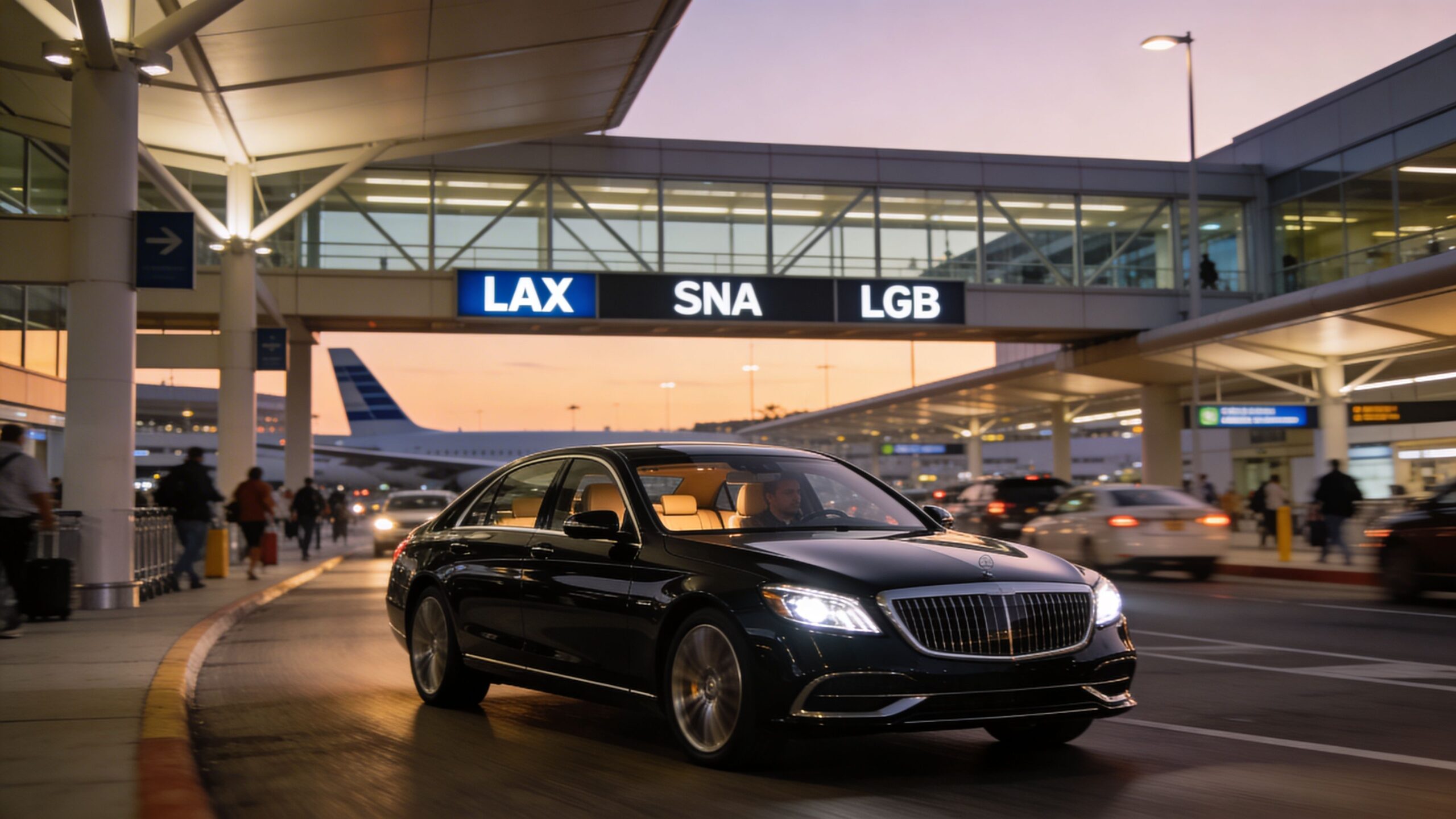
LAX demands active coordination
LAX is the airport that exposes lazy planning first.
The scale is bigger. The curb pressure is heavier. The pickup flow changes fast. A traveler can do everything right and still lose time if the driver isn’t watching the live situation closely.
Flight tracking and dispatch integration stop being nice extras and become the core of the ride. Industry leaders cited by Grand Limousine’s analysis of private airport transportation show that advanced flight tracking tied to dispatch can deliver a 99.5% on-time pickup rate. The same source notes that standard services without integrated monitoring can see 20-30% average delays, and frequent flyers can save an estimated 15-20 minutes per transfer when the system adjusts to delays and gate changes.
For LAX, that means the system has to think ahead.
Not just “the driver is nearby.”
More like this:
- Arrival watch: The team tracks changes before the passenger lands.
- Terminal awareness: Pickup timing reflects actual terminal flow, not a generic arrival time.
- Route adjustment: Traffic isn’t treated as a surprise.
SNA looks easier than it is
John Wayne Airport feels more manageable.
That can fool people.
SNA is smaller and more orderly, and timing matters even more because the margin is tighter. A car that arrives too early can create one kind of problem. A car that arrives late feels obvious right away. There isn’t much room for drift.
For Orange County executives, SNA supports day trips, short-haul business travel, and guest pickups where the whole point is speed and calm. The wrong system still introduces avoidable noise.
That’s why many travelers look for a dedicated airport car service model instead of a casual app pickup. The airport may be compact, and the ride still needs structure.
LGB rewards precision
Long Beach Airport is calmer in tone.
That doesn’t mean it’s forgiving.
Smaller airports create a false sense of safety in planning. People assume the handoff will be simple, so they under-plan the arrival. Then one detail slips. A changed flight time. A missed text. A curb confusion. A bag delay that the driver doesn’t know about.
LGB works best when the ride is built around specific passenger movement, not broad assumptions.
The nearby destinations matter too
For Orange County travelers, the airport is often only half the job.
The ride may continue to:
- Disneyland Resort
- Newport Beach hotels
- Irvine offices
- Anaheim convention sites
- San Pedro or nearby cruise terminal connections
Each destination changes the handoff. Families need space and patience. Executive teams may need quiet for calls. Group arrivals may come in on separate flights. None of that works well when the transportation plan treats every ride the same.
A generic car can move a passenger.
Elite transportation handles the context around the passenger.
What Elite Transportation Means
Elite transportation is misunderstood.
People hear the term and think about leather seats, tinted windows, and a polished vehicle. Those things matter, and they aren’t the point.
The point is control.
It started as a reliability problem
The idea behind elite transportation is old.
According to Elite Transportation Group’s history of the industry, premium urban travel in the U.S. reaches back to the 1830s, when horse-drawn omnibuses and horsecars offered smoother travel for affluent passengers on dedicated routes. The same source notes how the industry kept adapting through later disruptions, including the rise of private automobiles and the pressure of wartime travel, with U.S. mass transit reaching a record 23.4 billion riders in 1946.
That history matters because the purpose hasn’t changed much.
People with important schedules have always needed a travel system that feels more dependable than the surrounding noise.
The modern version is simpler than it sounds
Today, elite transportation means a ride is run like an operation, not a guess.
A quiet system includes:
- Planned assignment: The chauffeur is attached to the job before the trip starts.
- Human oversight: Someone checks the details, not solely software.
- A defined standard: Vehicle condition, communication, and arrival conduct aren’t left to chance.
- Discretion: The passenger doesn’t have to explain the tone of the ride.
That’s why this category matters in Orange County.
A transfer from Newport Coast to LAX isn’t just mileage. A family ride to Disneyland isn’t just a map route. A pickup for a guest arriving at SNA isn’t just matching a car to an address. Each trip carries context, and systems either absorb that context or push it back onto the traveler.
What doesn’t count as elite transportation
A black vehicle alone doesn’t make the ride elite.
A luxury badge doesn’t do it either.
If the passenger still has to chase updates, repeat instructions, or wonder whether the driver understands the airport, the ride is wearing the look without doing the job.
That’s the dividing line:
❌ Reactive transportation waits for problems and then scrambles.
✅ Elite transportation plans enough details that many problems never reach the passenger.
The best executive ride is the one the traveler barely has to think about.
One local example of the model
In practical terms, an owner-led Orange County service such as Luxe Elite Transportation fits this category when it uses scheduled chauffeur assignment, real-time flight monitoring, and professional black car service for LAX, SNA, LGB, Disneyland, and cruise terminal transfers.
That isn’t a style claim. It’s an operating model.
Once that model is in place, the vehicle becomes part of a larger promise. The traveler gets fewer surprises, less app noise, and a ride that behaves like part of the day’s plan.
The Simple Mechanism Behind Predictable Arrivals
Predictable arrivals come from a short chain of decisions.
First, the ride is scheduled, not requested at the last minute.
Second, the chauffeur is assigned in advance, so responsibility belongs to a real person.
Third, a human team watches the flight, the route, and the timing as conditions change.
That’s the mechanism.
❌ App systems wait for demand, match a driver, and ask the passenger to absorb the uncertainty.
✅ A scheduled elite transportation system starts with the itinerary, builds around it, and keeps adjusting before the traveler needs to ask.
This is why the outcome feels calmer.
The passenger isn’t doing dispatch work. The driver isn’t improvising from incomplete data. The route isn’t frozen at the moment of booking. Human accountability closes the gaps that algorithms leave open.
For Orange County airport work, that difference matters most on rides to LAX, SNA, and LGB, and it matters on Disneyland and cruise terminal transfers too. The route may look ordinary. The management of the route is what changes the experience.
How a Scheduled System Creates Calm and Control
When the system is structured well, the benefit shows up in the passenger’s day, not only on the invoice or trip log.
The ride feels quiet because the work happened earlier.
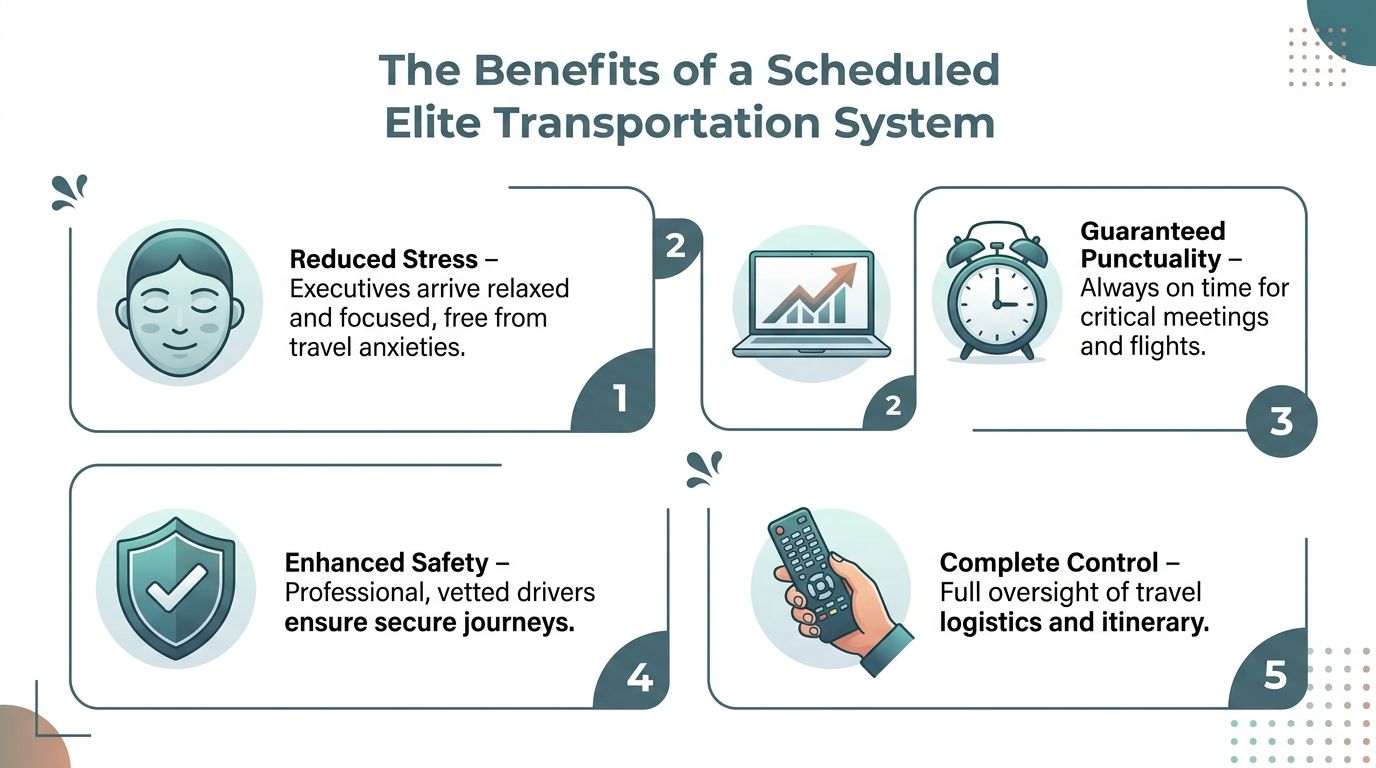
The result for the passenger
A scheduled system changes what the traveler has to carry mentally.
✅ You know who is responsible
A vetted chauffeur isn’t just a convenience. It means one person owns the assignment.
✅ The ride protects work time
The cabin can stay quiet enough for calls, notes, or simple decompression.
✅ The airport handoff feels more stable
The trip isn’t rebuilt from scratch at the curb.
✅ The vehicle standard stays consistent
Cleanliness, luggage space, and basic professionalism stop being open questions.
Why the chauffeur standard matters
In this part of the industry, the chauffeur is the system people meet.
That’s why screening and training matter more than branding. According to White Glove Transportation’s standards overview, services using rigorous certification such as PAX and FBI-level background checks correlate with an incident rate as low as 0.1%, compared with 2-5% in unregulated services.
For executives, planners, and private clients, that changes more than safety.
It also changes discretion, judgment, and the ability to handle a day that doesn’t move in a straight line.
A strong chauffeur doesn’t add personality to the trip unless it helps. They add steadiness.
Scheduled system vs on-demand algorithm
| Feature | Scheduled System (Luxe Elite) | On-Demand App |
|---|---|---|
| Driver assignment | Set ahead of the trip | Matched when demand allows |
| Oversight | Human review of timing and route | Mostly automated |
| Airport coordination | Planned around terminal flow | Based on broad pickup logic |
| Vehicle expectation | Predefined service standard | Variable |
| Passenger workload | Lower | Higher |
Where this matters most in Orange County
The use cases are practical.
For airport transfers, the scheduled model reduces the small misses that turn into missed calls, rushed terminal entries, and tense arrivals.
For corporate transportation, it helps teams move between offices, hotels, events, and airports without every passenger managing their own logistics.
For Disneyland and cruise terminal transfers, it gives families, guests, and hosted groups a cleaner start. Bags fit. timing stays visible. The trip doesn’t begin with confusion.
That’s the adult choice in transportation.
Not louder. Just more controlled.
A Predictable Workflow from Booking to Drop-Off
The best transportation workflow is easy to explain.
A trip gets booked. The details are confirmed. The ride is attached to a real schedule. Then the operating system does its job.
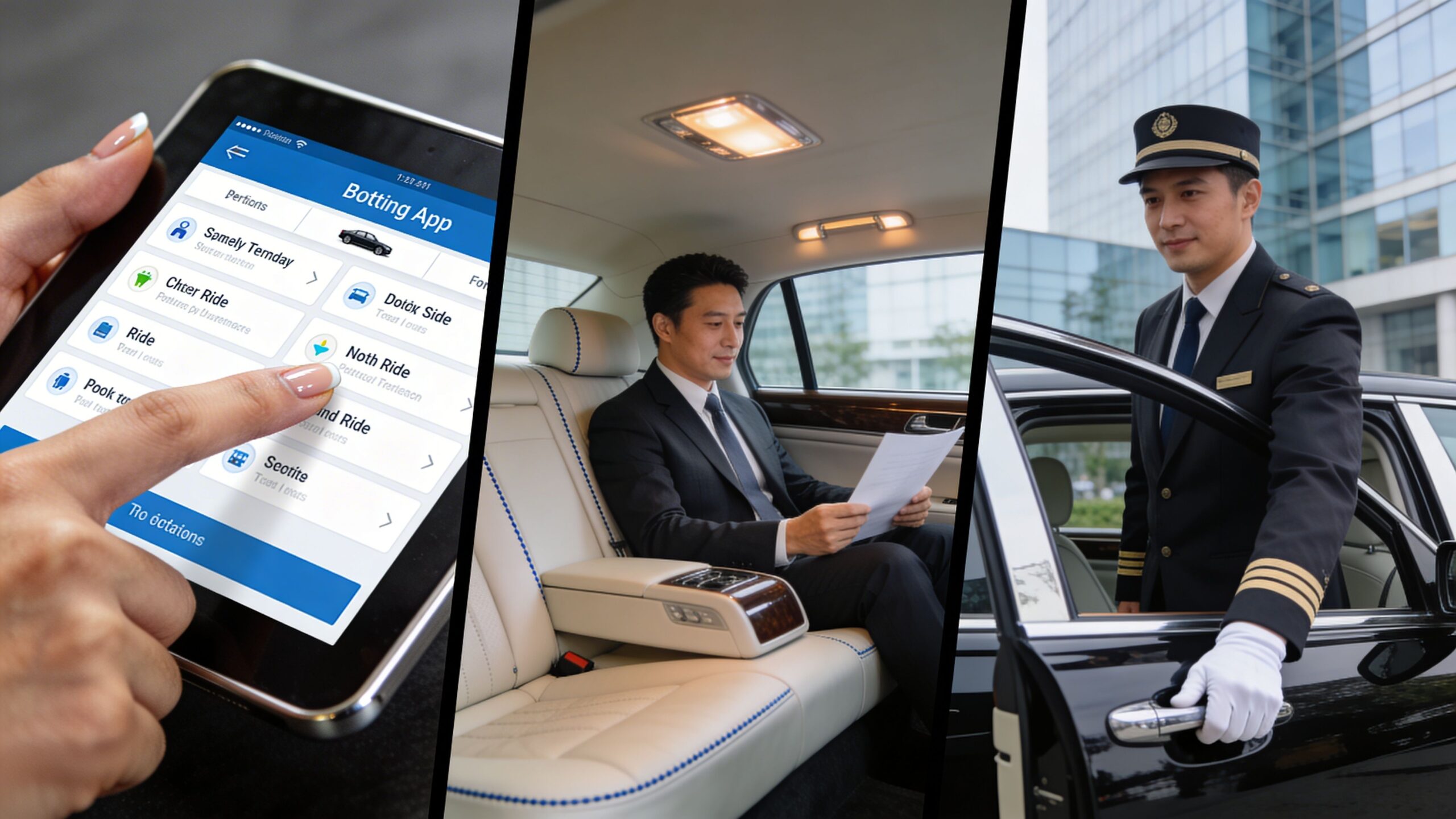
What a stable process looks like
For Orange County airport and destination work, the workflow is this simple:
Trip details go in
Pickup point, destination, flight details if needed, passenger count, and any notes on luggage or timing.The job is confirmed
The traveler or planner knows the ride is on the board. That matters more than a vague app acknowledgment.The trip gets monitored
If it involves LAX, SNA, or LGB, the airport side is watched. If it involves Disneyland or a cruise terminal, timing and access points are clarified early.The chauffeur executes the plan
The passenger gets picked up, transported, and dropped off without needing to manage the chain.
Common questions that come up
Some concerns are reasonable and come up.
What if the flight changes?
In a scheduled system, the ride should adjust with the flight information attached to the booking. That removes the need for the passenger to relay every change manually.
Is this only for corporate travelers?
No. The same structure works for executives, families, hosted guests, and anyone who wants a calmer airport, Disneyland, or cruise transfer.
Is this a stable industry or just a premium version of gig work?
The industry itself is established. Revenue benchmarks discussed in Prospeo’s profile of elite transportation revenue describe a scalable business model for owner-led operations and note that a firm founded in 2007 can reach an industry-standard valuation of over $800,000. That matters because stable operators can keep investing in trained personnel, maintained vehicles, and consistent standards.
Why predictability matters at the end too
Drop-off is part of the service, not the end of it.
A good system closes the trip cleanly. The passenger gets out where they should. Bags are handled properly. The ride ends without a loose final moment.
For travelers who want that level of control, the next practical step might be to review how a scheduled transfer is set up through this booking page.
The right choice depends on the stakes of the trip.
If the ride can absorb some chaos, an app may be enough.
If the day needs to stay quiet, elite transportation gives you a different kind of result. Fewer moving parts reach the passenger. More responsibility stays with the system that was hired to carry it.
If having this handled matters, you can review options with Luxe Elite Transportation.