

SEO Title: vip transportation orange county 7 Calm Fixes for Reliable Executive Travel
Meta Description: vip transportation orange county travel works best when it is planned, tracked, and human-managed. Learn how to avoid airport pickup failures at LAX, SNA, LGB, Disneyland, and cruise terminals.
URL Slug: /vip-transportation-orange-county
The hard part of travel is often not the flight.
It is the few feet between the curb and the car. It is the silence after a driver cancels. It is the text that says someone new is coming, and no one can say when. It is standing outside LAX, SNA, or LGB knowing your day now depends on a system that was built for volume, not for certainty.
That is why vip transportation orange county matters to busy people. Not for show. For control.
Executives, travel managers, families heading to Disneyland, and travelers going to cruise terminals all face the same problem. The roads are crowded, airport pickup rules keep shifting, and app-based dispatch systems keep handing serious trips to software that does not understand stakes.
The stress is real, and the cause is plain. Bad systems create avoidable chaos.
The Unspoken Anxiety of Executive Travel in Orange County
A lot of important travel in Orange County looks calm from the outside.
A car is booked. A meeting is on the calendar. The flight is confirmed. The hotel is set. On paper, everything is handled.
Then the weak part of the plan shows up. Ground transportation.

Control disappears at the curb
The traveler has done nothing wrong. The failure starts inside the system.
An app changes the driver. A car circles in the wrong zone. A flight lands early and no one is watching. A phone call starts in ten minutes, and the passenger is still trying to figure out which lane is the pickup lane.
That low-grade pressure is common in Southern California. Orange County sits inside a travel corridor where airport traffic, hotel arrivals, convention schedules, theme park traffic, and commuter patterns all collide. A simple transfer can feel unstable, even when the trip itself is routine.
For an executive, that is not a small problem.
The ride to or from the airport is often the last quiet space before a board meeting, investor conversation, client dinner, or flight home. When that ride is unstable, the whole day becomes noisy. Good judgment gets spent on basic logistics.
Key takeaway: Travel stress usually starts before the passenger enters the vehicle. It starts when timing, pickup, and accountability are handed to an impersonal dispatch system.
Orange County creates a false sense of simplicity
Orange County looks manageable on a map.
The airports seem close. Disneyland seems straightforward. A cruise terminal transfer sounds like a simple long ride. LAX looks like just another airport run.
Real travel does not work that way.
A pickup from a resort in Anaheim to LAX has different risks than an Irvine to SNA departure. A late evening arrival at Long Beach has different curbside issues than an early morning departure from John Wayne. A family going to Disneyland may need luggage space and patience. A corporate traveler may need silence, charging, and route discipline.
The same word gets used for all of it: transportation.
The actual job is more precise. The job is to remove friction from a route that already has enough of its own.
Quiet travel depends on planned travel
That is why people search for vip transportation orange county when the trip matters.
They are not always looking for a dramatic experience. Most are looking for the opposite. They want less uncertainty. They want to know who is driving, what vehicle is coming, how flight changes are handled, and whether anyone is actively responsible if traffic shifts or arrival times move.
That is the adult need in modern travel.
Not hype. Not a long fleet list. Not vague promises about premium service.
A real plan.
In practice, the most useful trips are the ones no one talks about later. The pickup happened. The route worked. The passenger arrived composed. There was nothing to fix.
That kind of trip feels simple from the seat. It is not simple behind the scenes. It comes from scheduled work, clear accountability, and someone paying attention before the passenger ever reaches the curb.
Why On-Demand Transportation Systems Fail High-Stakes Travel
On-demand systems are built to move a large number of rides.
That design works for casual trips. It breaks down when timing matters, privacy matters, or airport coordination matters.
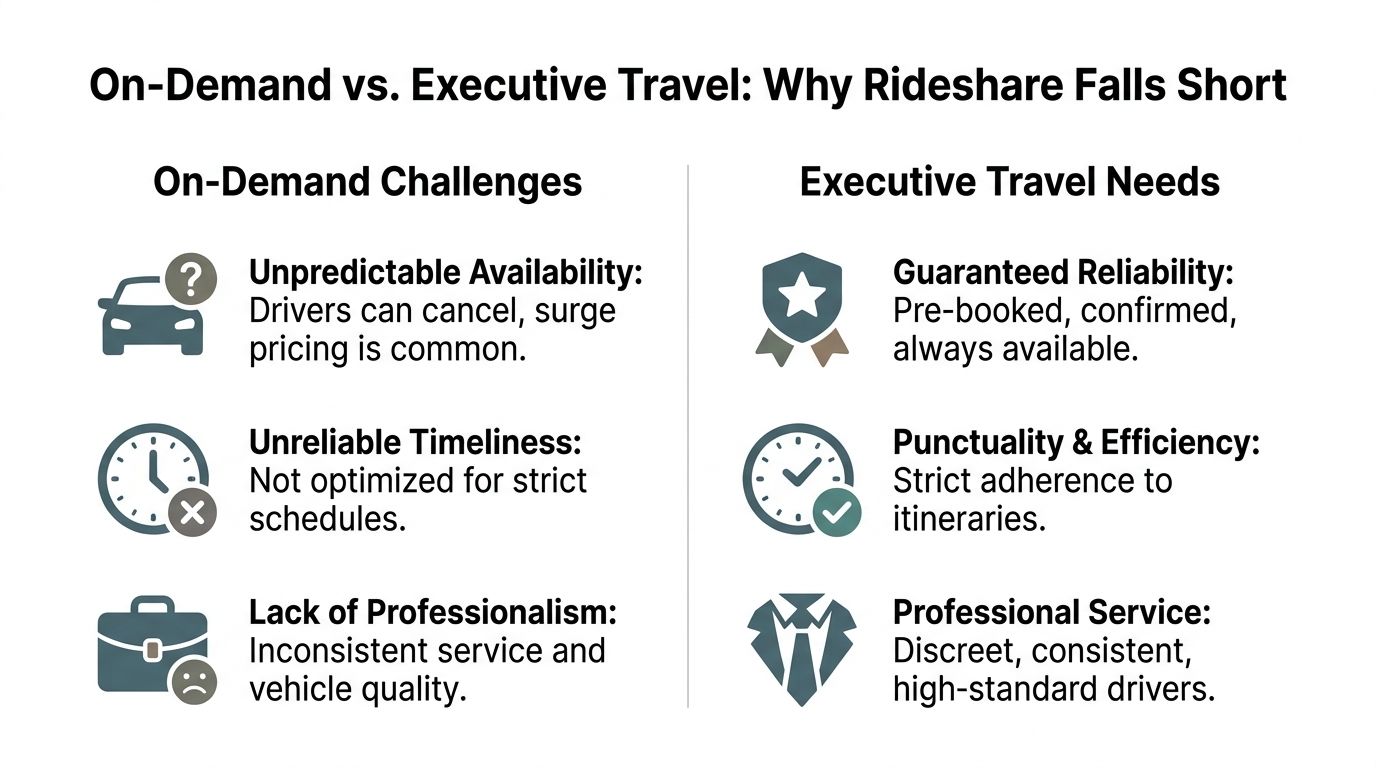
The weak point is not usually the driver. The weak point is the algorithmic dispatch model. It rewards speed of assignment and volume of rides. It does not reward continuity, foresight, or ownership.
Where the on-demand model breaks
Analysis of Southern California ground transport notes that last-minute driver changes and unmonitored flights affect up to 30% of on-demand rides, with delayed pickups from untracked flights averaging 15 to 20 minutes (LA VIP Car Service luxury transportation to Orange County).
That tells you a lot.
The failure does not begin with traffic. It begins earlier, when no one is assigned with enough commitment to own the ride from start to finish.
❌ Driver roulette
A new driver appears at the last minute.
The car type changes. The pickup instructions change. The person meeting the traveler may know nothing about the itinerary beyond a pin on a map.
For a grocery run, that may be acceptable.
For an airport arrival, executive pickup, Disneyland transfer with children, or cruise terminal departure with luggage, it creates noise that should not exist.
❌ Flight blind spots
If the system is not tracking a flight in real time, the dispatch is already behind.
Commercial flights move. Gates change. taxi time changes. Baggage claim changes. A static pickup time becomes wrong the moment the airline schedule shifts.
The passenger then becomes the coordinator. That is backward.
❌ Price logic that punishes planning
On-demand pricing follows demand spikes, airport rushes, and event traffic.
This means the traveler can do the responsible thing, plan the day carefully, and still get penalized when the market gets crowded. The system treats an important transfer the same way it treats any other ride request.
That is not a planning model. It is a volatility model.
What works instead
Reliable transportation follows a different logic.
It starts with the idea that one person should be responsible for one trip.
✅ Assigned accountability
A scheduled trip works better when the chauffeur is assigned in advance.
That creates a chain of responsibility. The passenger is no longer handed from software to whichever car is closest. A specific person is connected to a specific reservation.
✅ Planned timing
Airport pickups should be built around live conditions, not hopeful guesses.
That means watching flight status, staging correctly, and building a pickup plan around the airport’s actual flow, not the original booking time.
✅ Stable expectations
The vehicle category should be known. Luggage fit should be known. The route should be considered ahead of time. The pickup instructions should be clear before the day starts.
That sounds basic. It is also what many app-driven trips skip.
Practical tip: If a service cannot explain how it handles driver assignment changes and flight monitoring in plain language, the system is likely reactive.
High-stakes trips need human management
This is the part many providers avoid discussing.
A fleet photo does not solve coordination. A luxury label does not solve pickup errors. A polished app does not solve accountability.
The quietest trips usually rely on old-fashioned principles applied well:
- One reservation, clearly owned
- A known pickup plan
- Human review before the trip starts
- Adjustments made before the passenger has to ask
That is why scheduled service keeps outperforming on-demand options for serious travel. It is not because the cars are nicer. It is because the operating model is calmer.
In Orange County, where road conditions shift fast and airport pickups can go sideways in minutes, that difference matters more than leather seats or bottled water. The system behind the ride decides whether the trip feels controlled or fragile.
Navigating the Southern California Airport Triangle LAX SNA and LGB
Southern California airport travel looks like one category from the outside.
It is not.
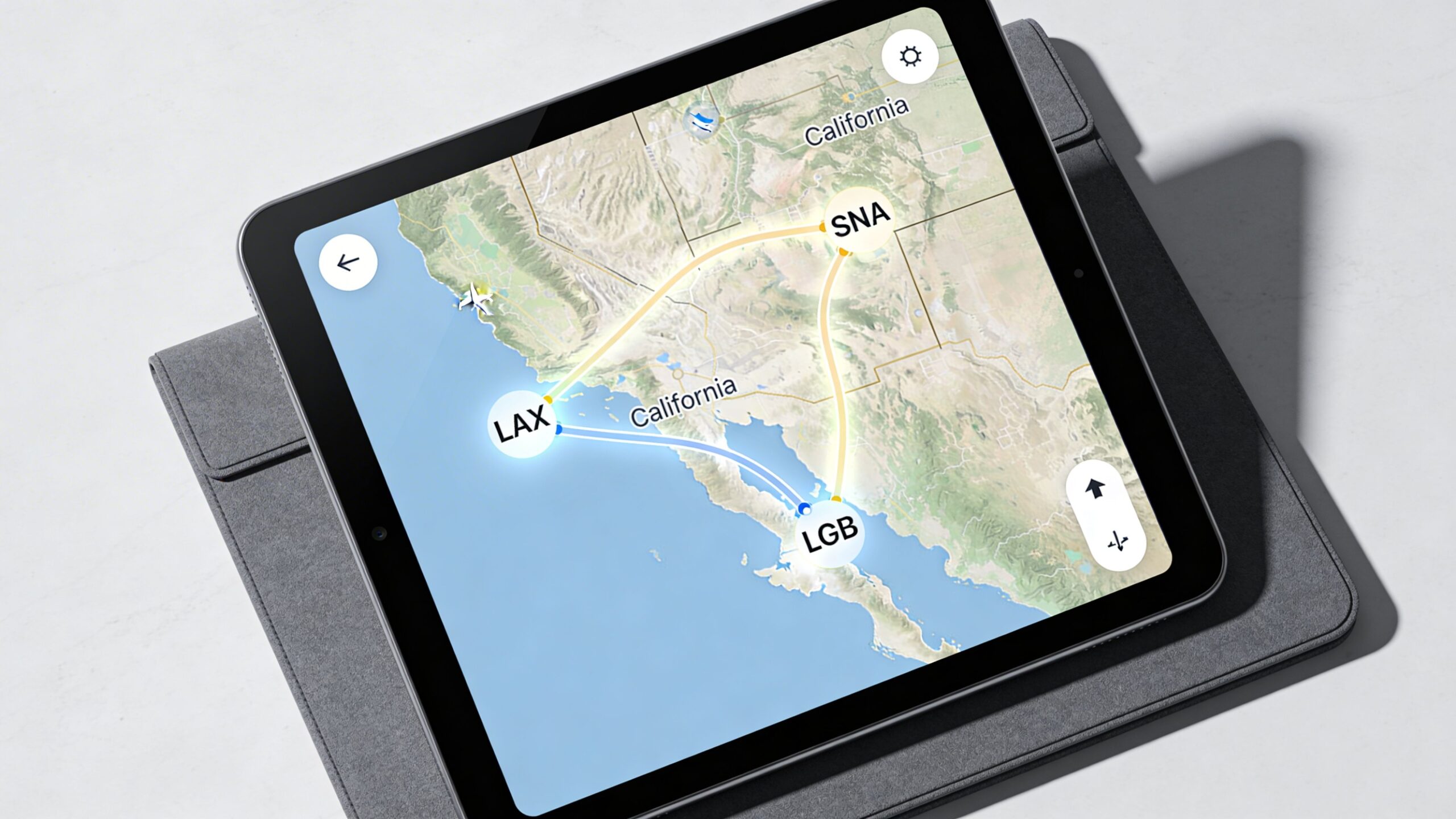
LAX, SNA, and LGB each create a different kind of pressure on ground transportation. A generic pickup strategy usually fails because each airport asks for different timing, staging, and curb judgment.
LAX is scale and friction
LAX is the airport most travelers already worry about.
That worry is reasonable. The airport is large, the roadway system is demanding, and pickup rules can feel detached from common sense. A missed message or a vague pickup instruction can create a long and frustrating handoff.
For Orange County travelers, there is a second layer. The airport trip does not end at LAX. It continues through Southern California traffic on the way south.
That means the transportation plan has to manage both airport complexity and regional road volatility. Apps often react after the problem has started. A planned car service should think through the handoff before the flight lands.
SNA is smaller and less forgiving
John Wayne Airport feels easier because it is compact.
That compact layout is helpful, and it also creates pressure at the curb. When arrivals stack up, the space gets tight fast. Timing matters more because there is less room for sloppy coordination.
According to Rob’s Rides on Orange County airport car service for SNA, John Wayne Airport has an average flight delay rate of 12%. Services without real-time flight tracking see 35% to 40% of pickups delayed by 15 minutes or more. Providers using integrated tracking reach over 98% punctuality by adjusting chauffeur dispatch around live flight changes.
Those numbers explain why SNA can feel easy one day and messy the next.
The airport itself is not the full issue. The problem is any pickup system that treats arrival time as fixed. At SNA, a static plan goes stale quickly.
Key takeaway: Small airports do not remove risk. They remove margin for error.
LGB is simple until it is not
Long Beach Airport often feels more relaxed than the other two.
That can help, and it can also lead to loose planning. The airport has its own pace, its own pickup feel, and its own quirks around where passengers exit and how quickly they move from plane to curb.
A service that knows only how to run the same airport script everywhere can get caught off guard. Travelers coming from LGB to Orange County hotels, homes, offices, Disneyland, or the coast still need the same thing they need at larger airports. Clear pickup instructions, active timing, and someone paying attention.
One region, three different operating problems
A simple comparison helps.
| Airport | Main challenge | What fails | What helps |
|---|---|---|---|
| LAX | Scale, road congestion, confusing pickup flow | Generic instructions and reactive dispatch | Detailed pickup planning and active communication |
| SNA | Tight curb space and arrival variability | Fixed pickup times with no flight monitoring | Live flight tracking and precise staging |
| LGB | Faster curb transitions and less room for loose timing | One-size-fits-all airport process | Local awareness and clear handoff planning |
Travelers often assume the airport is the problem.
Most of the time, the larger problem is a transportation model that does not adapt to the airport it is serving.
The True Cost of Logistical Failure
A failed pickup is rarely just a late car.
It changes the traveler.
Someone who should arrive ready now arrives distracted. Someone who needed quiet time to prepare now spends that time texting, calling, and looking over their shoulder at the curb. If the passenger is a guest, an executive, or a client, the ride problem becomes a reputation problem.
Lost focus is a business cost
A vehicle can be a work space or a recovery space.
When transportation is unstable, it becomes neither. Calls get delayed. Notes stay unread. The passenger reaches the destination mentally scattered instead of settled.
This matters more now because many travelers expect the car to support real work. The quality of the ride affects the quality of the meeting that follows.
One weak handoff can damage the whole day
There is also the external cost.
If a corporate guest lands at LAX and no one seems fully responsible, the host company looks disorganized. If a family heading to a cruise terminal starts the trip with curb confusion and luggage stress, the vacation feels off before the ship is even in view.
The transportation vendor may see one ride.
The passenger experiences the whole day through that ride.
For anyone comparing options, the useful question is not only price. It is what kind of failure the system allows. A simple review of how much a chauffeur can cost is helpful when weighed against the cost of distraction, missed preparation time, and a poor arrival.
Practical tip: If the trip carries reputational weight, treat the ground segment like part of the meeting, not a ride before the meeting.
The Simple Mechanism of Scheduled Transportation
The fix is not complicated.
It is a different operating system.
Four parts that reduce noise
A chauffeur is assigned before the trip.
One person is accountable.The flight is tracked in real time.
The pickup adjusts when the flight changes.The route is considered before departure.
Traffic risk is managed early, not after it causes a problem.The vehicle is chosen for the job.
A solo executive, a small team, and a family with luggage do not need the same setup.
This is why scheduled service feels calmer. The passenger is removed from the center of the coordination work.
One option in Orange County is Luxe Elite Transportation, which uses a scheduled model with pre-assigned chauffeurs, real-time flight tracking, and selected vehicle types for airport and executive travel. That kind of structure is what matters. Human accountability replaces algorithmic guesswork.
A Guide to Fleet Options and Onboard Amenities
Vehicle choice matters less for image and more for fit.
The right cabin size, luggage space, and working environment can make the whole transfer easier to manage.

Sedan for quiet solo travel
A luxury sedan fits the traveler who wants calm.
This is usually the cleanest option for one passenger, or two with light luggage. The cabin stays quieter, entry and exit are simple, and the ride works well for phone calls, reading, or doing nothing at all.
SUV for teams and extra bags
An executive SUV adds margin.
It helps when there are airport bags, presentation materials, family luggage, or a small group moving together between Orange County and LAX, SNA, Disneyland resorts, or cruise terminals. The extra room removes the need to force a tight fit.
Sprinter for group coordination
A Mercedes Sprinter works well when the ride itself needs structure.
That includes event groups, executive teams, wedding parties, and families who want everyone in one vehicle. The main advantage is not status. It is keeping the group together with one arrival plan.
Amenities should support the job of the trip
Many providers talk about amenities in broad terms.
The more useful question is whether those amenities still work under real Southern California conditions. According to OC VIP Car Service, demand for work-enabling rides increased by 25% in the last year, while onboard Wi-Fi on traffic-heavy routes often has less than 50% uptime.
That gap matters.
If the passenger needs to send emails, join a call, or review materials, weak connectivity turns a promised feature into another point of failure.
A simple way to think about amenities:
- Wi-Fi: Useful only if it stays stable enough for actual work
- Quiet cabin: Helps with calls, preparation, and decompression
- Charging ports: Important for airport days when battery life gets thin
- Water and climate control: Small details that keep the passenger settled
A visual review of available fleet options can help match the vehicle to the purpose of the trip.
Key takeaway: A good vehicle is not the most impressive one. It is the one that removes the most friction from your specific route.
Planning for Corporate Accounts Events and Special Destinations
Planned transportation matters even more when the trip is not just one traveler and one airport.
That is where systems either hold together or start to fray.
Corporate travel needs one standard
Companies need repeatable handling.
Executives, assistants, travel managers, and guests all benefit when billing is clear, pickup rules are consistent, and each trip follows the same logic. This is one reason the corporate segment remains strong. BEST-VIP Chauffeured Worldwide generates over $12M in annual revenue by specializing in corporate ground transportation across hundreds of cities for meeting planners and executives (Growjo profile of BEST-VIP Chauffeured Worldwide).
That kind of scale points to a simple truth. Business travelers keep choosing systems that reduce uncertainty.
Events and destinations need tighter coordination
The same planning model works for more than airport transfers.
Disneyland trips need clean pickup timing, room for bags, and patience around hotel loading zones. Cruise terminal runs need luggage planning and a clear departure buffer. Event transportation needs one point of control, especially when several passengers arrive from different places.
For teams that need repeated service, setting up recurring corporate chauffeur service can reduce the back-and-forth that usually clutters bookings.
A core benefit is consistency
A planned system scales because the rules stay stable.
The route may change. The airport may change. The passenger list may change. The operating discipline stays the same. That is what gives travel managers, hosts, and families room to think about the day itself instead of the curb.
Your Booking Checklist for Flawless VIP Transportation in Orange County
A calm trip usually starts with a calm booking.
The goal is simple. Give the transportation team enough detail to remove guesswork early.
What to have ready
Bring these details together before you book:
- Flight information: Airline, flight number, and arrival or departure time
- Passenger count: Include children if car seats or extra space matter
- Luggage notes: Standard bags, oversized items, strollers, or equipment
- Pickup and drop-off addresses: Hotel, office, residence, terminal, or resort
- Special timing needs: Meeting deadlines, cruise check-in windows, or event start times
What a good booking flow should include
After booking, the process should feel clear.
Look for:
- Reservation confirmation: A record that the trip exists and is being handled
- Advance chauffeur details: So the passenger knows who is coming
- Day-of updates: Especially for airport arrivals and route timing
- A defined wait-time policy: So curbside decisions are not improvised
Short FAQ
How should airport delays be handled?
The service should monitor the flight and adjust the pickup without asking the passenger to coordinate from baggage claim.
What if I am traveling through LAX, SNA, or LGB and want to check airport conditions myself?
You can review the official FAA Airport Status page for operational updates that may affect planning.
What matters most for Disneyland and cruise terminal service?
Vehicle fit, luggage space, and a realistic pickup plan matter more than flashy extras.
What should I ask before confirming a reservation?
Ask who is accountable for the ride, how flight changes are managed, and when you will receive final trip details.
If you want to plan this properly, you can review options with Luxe Elite Transportation. The useful goal is simple. More clarity, less noise, and a trip that stays under control.