

Landing at LAX after a long day should be simple. It rarely is.
You step off the plane, turn your phone back on, and the old question starts again. Who is picking you up, where are they allowed to wait, and how long will this take?
That stress isn't a personal planning problem. It's what happens when airport arrivals run on scattered systems, app logic, curb rules, and moving targets.
If you're trying to arrange a taxi from airport service in Orange County, LAX, SNA, LGB, Disneyland, or a cruise terminal transfer, the hard part usually starts after the flight lands.
The Unspoken Chaos of Airport Arrivals
At arrival, most travelers want one thing. A clear next step.
Instead, they get noise. Signs point in different directions. Pickup zones change by service type. Drivers text vague messages. Some services want curbside pickup. Others want a remote lot. Some ask you to wait. Others ask you to rush across a terminal frontage road with luggage.
That is why a taxi from airport plan often feels fragile the moment the cabin door opens.
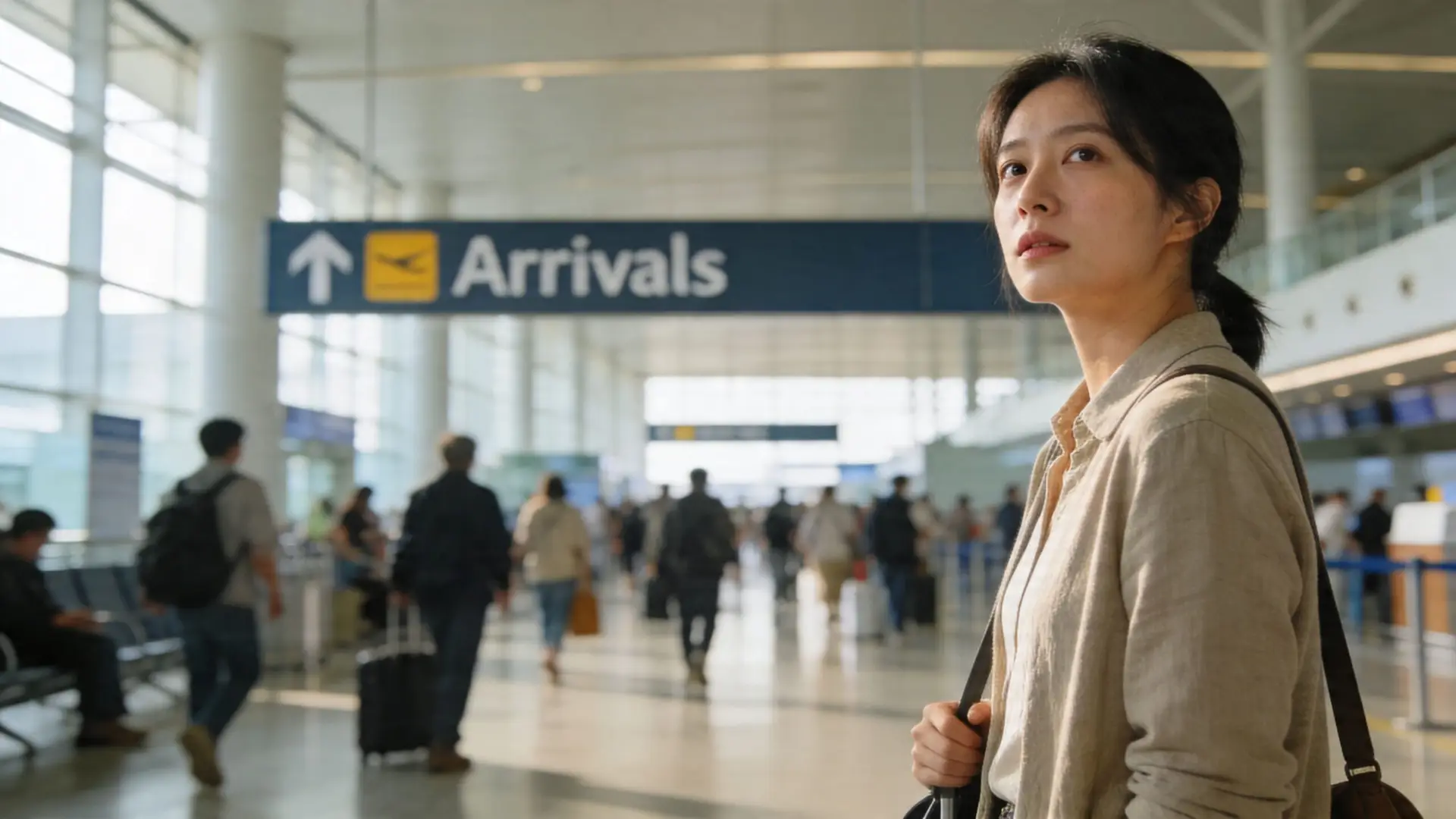
The stress starts before the curb
In Southern California, this is easy to recognize.
A traveler lands at LAX and checks messages while taxiing to the gate. A different traveler lands at John Wayne Airport in Orange County and assumes the pickup will be simple because the airport is smaller. A family heading to Disneyland expects the hard part to be the flight, not the ride after it. A cruise passenger arriving before embarkation thinks a short airport transfer should be low-risk.
Then the same pattern appears.
- The phone becomes the control center. You're reading texts, checking baggage timing, and trying to decode pickup instructions at the same time.
- The airport layout starts making decisions for you. You don't always choose the best pickup point. The terminal rules choose it.
- The ride becomes reactive. You start adjusting to whatever the system gives you.
Airports are full of movement, and very little of that movement is designed around a tired traveler with luggage and a schedule to keep.
This is why modern airport pickup feels strangely unstable, even for people who travel often.
It feels broken because it is broken
The old advice says to land, order a ride, and follow the signs.
That advice is outdated. It assumes the ground side of the airport is simple. It isn't. It assumes the app sees what you see. It doesn't. It assumes the driver, the terminal, and your flight timing all line up. They often don't.
For business travelers, that gap matters more than people admit. The issue isn't comfort. It's loss of control.
When the system around you is reactive, every small delay spreads outward. A late gate assignment becomes a late pickup. A crowded curb becomes driver confusion. A missed message becomes more waiting.
And that is usually the actual problem with airport ground transport. Not the vehicle. The system behind it.
Why Your Airport Pickup Plan Often Fails
A common failure starts like this. The aircraft touches down on time, the traveler turns their phone back on, opens a rideshare app, and assumes the hard part is over. It usually is not.
The weak point is the handoff between aviation timing and curb timing. On-demand pickup systems work off visible signals such as "landed" or "ready for pickup." Airports do not.
Landing is only the start of the arrival process
Touchdown does not put a passenger at the curb. The aircraft still has to taxi, wait for gate access, and clear gate readiness before anyone stands up. Analysts in the Oklahoma State aviation operations analysis found that 86% of taxi-in operations at a major airport fall between 3 and 9 minutes, while 14% exceed 10 minutes, with some surpassing 20 minutes because of gate readiness delays and traffic congestion.
That range creates planning risk.
A driver sent early reaches the airport before the traveler can exit. A driver sent late arrives after the traveler has already been pushed into a designated pickup zone with luggage and limited space to wait. In both cases, the passenger ends up managing a problem that started upstream.
Airport timing has become less forgiving
The broader operating pattern has also become harder to predict. According to the Bureau of Transportation Statistics special report on taxi times, average aircraft taxi-out time increased from 13.8 minutes to 16.7 minutes from 1995 to 2007, and taxi-in time increased from 5.5 minutes to 6.9 minutes. The same report noted that 93% of flights departed within 30 minutes of gate departure in 2007, down from 96% in 1995.
Those figures describe aircraft movement, but they explain a ground truth every frequent traveler recognizes. Airport operations absorb delay in small increments, and those increments break pickup plans built around exact minutes.
Why reactive pickup systems keep missing the mark
Reactive systems fail because they wait for the airport to reveal the next problem.
That sounds efficient. It is usually the opposite.
A rideshare platform may know the flight has landed, but it does not control runway flow, gate congestion, baggage release timing, terminal-specific pickup rules, or how long it takes a traveler to move from seat to curb. The driver assignment logic may also favor the nearest available vehicle instead of the vehicle that can reach the correct zone at the right time. That is one reason the difference between app-based pickup and a scheduled car matters. This chauffeur service vs rideshare comparison explains the operational trade-off clearly.
Here is the practical issue:
- Runway and gate changes shift the actual arrival time.
- Deplaning and baggage delays break app estimates.
- Airport pickup rules force travelers into specific lots, curbs, or shuttle points.
- Driver positioning often happens before the passenger is fully ready.
- Text-based coordination fails fast in crowded terminals.
A pickup plan that depends on perfect timing at each of those steps is fragile from the start.
The traveler ends up doing dispatcher work
This is why many airport pickups feel harder than they should. The traveler is expected to read signage, monitor messages, estimate baggage timing, choose the right zone, and correct driver confusion while walking through an active terminal.
For an executive arriving for a board meeting, that is wasted attention. For a family with children and checked bags, it creates delay at the worst point in the trip. For a cruise transfer or a multi-stop itinerary, one missed handoff can force a full reschedule.
The core problem is not the car. The problem is a reactive system trying to serve a process that needs pre-coordination.
A dependable airport pickup plan accounts for gate uncertainty, terminal rules, curb restrictions, and driver staging before the flight lands. That is how you get control back.
The Three Ground Transportation Models Explained
A traveler lands late, the phone comes out, and the ground transfer is still undecided. That is the point where airport transport stops being a ride and becomes an operating model.
At LAX, SNA, and LGB, three systems handle most arrivals. Traditional taxi. App-based rideshare. Scheduled chauffeur service. Each one assigns responsibility differently. That difference matters more than the vehicle.
Traditional taxi
A taxi from airport trip runs on physical supply. Cars wait in an authorized queue, and the passenger joins that system after reaching the stand.
How it usually works:
- You exit the terminal and follow airport signs to the taxi area.
- A dispatcher or queue order assigns the next available car.
- The trip starts only when you reach the front of the line.
This model still has a practical advantage. It is visible. If the stand is functioning well, the traveler can see the line, gauge the wait, and get into the next car without app coordination.
The limits are just as clear. You do not know the vehicle in advance. You do not control driver assignment. Specialized needs, extra luggage, child seats, multiple stops, or executive meet-and-greet handling usually get solved on the spot, if they get solved at all.
For simple arrivals, that may be acceptable. For a schedule with little margin, it pushes decisions too late.
App-based rideshare
Rideshare runs on live matching. The car is not part of your trip until after you request it.
That sounds efficient, and in many street pickups it is. Airports expose the weak point. The passenger is moving through a controlled environment while the app, the driver, and the airport are all adjusting in real time.
The sequence is familiar:
- The traveler lands and opens the app.
- The platform assigns a pickup zone allowed by the airport.
- A driver accepts, cancels, or repositions.
- Pickup instructions change as traffic control or airport rules require.
- Passenger and driver try to connect with texts, pins, and curb numbers.
The convenience is real. So is the failure rate once timing gets tight.
A live-match system works best when delay is tolerable. It works less well when the traveler needs one accountable process from touchdown to departure. A more detailed breakdown appears in this comparison of chauffeur service vs rideshare operating differences.
Scheduled chauffeur service
A scheduled chauffeur service uses pre-assignment and trip management. The reservation exists before travel day. Flight details are attached in advance. Pickup handling is adjusted inside that plan instead of being built after landing.
That changes who does the work.
The traveler is no longer expected to assemble the transfer while walking through the terminal. The coordination happens before arrival, with the driver and company working from a defined reservation, pickup procedure, and service window.
Here is the practical difference:
| Model | When the trip is formed | Who carries the coordination load | What happens when arrival timing changes |
|---|---|---|---|
| Taxi | At the stand | Passenger and taxi queue | Passenger adjusts after landing |
| Rideshare | After the app request | Passenger, app, and available driver | Everyone reacts live |
| Scheduled chauffeur | Before travel day | Transportation company and assigned driver | The trip is adjusted within the reservation |
This is why the scheduled model feels controlled. The uncertainty has already been assigned to a system.
Why these models produce different results
Taxi service is built for queue access. Rideshare is built for real-time matching. Scheduled chauffeur service is built for advance control.
Those are different answers to the same question. Who absorbs the variability of an airport arrival?
- Taxi fits when the traveler can accept public queue timing and standard vehicle assignment.
- Rideshare fits when price and flexibility matter more than consistency.
- Scheduled service fits when the arrival needs supervision, defined handoff procedures, and one accountable party.
For executive airport travel, the issue is rarely comfort. It is exposure to avoidable failure. A missed pickup window, a bad curb handoff, or ten minutes of phone coordination can disrupt the meeting that justified the trip in the first place.
That is why experienced planners choose the transport model first and the car second.
A Practical Comparison of Your Airport Options
A delayed flight lands after 9 p.m. The traveler is carrying a laptop bag, a roller, and a meeting that starts the next morning. At that point, the decision is not about a nicer ride. It is about how much uncertainty is left in the last leg of the trip.
For airport arrivals, the useful comparison is operational. Which option leaves the traveler with fewer decisions, fewer handoff points, and fewer chances for pickup failure?
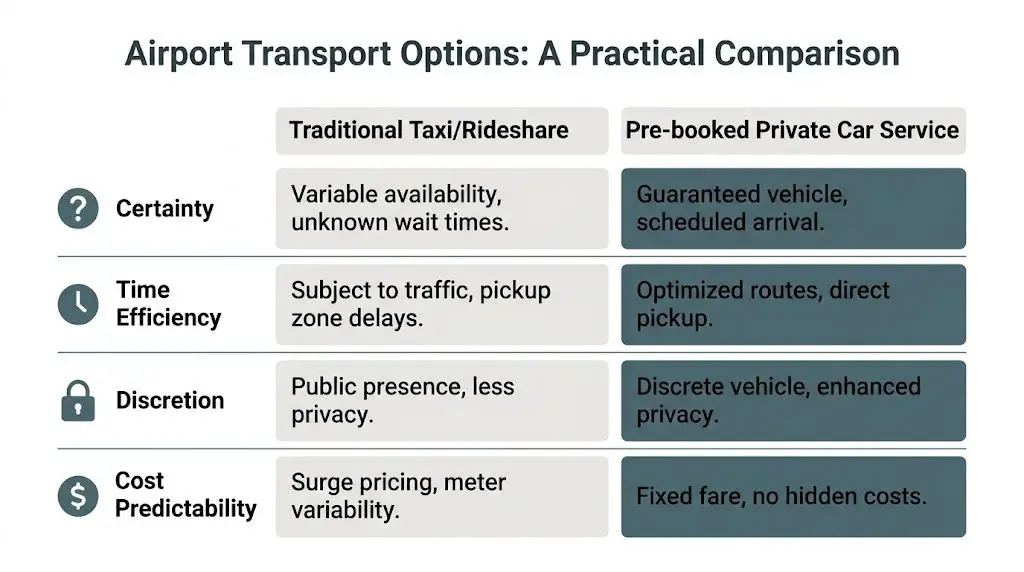
What actually changes the outcome
Taxi and rideshare can work well enough on a light travel day. Problems show up when the arrival is late, the terminal is crowded, the pickup rules are unclear, or the traveler cannot spend ten minutes solving the handoff.
That is the true dividing line.
Certainty at the curb
❌ Taxi and rideshare
The vehicle assignment is still being solved after landing. A taxi depends on stand flow and queue length. A rideshare depends on app matching, driver acceptance, and a pickup point that may change while the traveler is walking toward it.
✅ Pre-booked private car
The reservation exists before wheels down. Driver assignment, contact procedure, and flight tracking are already tied to the trip, so the curbside handoff is managed instead of improvised.
Time control
❌ Taxi and rideshare
Lost time usually comes in fragments. Five minutes in a queue. Seven minutes crossing to the correct zone. Another few minutes on messages because the driver is not where the map suggests. That drift matters when the traveler still has a long drive ahead.
✅ Pre-booked private car
The pickup is built around the arrival plan. That reduces waiting, cuts message traffic, and lowers the odds that the traveler becomes the dispatcher.
Exposure and discretion
❌ Taxi and rideshare
The process is public and reactive. The traveler may be standing in a line, waiting at a crowded curb, or discussing location details by phone in front of everyone else.
✅ Pre-booked private car
The handoff is quieter and more controlled. For executives, attorneys, medical professionals, and families with children, that reduces unnecessary friction at the exact moment people are most tired.
Cost control
❌ Taxi and rideshare
Taxi fares can expand with route conditions and idle time. App pricing can shift with demand, traffic, and pickup pressure. The cheapest option on paper can become expensive once delays and missed time are counted.
✅ Pre-booked private car
Pricing is usually agreed in advance. That makes expense reporting easier and removes one more variable from the arrival.
The practical decision
Airport travelers have always valued an orderly exit from a disorganized environment. The lesson from the older taxi system still holds. People want a dependable way off airport property without having to manage the process themselves.
Today, that matters even more because airport pickup rules have become more fragmented. At large airports, service types are often separated by different curb or lot instructions. A traveler dealing with LAX curbside pickup rules and handoff logistics is dealing with an operating procedure, not a simple ride request.
A useful filter
- Choose a taxi if the arrival is simple, the traveler can queue without concern, and a standard vehicle is acceptable.
- Choose rideshare if app convenience matters more than consistency and the traveler can absorb live changes.
- Choose pre-booked service if the trip has a meeting, a family handoff, a cruise check-in, or any other timing point that should not depend on curbside improvisation.
A low fare does not reduce risk. It often shifts the work onto the traveler.
For a business arrival, the strongest option is usually the one that removes decisions after landing and assigns responsibility before the flight even arrives.
Navigating Pickup Zones at LAX SNA and LGB
Airport pickup friction becomes much easier to understand when you look at the curb rules in real places.
LAX, SNA, and LGB all serve Southern California travelers. They do not feel the same when you are trying to leave them.
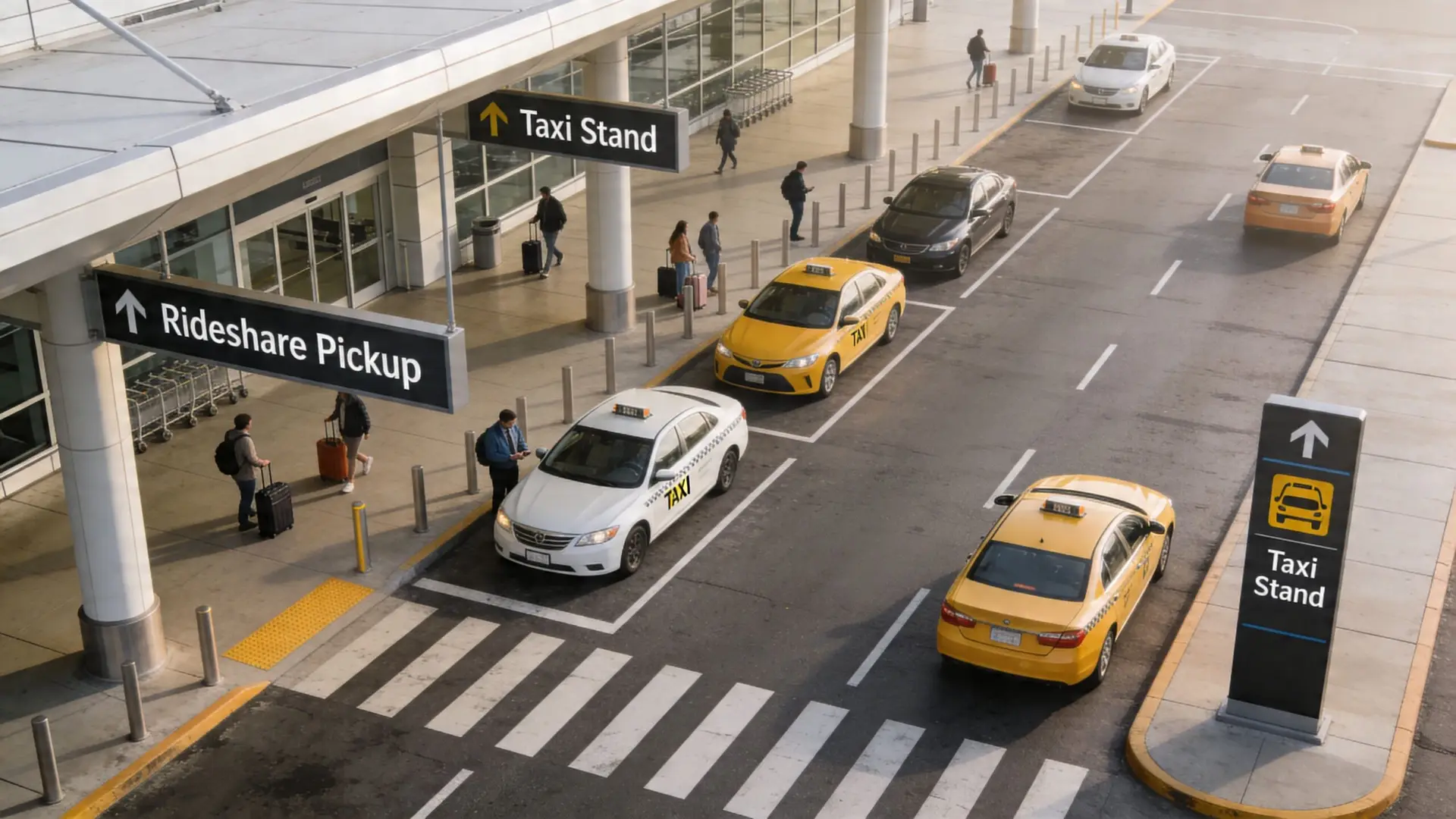
LAX
LAX is where many pickup plans start falling apart.
The airport is large, the terminal roadways are busy, and the pickup rules can separate service types in ways that confuse tired travelers. If you are using on-demand transport, the process may involve leaving the immediate arrival area and following the airport's service-specific instructions. That adds walking, message traffic, and timing drift.
A clearer explanation of curbside pickup at LAX helps show why the first few minutes after landing matter so much there.
Common LAX problems include:
- Split pickup rules for different transport types
- Heavy terminal frontage traffic
- Driver location confusion
- Long walks with luggage before the ride even begins
At LAX, a weak pickup plan usually gets weaker as the traveler moves.
SNA
John Wayne Airport feels easier because it is smaller.
That helps, and it can create false confidence. Travelers often expect a quick exit and then run into curb crowding, unclear timing between baggage claim and pickup, or overlapping vehicle activity in a compact space.
SNA is usually more manageable than LAX. It still rewards planning.
A common mistake at SNA is assuming the airport size removes the need for coordination. In practice, the smaller footprint means mistakes become visible faster. If the car is early, there may be limited room to wait in the right place. If the traveler is delayed, curb timing can still get awkward.
LGB
Long Beach Airport is often calmer in feel.
That doesn't mean every pickup is simple. Smaller airports can create their own version of confusion because travelers assume they can improvise and still exit quickly. If they guessed wrong about the pickup point, there are fewer layers of airport activity to hide the mistake.
LGB tends to work best when everyone already knows:
- Which side of the terminal process the pickup uses
- Whether the meeting point is curbside or nearby
- Who is initiating communication first
At smaller airports, confusion feels sharper because the traveler expects simplicity and gets a handoff problem instead.
What this means for Orange County trips
For Orange County travelers, airport pickup often connects to one more handoff.
That could mean:
- Disneyland resort arrival
- Meeting in Irvine or Newport Beach
- Transfer to a cruise terminal
- Late-night return home after a business trip
If the airport pickup is uncertain, the rest of the itinerary becomes reactive too.
That is why experienced planners don't judge an airport ride only by the vehicle. They judge it by the pickup choreography. The airport signs, the timing method, the communication chain, and the accountability all matter.
At LAX, SNA, and LGB, the curb isn't just where the trip starts. It is where the plan proves whether it was a real plan at all.
The Simple Shift From On-Demand to Pre-Planned
The key shift is small, and it changes everything.
❌ On-demand transport asks the traveler to react to airport chaos in real time. The flight lands. The gate changes. The curb rules interfere. The app tries to match supply and demand. The traveler fills the gaps.
✅ Pre-planned transport puts a system around the trip before travel begins. The reservation includes the flight. The pickup timing adjusts with the airport process. One accountable party handles the changes instead of pushing them onto the passenger.
That is the practical difference.
A reactive model treats the ride as something you build after landing. A planned model treats the ride as part of the itinerary itself. For airport work, those are not minor variations. They are opposite operating ideas.
For travelers who want that handled properly, a scheduled option such as a car service to airport approach makes sense because the transport is managed as part of the trip, not as a last-minute errand.
The quiet win is simple. You stop improvising at the most tired point in the day.
Gaining Full Control Over Your Arrival Experience
Once you stop treating airport pickup as an app task, the whole arrival feels different.
You land, turn your phone on, and you're checking details, not solving a problem. That is what control feels like in travel. Not drama. Not luxury language. Just fewer moving parts handed to the traveler.
Control starts before takeoff
The biggest weakness in on-demand airport transport is that it often doesn't connect the vehicle plan to the live flight reality.
The underlying aviation system has become harder to time cleanly. As noted earlier, aircraft taxi-out times rose over time because of congestion. One of the overlooked problems in ground transportation is that many on-demand systems still don't absorb that variability into the pickup plan. The result is a disconnect between flight status and vehicle positioning, a gap that planned chauffeur operations are designed to handle.

That is why a scheduled service can feel quieter. The trip is being watched before you need to think about it.
What to confirm before your trip
A reliable airport plan doesn't need a long checklist. It needs the right details.
- Flight information: Give the exact flight number. That is what allows proper monitoring.
- Arrival airport and terminal expectation: Confirm whether you're arriving at LAX, SNA, or LGB and whether the pickup method is curbside or a designated meeting point.
- Passenger count and luggage: This avoids the common problem of the wrong vehicle size.
- Destination details: Disneyland hotel, office tower, home address, or cruise terminal. The route logic changes with the destination.
- Primary contact method: Decide whether communication should happen by text or call.
These sound basic. That is the point. Good systems rely on simple information gathered early.
What good airport coordination looks like
When the process is handled well, the traveler notices fewer surprises.
A properly managed arrival usually includes:
| Part of the trip | What should happen |
|---|---|
| Before departure day | Reservation is confirmed with flight details |
| During flight movement | Flight status is monitored |
| After landing | Pickup timing adjusts to actual arrival flow |
| At the meeting point | Vehicle identity and driver contact are clear |
| After departure from airport | Route and next stop are already known |
One option in Orange County is Luxe Elite Transportation, which operates as a scheduled chauffeur service with advance assignments and live flight monitoring for transfers involving LAX, SNA, and LGB. That matters because the system is built around pre-planning rather than reactive matching.
Safety and etiquette still matter
Even with a planned ride, a few traveler habits make the handoff cleaner.
Keep your phone available after landing, and don't switch into silent mode until you're in the car.
Use these simple habits:
- Verify the vehicle details: Match the car and driver information before entering.
- Stay at the agreed point: Moving around too much creates avoidable confusion even in a planned system.
- Send one clear update if needed: If baggage is delayed or you are assisting another traveler, one direct message is enough.
- Don't negotiate the trip curbside: The route, destination, and service details should already be settled.
This is the adult choice in airport transportation. Not because it looks nicer. Because it removes improvisation from a part of travel that doesn't reward improvisation.
Why this matters for executives and families
An executive arriving for a board meeting doesn't need another live problem to solve in the terminal.
A parent arriving at SNA with children and luggage doesn't need app instructions that keep changing.
A cruise passenger heading from LAX to the terminal doesn't need a pickup chain that depends on perfect timing from strangers who were not assigned until minutes ago.
Planned airport transport works because it accepts reality. Flights shift. gates change. curbs get crowded. airport rules interfere. A good system absorbs those changes and keeps the traveler out of the operational noise.
That is the core value. Quiet handling. Lower cognitive load. More certainty.
Your Next Steps for a Quietly Handled Trip
A delayed flight lands after 10 p.m. The curb is crowded, pickup rules have shifted again, and the traveler still has to decide who is meeting them, where, and how long the wait will be. That is the point where a routine arrival turns into operational drag.
The fix starts before departure. Put airport pickup on the itinerary with the same discipline used for the flight, hotel, and first meeting.
What to prepare
A driver can only be positioned correctly if the trip details are settled early and passed through cleanly:
- Flight number
- Arrival airport
- Destination after landing
- Luggage requirements
- Preferred contact method
Those five items do more than fill out a booking form. They determine whether the handoff is managed by a system or pushed back onto the traveler. In practice, the common failure point is the gap between flight movement and vehicle timing. A pre-assigned service reduces that gap by tying dispatch to live flight status, as noted in this review of the need for real-time flight tracking in airport ground coordination.
A better way to judge the ride
Use one test.
Ask who owns the handoff from touchdown to departure from the airport roadway.
If that responsibility sits with an app, a taxi line, or the passenger making calls from the curb, there is still too much improvisation in the process. If the responsibility sits with a planned service that is already watching the flight and working from a confirmed itinerary, the traveler keeps control without having to manage each step personally.
That difference matters on busy Southern California runs. LAX, SNA, and LGB each create their own pickup friction, and the cost of a weak plan shows up fast when the next stop is a board meeting, a hotel check-in, Disneyland, or a cruise terminal transfer.
If you want a clearer process with fewer handoff errors, you can review how it works through Luxe Elite Transportation.