

A sedan to lax trip usually feels harder than it should.
The flight may be booked. The bags may be packed. And the part that still feels shaky is the drive from Orange County to the terminal.
That stress is real. It doesn’t come from poor planning on your side. It comes from bad systems, crowded roads, changing pickup rules, and app-based handoffs that leave too much to chance.
For many travelers, the airport problem isn’t the airport. It’s the hour before it.
The Unseen Stress of Getting to the Airport
A traveler in Orange County can do everything right and still feel uncertain on departure day.
You leave for LAX with a clear schedule. Then the roads stop behaving like a schedule. The drive doesn’t feel like a simple transfer. It feels like a moving target shaped by congestion, airport access rules, and too many vehicles feeding the same terminals.
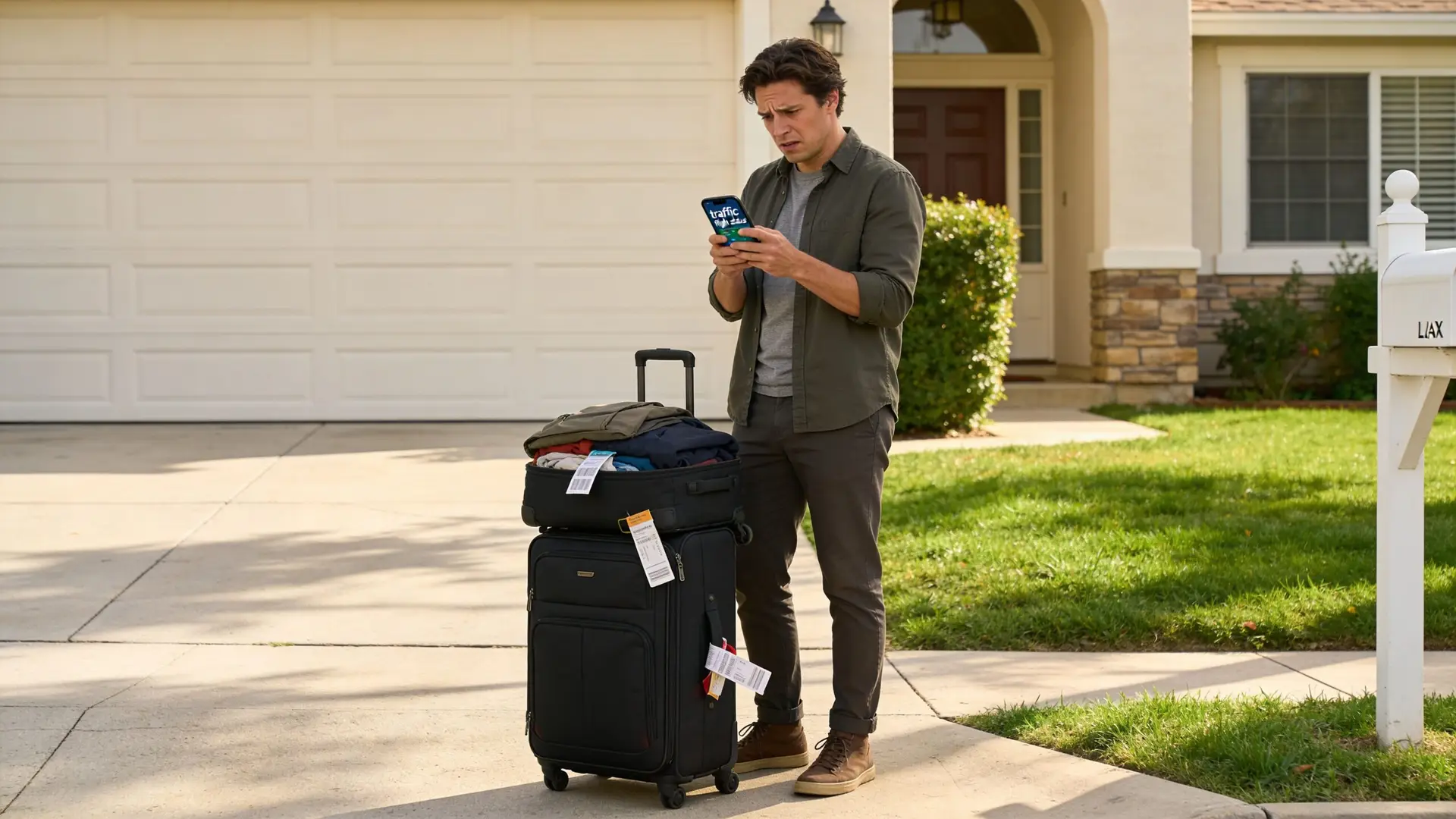
Orange County to LAX feels unstable for a reason
This route asks a lot from one drive. It often starts in a calm neighborhood in Irvine, Newport Beach, Anaheim, or near Disneyland, and ends inside one of the most crowded airport access environments in Southern California.
A sedan to lax trip from Orange County usually runs through roads that are already carrying intense daily demand. Traffic volumes on Interstate 5 rank among the nation’s highest, and near LAX, trucks account for 29.7% of total vehicle flow during peak hours, according to Federal Highway Administration traffic data.
That matters because the stress isn’t random. The system is crowded by design.
Practical rule: If the road network is overloaded, hope is not a travel strategy. Timing has to be managed before the wheels move.
The airport zone adds a second layer of pressure
The drive itself is only part of the problem.
Once the car gets close to LAX, the airport access pattern changes again. Cargo traffic, terminal circulation, lane restrictions, and pickup rules all compete in the same space. A simple drop-off or pickup gets pulled into a wider machine that wasn’t built around calm passenger movement.
That’s why many travelers say the same thing in different ways. The flight is easy to understand. The ground part is what feels slippery.
For people heading from Orange County, SNA, LGB, Disneyland hotels, or even a cruise terminal connection into LAX, the emotional strain usually starts before they ever get in the car. They’re not worried because they missed something. They’re worried because too much depends on systems they can’t control.
Control matters more than speed
A lot of travel advice still focuses on getting there fast. That advice is outdated.
Most experienced travelers aren’t chasing speed. They’re trying to remove uncertainty. They want to know who’s driving, when the car arrives, and how the pickup or drop-off will work when roads are tight and terminal access gets messy.
That is the key value of planning a sedan to lax transfer properly. It restores control.
A calm transfer starts when the travel plan stops depending on luck, app estimates, and airport chaos. Once that shift happens, the ride becomes what it should have been all along. A scheduled movement from one point to another, handled smoothly.
Why Standard Rideshare and Shuttles Often Fail for LAX
Most airport ride problems don’t begin in the car. They begin in the operating model.
On-demand apps are built for availability, not accountability. Shared shuttles are built for load efficiency, not calm timing. That’s why both can look reasonable at booking time and still create stress when the trip matters most.
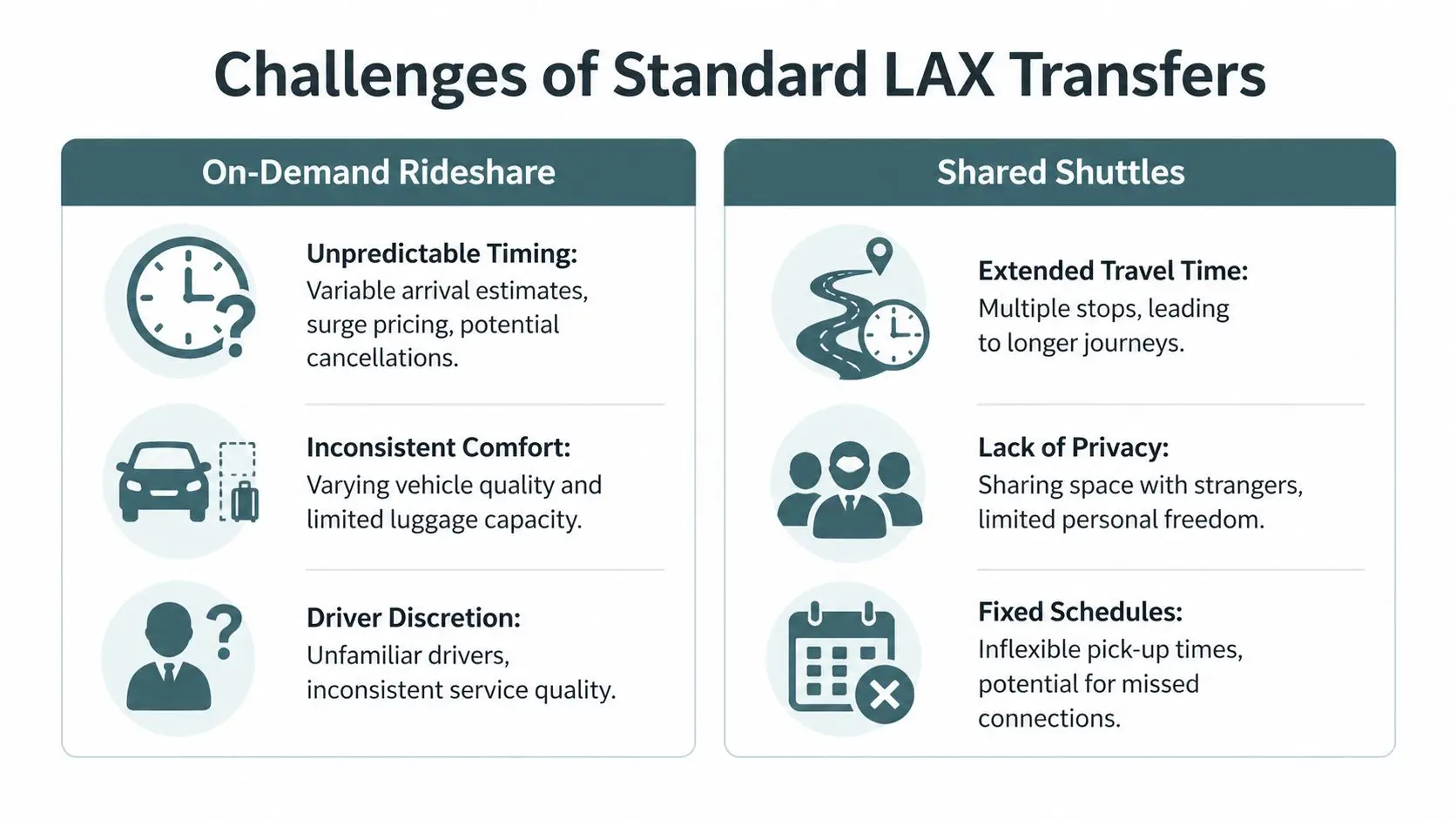
What breaks in the rideshare model
A rideshare app promises convenience. The trouble is that the traveler often becomes the dispatcher.
If a flight changes, many competitors still require the passenger to contact dispatch, and they don’t clearly explain driver vetting or backup plans, as noted in this review of operational blind spots in LAX car services. That kind of friction matters most when the traveler is arriving late, landing early, or coordinating a pickup for an executive.
Here’s where the system often fails:
- ❌ Driver assignment changes: The person shown in the app may not be the person handling the trip until very late.
- ❌ Timing shifts without accountability: Estimated arrival times move around, and nobody owns the disruption.
- ❌ Airport pickup confusion: The traveler still has to figure out where to go, who to call, and what changed.
- ❌ Comfort varies: Vehicle quality, cabin quiet, and luggage fit can change from one ride to the next.
And the issue isn’t that travelers are using the wrong app. The issue is that the app model was never built for high-stakes airport timing.
Why shared shuttles create a different kind of chaos
Shuttles usually remove one variable and add several more.
Yes, the vehicle is scheduled. And the route usually isn’t yours alone. The shuttle may stop for other passengers, follow a fixed sequence, and run on a timetable that serves the operator first.
That creates familiar problems:
- ❌ Multiple stops: Each extra passenger adds time and uncertainty.
- ❌ Less privacy: Business calls, family stress, and simple quiet all become harder.
- ❌ Rigid routing: A shuttle can’t adapt easily when one part of the plan changes.
- ❌ Poor fit for connections: If you’re moving between Orange County, LAX, SNA, LGB, Disneyland, or a cruise terminal, shared routing often works against the day.
A transfer can be cheap on paper and still be costly in focus, time, and composure.
What a planned sedan system does differently
A scheduled sedan works because it changes the operating logic.
✅ The ride is assigned in advance
A real plan starts with a known reservation, not a search request.
✅ The route is managed for reliability
The goal isn’t to chase the fastest line on a map. The goal is to protect the arrival.
✅ The pickup method is clear
The traveler shouldn’t have to solve the airport after landing.
✅ The service can support discretion
That matters for executives, families, and anyone who doesn’t want a public, improvised handoff.
For travelers comparing options, this overview of Los Angeles airport car service planning is useful because it frames the decision around reliability, not novelty.
LAX transfer options compared
| Feature | Scheduled Sedan | Rideshare App | Shared Shuttle |
|---|---|---|---|
| Driver assignment | Pre-arranged | Can change late | Assigned to route, not traveler |
| Route style | Direct and managed | App-driven and variable | Shared, multi-stop |
| Airport pickup | Planned in advance | Often requires extra coordination | Fixed process |
| Privacy | Private cabin | Inconsistent | Shared ride |
| Response to schedule changes | Built into the service model | Often pushed back to the traveler | Limited flexibility |
The important trade-off is simple. Standard options can work when nothing changes. Airport travel rarely stays that simple.
The True Cost of an Unpredictable Arrival
The obvious cost of a bad airport transfer is delay.
The less obvious cost is what it takes from the traveler before the trip even begins. Focus gets burned up. Patience gets drained. And a normal travel day starts with the feeling that you’re already behind.
Mental energy gets spent in small pieces
Unpredictable arrivals create a long chain of small decisions.
You check the app again. You wonder if the driver will cancel. You ask whether there’s room for luggage. You try to guess if the pickup zone is clear. None of these tasks are hard on their own, and together they pull attention away from the work or family reason behind the trip.
For executives, this shows up as lost preparation time. For families, it shows up as tension that follows everyone into the terminal. For a travel manager, it shows up as preventable noise across an already busy day.
Professional composure has value
An airport ride isn’t just transportation. It sets the tone.
A traveler who arrives calm walks into the terminal differently than someone who spent the last hour managing app alerts and driver uncertainty. That difference is hard to put on a spreadsheet, and it’s easy to feel in real life.
Field note: Good ground transportation disappears into the background. Bad ground transportation becomes the main story of the morning.
This matters even more for people moving between meetings, airport transfers, Disneyland-area hotel pickups, SNA handoffs, LGB connections, or a cruise terminal schedule. Those days already have enough moving parts. A weak transfer system makes every other piece feel less stable.
The hidden tax is loss of control
Actual tax isn’t only time.
It’s the feeling that no one is holding the trip together. That kind of uncertainty changes how people travel. They leave too early because they don’t trust the ride. They carry unnecessary stress into check-in. They spend the first part of the day reacting instead of arriving prepared.
A planned sedan to lax transfer fixes a problem that most travelers have learned to normalize. It removes the hidden tax of constant monitoring and puts accountability back into the trip.
That’s why experienced travelers often stop asking for the cheapest ride or the newest app feature. They start asking a calmer question. Who is responsible if something shifts?
The Simple Mechanism for a Controlled Transfer
The solution is simple. Move from on-demand transportation to scheduled transportation.
That means three things:
- A pre-assigned chauffeur instead of a late app match
- Real-time flight tracking instead of asking the traveler to fix schedule changes
- Route management for reliability instead of leaving the whole trip to live algorithms
❌ On-demand systems react after chaos starts.
✅ Scheduled systems plan before chaos can spread.
That’s the adult choice in airport travel. The car matters, and the main difference is the operating method behind it.
A sedan to lax trip becomes calm when the traveler no longer has to manage the moving parts. Human accountability replaces guesswork, and the ride stops depending on chance.
What a Calm Sedan Transfer to LAX Looks Like
A calm transfer doesn’t feel dramatic.
It feels quiet. The details arrive in the right order, and nothing asks the traveler to scramble. That’s usually the clearest sign that the system is doing its job.
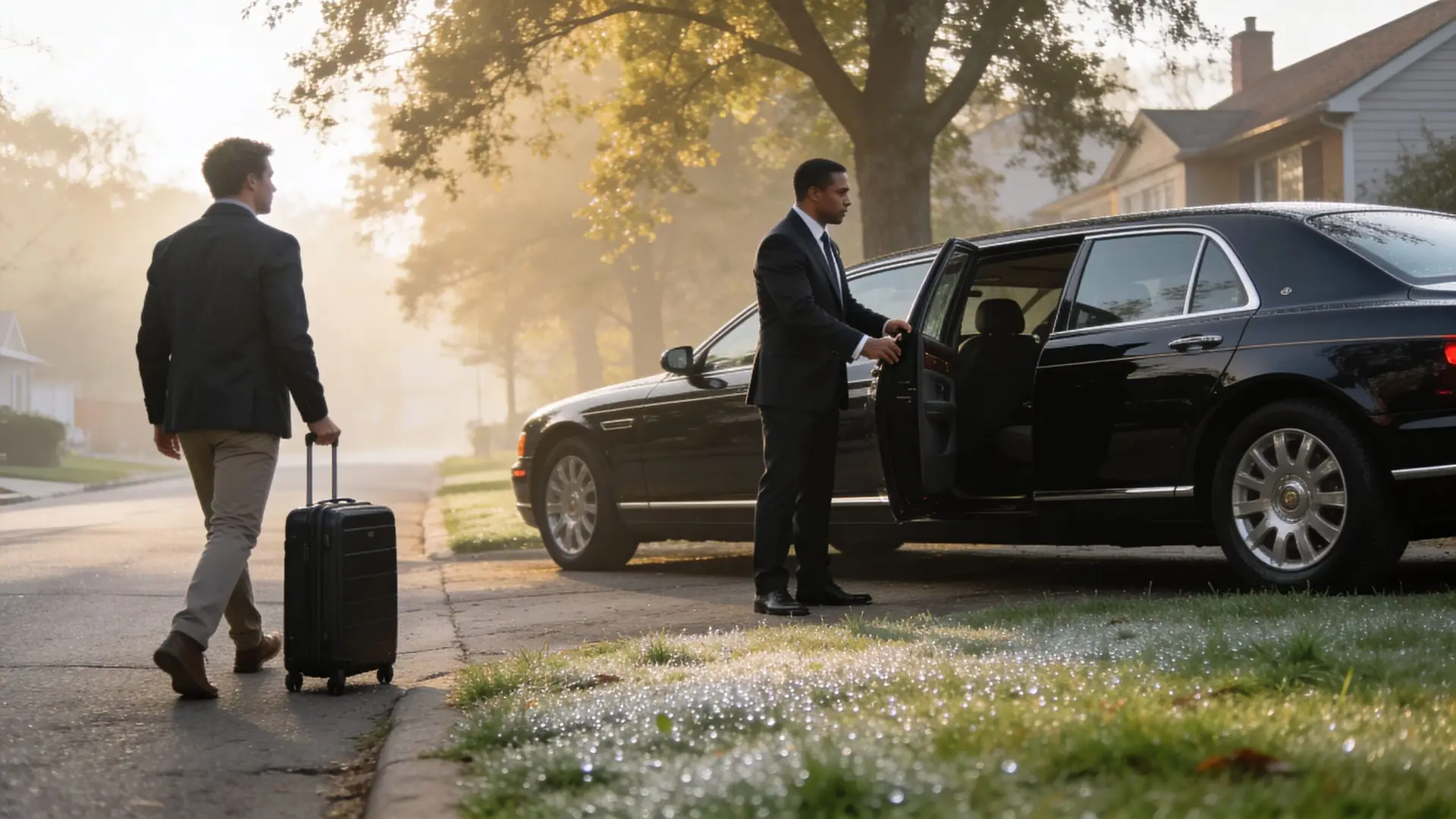
Before the day starts
The booking confirms the route, pickup time, and vehicle class.
The traveler knows the transfer is private. If the trip begins in Orange County and ends at LAX, there’s no question about extra stops, shared routing, or a driver search still running in the background. That silence matters.
In this model, one option is Luxe Elite Transportation’s sedan and airport transfer planning guide, which reflects the scheduled approach rather than the app-based one.
When the flight or traffic changes
Here, strong systems separate themselves from improvised ones.
Pre-scheduled sedans can bypass LAX-it stand delays and reduce pickup waits from 60+ minutes for rideshares to under 5 minutes through pre-arranged commercial permits and GPS-optimized routing, according to Opoli’s executive sedan service details. That doesn’t remove airport traffic entirely, and it changes the part of the trip the traveler feels.
The best transfer is the one that doesn’t ask you to solve new problems after landing.
If a flight runs early or late, the right system adjusts without turning the traveler into the coordinator. The traveler shouldn’t have to land, call, explain, and renegotiate the ride while standing at the curb.
At pickup and on the road
A proper curbside handoff is simple.
You collect your luggage. You receive clear pickup guidance. You walk to the arranged point and get in. No shuttle detour. No holding lot confusion. No crowd-driven guessing game.
From there, the ride does what airport transportation is supposed to do. It carries you smoothly between Orange County, LAX, SNA, LGB, Disneyland-area hotels, or a cruise terminal connection with as little friction as possible.
That’s what a controlled sedan to lax transfer looks like in practice. Not flashy. Not loud. Just handled.
How to Plan Your Orange County to LAX Transfer
A controlled airport day usually starts the night before, not at the curb. The traveler who leaves Orange County for LAX with a clear pickup time, the right vehicle size, and complete trip details is usually the traveler who avoids last-minute decisions.
Start with the route, then work backward from the flight. Pickup timing from Irvine, Newport Beach, Anaheim, Costa Mesa, or farther south is not interchangeable. Morning departures, school traffic, convention traffic, and terminal congestion all change the buffer you need. The point is not to chase a better app. It is to remove uncertainty by setting the trip as a scheduled operation.
What to confirm before you book
Small details decide whether the transfer stays quiet or becomes another moving part to manage.
- Exact pickup point: Use the full address, hotel valet entrance, office loading area, or residence access notes.
- Airline and flight information: A scheduled reservation works better when the itinerary is attached from the start.
- Passenger count and luggage: A sedan fits solo travelers, couples, and light to moderate bags. Larger cases or extra passengers may require a different vehicle.
- Special instructions: Car seats, accessibility needs, gate codes, and intermediate stops should be added before dispatch.
- Billing method: For executive travel or family coordination, one confirmed payment record prevents confusion later.
Pricing structure matters too. Flat-rate service is often easier to plan around than app pricing that changes with demand. Earlier in the article, Plush Transportation's LAX transfer page was cited as an example of how sedan pricing is commonly presented for this corridor. What matters in practice is knowing the cost and service scope before the day starts.
What the ride should support
A sedan to LAX should protect time that would otherwise be lost to noise and interruptions.
For some travelers, that means answering email or taking a call without background commotion. For others, it means sitting still, charging a phone, and arriving with some margin left mentally. Quiet cabin conditions, charging access, and climate control are not luxury talking points in this context. They are operating conditions that make the transfer usable.
Vehicle choice should also match the trip. A sedan is usually the cleanest fit for one or two travelers who want privacy, direct routing, and easy curb access without using a larger vehicle than the job requires.
A planning standard that keeps the day under control
If the itinerary includes meetings, hotel check-in, Disneyland timing, a return leg through another airport, or a cruise departure, fix the ground transfer first. Once that piece is scheduled, the rest of the day has a stable anchor.
Travel coordinators and families usually benefit most from that approach because they are managing more than one handoff at once. A direct Orange County to LAX car service option lets you review the route structure before booking, which is the right way to judge whether the service fits the trip.
A calm arrival at LAX is usually the result of preparation, not luck. Set the pickup clearly, match the vehicle to the load, confirm the flight details, and treat the transfer like a scheduled part of the itinerary. That is how airport travel gets quiet again.
If discretion is a priority for your transfer, you can review Luxe Elite Transportation and decide whether a scheduled approach fits your next Orange County airport transfer.