

The night before an LAX flight looks calm from the outside.
Inside, it rarely feels calm.
You check the app again. You look at the pickup time again. You wonder if the route will hold, if the driver will show, and if one small delay will spread across the whole morning.
That strain is common with newport beach to lax transportation. The problem is not poor planning on your side. The problem is that too many airport rides still depend on chaos, app algorithms, and handoffs no one fully owns.
| Option | Best fit | Main trade-off | What usually matters most |
|---|---|---|---|
| Private car service | Business travelers, families, VIPs | Higher cost | Control, direct routing, accountability |
| Rideshare app | Flexible solo travel | Driver changes and timing shifts | Convenience if timing is loose |
| Taxi | Last-minute booking | Cost and variable availability | Simplicity |
| Shared shuttle | Budget-minded travelers | Waiting and extra stops | Lower cost over speed |
| Public transit | Very flexible schedules | Long trip with transfers | Lowest cost if time is not a concern |
| Rental car | Multi-stop day plans | Parking, driving, and return logistics | Independence |
The Unseen Anxiety of the Newport Beach to LAX Trip
For many Orange County travelers, the stress starts long before the front door opens.
It starts when the calendar says flight day. It starts with that math in your head. How bad will the 405 be. Will the pickup happen on time. How much extra time is enough when the whole route can change shape in one bad stretch of traffic.

The trip steals attention before it begins
A flight from LAX is rarely a flight for a Newport Beach traveler.
It is the airport. The route. The pickup window. The risk of a late driver. The fear of arriving flustered. For executives, that strain also affects the workday. The mental side of travel stress is covered well in this piece on how airport stress affects executive mental performance.
That is why this route feels heavier than its mileage suggests.
Quiet stress comes from missing control
Many travelers do not worry because they dislike travel.
They worry because too much is left open. A rideshare may look confirmed and still change. A shuttle may sound organized and still wait on other passengers. A family member driving may be kind and helpful, and the plan still rests on traffic, curb rules, and airport timing.
The hard part is not getting from Newport Beach to LAX. The hard part is knowing who is actively managing the trip once conditions change.
In practice, peace of mind comes from reducing unknowns.
That means knowing who the driver is. Knowing whether the flight is being watched. Knowing the route will be adjusted if traffic tightens. When those pieces are missing, travelers keep checking their phones because the system gives them no stable answer.
This route asks for more than a car
Many airport trips in Orange County are short and local. SNA can feel simple. LGB can feel manageable.
LAX is different. It asks for timing discipline. It asks for route awareness. It asks for someone to care about the ride after the booking is made.
That is why newport beach to lax transportation is not a car question. It is a control question.
Why the Transportation System Is Set Up to Fail
The route itself tells the story.
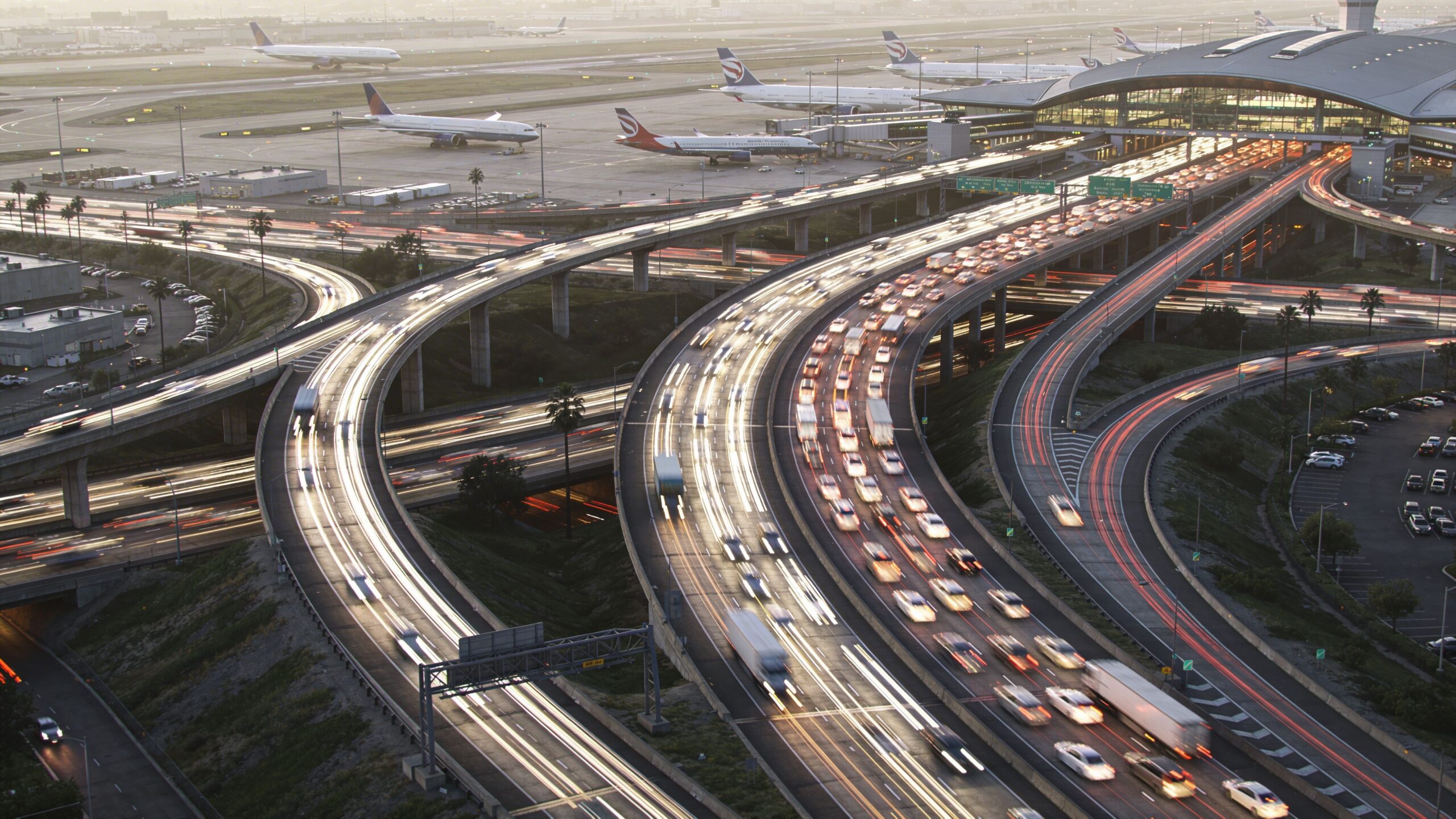
The drive from Newport Beach to LAX is roughly 44 miles, and LAX processed 6.3 million passengers in December 2025 alone, which adds heavy pressure to the roads and curbs around the airport, especially when I-405 traffic builds, according to Visit California passenger traffic reporting.
Volume systems are built for throughput
Most common transport tools are not built for your specific trip.
They are built to move as many people as possible. App platforms optimize supply. Shared services optimize capacity. Airport road systems absorb constant pressure from arriving and departing traffic. Each one serves a mass system first, and the individual traveler second.
That design creates friction in predictable ways.
A driver gets reassigned. A pickup window stretches. A route update arrives late. A curbside handoff gets changed. None of this means anyone did something wrong. It means the system values volume over certainty.
The 405 does not care about your boarding time
Southern California traffic punishes weak planning.
The route from Newport Beach to LAX can move cleanly for part of the drive and then tighten fast near the airport corridor. That is why surface-level timing advice can fail. A static estimate is not an operating plan.
This matters even more when there is no one actively owning the trip.
If the ride depends on an app, the app reports what is happening. It does not calm the situation. It does not make judgment calls. It does not call an audible early enough to protect the arrival.
For travelers who want a broader overview of airport transfer logistics, this page on transport from airport helps explain the planning side.
Good airport transportation is not about reacting late. It is about building a trip that expects disruption.
Algorithms create hidden instability
Apps feel clean because the screen is clean.
The operation behind the screen can be messy. Matching systems can swap drivers. Estimated arrival times can slide. Incentives can pull drivers toward easier rides. During peak demand, the traveler may still have a booking and still lose confidence because no one is accountable in a direct human way.
That is the hidden issue with many forms of newport beach to lax transportation.
The system is not broken in a dramatic way. It is broken in a way that leaves too much to chance, and then asks the traveler to absorb the risk.
An Overview of Your Newport Beach to LAX Transportation Choices
Travelers choose from a short list of familiar options.
Each one can work. Each one solves a different problem. The key distinction lies in the level of uncertainty you are willing to carry on the day of travel.
Private car service
This is a scheduled, direct ride booked in advance.
The core idea is straightforward. A driver is assigned ahead of time, the vehicle type is selected for the passenger and luggage needs, and the trip is treated as a managed transfer rather than an on-demand request. For people comparing methods, this guide to the best way to get to LAX outlines the main planning factors.
Private service is chosen when timing matters, when discretion matters, or when the passenger wants fewer moving parts.
Rideshare apps
Uber and Lyft are common because they are familiar.
They work well for people who value quick booking from a phone and are comfortable with variable pickup timing. The appeal is ease. You tap, confirm, and wait for a driver match.
For some travelers, that is enough.
Taxis
Taxis are still a practical airport option.
They are straightforward. They are known. Some travelers prefer them because they do not want to depend on an app. A taxi can make sense for a simple one-way trip when availability is clear and the traveler wants a traditional point-to-point ride.
Shared airport shuttles
Shuttles are designed around pooled travel.
A traveler books a seat or shared ride and accepts that the trip may include timing windows, passenger grouping, and multiple stops. This option is considered when cost matters more than direct routing.
It is a transport product built around efficiency at the operator level.
Public transit
Public transit is the low-cost route for travelers with flexible time.
This can involve bus and rail combinations, airport connections, and transfers. It asks the traveler to do more of the routing work personally. It can be useful when budget is the main filter and the schedule can absorb complexity.
Rental cars and self-driving
Some travelers choose to drive themselves.
That approach can make sense if the airport run is part of a larger day with several stops in Orange County or Los Angeles. It gives the traveler full control of departure time and route choice, and it also adds parking, airport drop logic, and return planning.
The right option depends less on status and more on tolerance for uncertainty.
For a person with a flexible schedule, a lower-control option may be fine.
For a traveler heading to a board meeting, managing a family departure, or protecting a tight international connection, the choice shifts toward a system with stronger oversight.
The Hidden Risks in Common Travel Options
Most airport rides sound fine at the booking stage.
Problems appear later, when traffic changes, airport volume spikes, or the trip depends on a system that was never built for precision. On the Newport Beach to LAX route, travel time can run from 40 to 50 minutes in off-peak hours to over two hours in heavy traffic, with taxis at $170 to $210 and public transit taking nearly four hours, according to this route summary for Newport Beach to LAX options.
Where common options break down
❌ Rideshare apps can shift under your feet
You may book one plan and get another. Driver changes, late arrivals, and weak flight awareness create instability. The app is useful for transactions. It is less useful when the trip needs active protection.
❌ Shared shuttles trade direct service for pooled efficiency
A shuttle can reduce cost. It also gives up control. One late passenger, one extra stop, or one dispatch adjustment can push the whole ride out of shape.
❌ Taxis are simple and still leave gaps
A taxi may be available when needed, and that can help. The weak point is that availability and experience can vary, especially when the traveler wants a very specific pickup process, a known vehicle standard, or tighter pre-trip communication.
❌ Public transit asks too much from a time-sensitive traveler
For someone with extra time, transit is a valid option. For someone protecting an important departure, the transfers and long duration add too many handoffs. Every handoff is another place for delay to enter the trip.
The hidden failures are operational
The main risk is not comfort alone.
It is what happens when one detail moves and no one catches it early. A flight lands ahead of schedule. A pickup point changes. Traffic hardens near the airport. The route needs adjustment and the transport method has no human layer assigned to solve that problem cleanly.
That is where airport travel can go wrong.
People think they bought a ride. In reality, they bought exposure to a chain of small operating decisions. If those decisions are owned by an app, a pooled dispatch line, or a loosely defined process, the traveler becomes the backup manager.
The more important the trip, the less sense it makes to rely on a system that expects the passenger to absorb surprises.
That is the practical trade-off. Lower upfront cost can come with higher operational noise.
The Mechanism of a Controlled and Quiet Arrival
A reliable airport transfer is not about leather seats or a nicer badge on the grille.
It is about system design.
According to this review of professional airport car service operations, chauffeur services can reach 98% on-time performance by using GPS-synced scheduling and proactive route management, while rideshares can see 30 to 60 minute delays during rush hours. The same source notes that managed service can keep travel time deviation to under 15% even in peak hours through active planning and route control, as described in this article on car service from Newport Beach to LAX.
What works in practice
✅ A pre-assigned chauffeur
The traveler knows who is responsible for the ride. That removes a major source of uncertainty.
✅ Live flight tracking
If the flight changes, the pickup timing changes with it. The passenger does not need to manage that manually.
✅ Active route management
The trip is not left on a default map path. Traffic is watched and the route can shift if needed.
✅ The right vehicle for the job
An executive sedan, SUV, or sprinter solves different luggage, privacy, and group needs.
One example of this operating model is Luxe Elite Transportation, which handles scheduled airport transfers with pre-assigned chauffeurs, flight monitoring, and managed routing rather than on-demand driver matching.
That is the whole mechanism. Remove guesswork. Reduce handoffs. Keep one party accountable from pickup to curb.
A Calm Comparison for Your Travel Needs
Different travelers need different things.
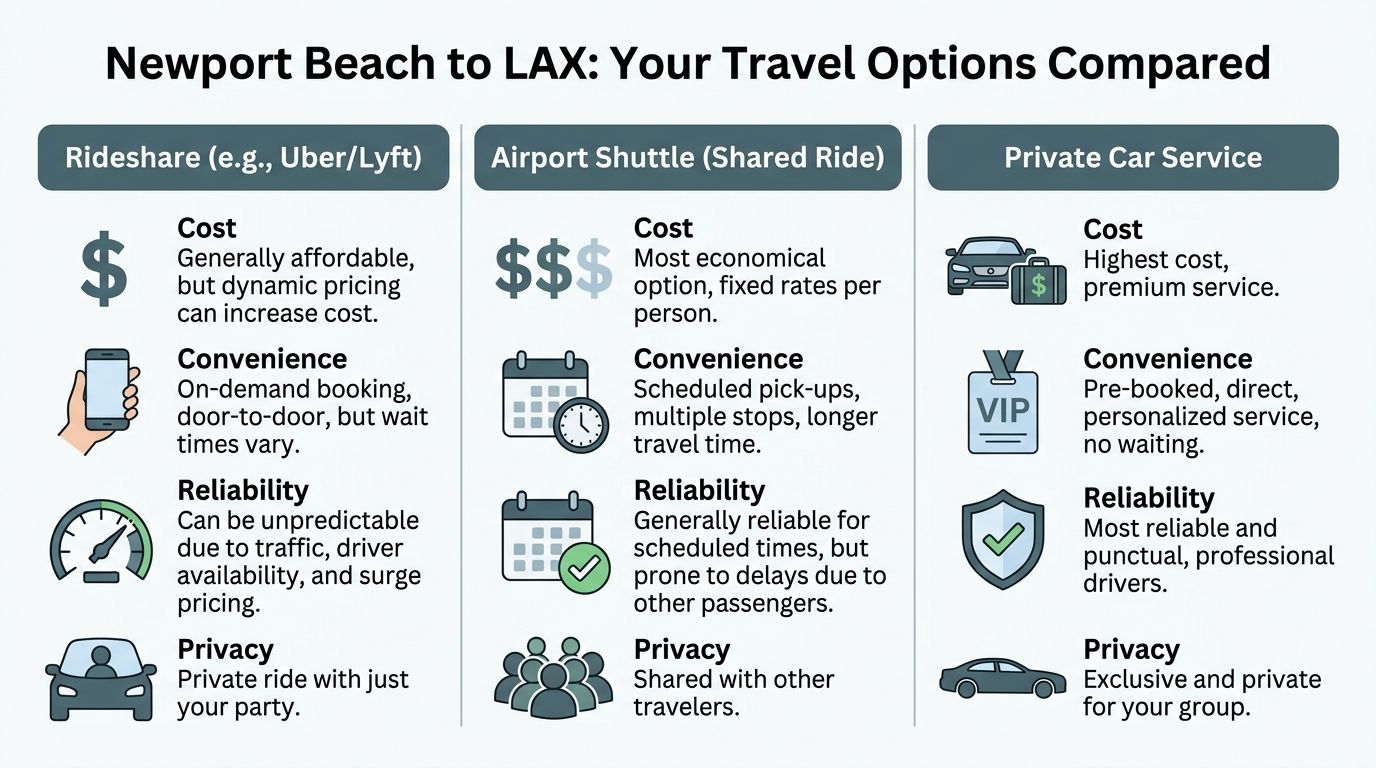
Some want the lowest possible spend. Some want a private cabin to work. Some want a method that causes the fewest surprises. The useful way to compare newport beach to lax transportation is by control, not by labels.
A practical side-by-side view
| Option | Predictability | Control | Comfort | Discretion |
|---|---|---|---|---|
| Rideshare | Moderate to low | Low once booked | Varies by driver and vehicle | Moderate |
| Shared shuttle | Moderate | Low | Basic | Low |
| Taxi | Moderate | Moderate | Standard | Moderate |
| Public transit | Low for time-sensitive trips | Low | Basic | Low |
| Private car service | High | High | High | High |
Matching the method to the day
If cost is the only priority and your schedule has room, public transit or a shared shuttle may be acceptable.
If the trip is personal, lightly timed, and flexible, a rideshare can be enough. Many people use one with no issue when the day has extra margin.
If the ride is tied to a meeting, a family departure, a client pickup, or a trip where being late creates larger problems, a scheduled private service fits the job more closely.
The adult choice is the quieter one
That does not make every lower-cost option wrong. It means each method carries a different amount of operational noise. In airport logistics, noise shows up as waiting, checking, confirming, adjusting, and worrying.
Choose the method that matches the consequences of delay, not just the price on the screen.
That is the standard professionals tend to use.
Your Blueprint for a Stress-Free Journey
Control comes from small decisions made early.
That is true whether you book a private car, a taxi, a shuttle, or another option. The goal is to remove avoidable uncertainty before travel day starts.
The simple checklist that helps
- Confirm the ride the day before: Make sure pickup details, terminal details, and contact information are current.
- Share flight information: A transport provider cannot adjust well if the flight details are missing.
- Build for heavy traffic, not ideal traffic: This route can change quickly. A weak plan assumes the road will cooperate.
- Match the vehicle to the actual load: Extra bags, child seats, golf clubs, or a work team change what works.
- Know who owns the trip: If something shifts, one person or one team should be clearly responsible for solving it.
Keep the plan simple
The best airport plans are rarely complicated.
They are clear. Pickup time is set. Flight details are attached. The route is watched. The traveler knows what happens if conditions change. That is what lowers stress.
For Orange County travelers moving between Newport Beach and LAX, the useful mindset is simple. Do not buy a ride and hope. Choose a process that can absorb problems without fuss.
If having this part of the trip handled with more structure matters, the decision can stay calm. There is no need to force it. There is only a choice between a reactive system and a managed one.
If you want to plan this properly, you can review Luxe Elite Transportation and see whether its scheduled Orange County airport service fits the level of control you want for the trip.