

A lot of executive travel stress starts before the flight.
The car is the weak point. Not the meeting. Not the hotel. The car.
You land at LAX, SNA, or LGB, and the app says your driver changed. The pickup zone shifts. The phone starts buzzing. Your next call is in less than an hour, and the whole plan is now sitting inside an algorithm that doesn't know who you are or why timing matters.
That isn't a personal mistake. It's a system problem.
In Orange County, where airport runs connect to boardrooms, Disneyland schedules, cruise terminal departures, and tight family itineraries, luxe transportation matters because it removes random failure from the day. It replaces chance with a plan, and that changes everything.
The Unspoken Anxiety of Executive Travel
A delayed flight does more than change an arrival time. It scrambles every handoff around it.
That stress shows up all the time on airport routes between Orange County and LAX, SNA, and LGB. The traveler isn't worried about sitting in a nice seat. Their primary concern is losing control of the next two hours.
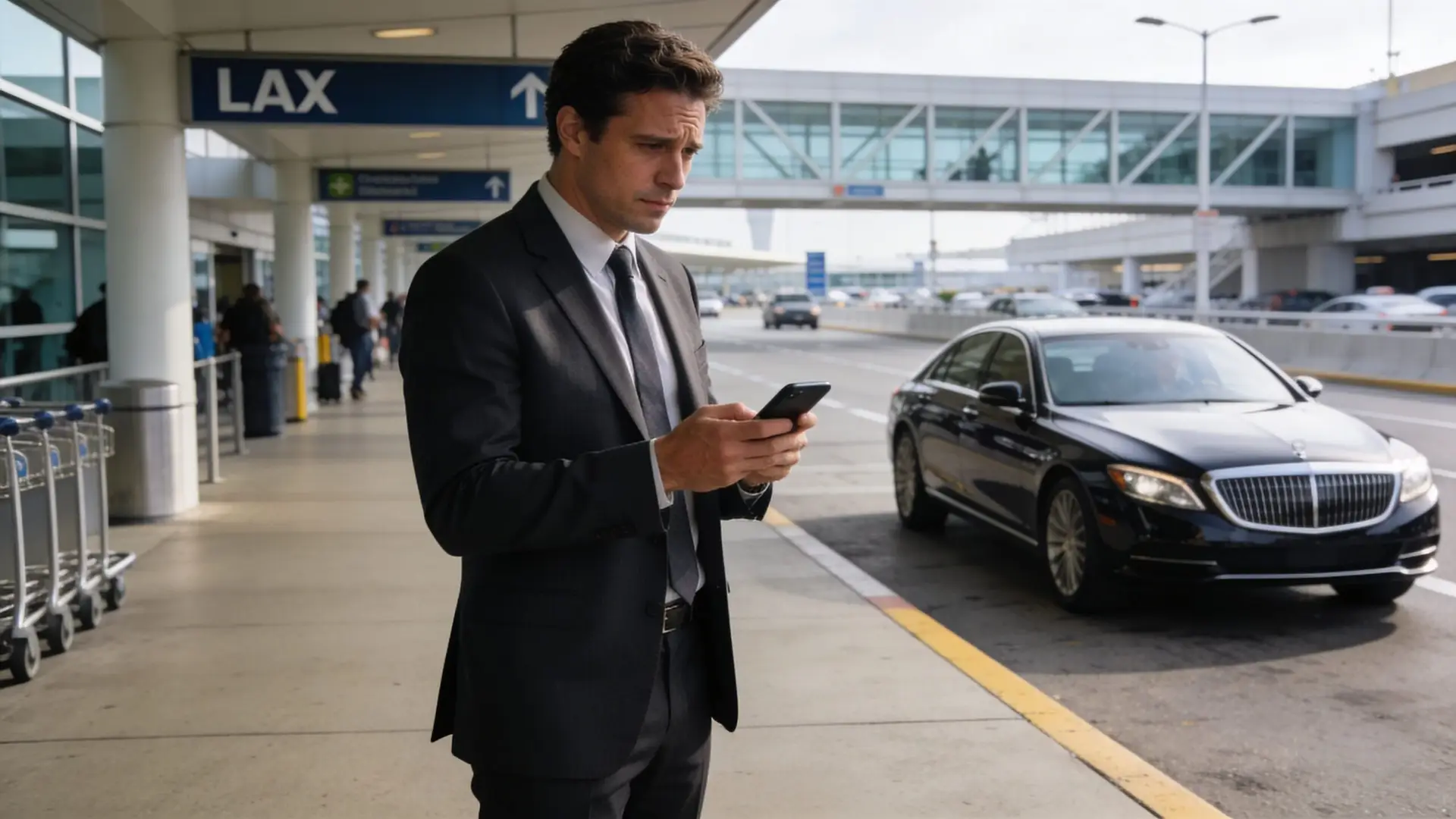
Where the stress really comes from
The usual pattern is simple. A traveler books a ride. The flight moves. The app doesn't think ahead. Now the passenger has to manage the correction while walking through a crowded terminal.
That is where bad systems show themselves.
A 2025 industry analysis found that 68% of business travelers report dissatisfaction with rideshare reliability for delayed flights, and it tied that frustration to weak communication and the lack of a guaranteed vehicle. The same analysis notes average inbound delays of 27 minutes at major Southern California airports, which makes reactive pickup systems a poor fit for executive travel in this region, according to this airport luxury car service analysis.
Practical rule: If the traveler has to monitor the ride, the system isn't doing its job.
For an Orange County executive going to LAX for an early departure, that can mean a late pickup, a rushed security line, and a meeting that starts with stress already in the room.
For an arriving client heading from SNA to a resort near Disneyland, it can mean standing outside with luggage while the platform rotates drivers.
Why this feels bigger than transportation
Airport transportation touches everything around it. It affects focus, tone, and timing.
When the pickup fails, the traveler carries that disruption into the next part of the day. That cost is hard to see on a receipt, and easy to feel in performance. The mental side of that strain is explained well in this look at airport stress and executive performance.
Here is the quiet truth. Many asking about luxe transportation aren't asking for flash. They're asking for a ride that doesn't become a problem.
That distinction matters in Southern California. Orange County travelers often need to move between home, office, airport, hotel, Disneyland, and cruise terminals without creating a chain of small delays. Apps were built for availability. High-stakes travel needs accountability.
The adult concern is certainty
People rarely say it this way, and this is what they mean.
- They want to know who is coming
- They want to know the car will be there
- They want the pickup to adapt when flights move
- They want quiet on the way to the next obligation
That is the key entry point into luxe transportation. Not indulgence. Not image. Control.
What Luxe Transportation Really Means
Hearing luxe transportation often brings to mind leather seats, polished paint, and a nicer version of a normal ride.
That old definition is too small.
In practice, luxe transportation means the trip is built as a system. The vehicle matters, and the true value sits in planning, communication, and accountability. That's why the modern market looks very different from the old limousine model.
A published industry overview says the luxury transportation industry has transformed and is growing at an estimated 8% annually by moving beyond occasional-use limousines into broader services like corporate travel, airport transfers, and executive transport. It also notes that clients now care more about comfort, reliability, and value than simple exclusivity, as described in this overview of the evolution of luxury transportation.
It is not about showing status
The strongest operator in this space is often the least noisy one.
The car arrives when expected. The route is already considered. The pickup point is clear. The chauffeur knows whether the traveler is leaving from Orange County for LAX, arriving at SNA after a delay, or heading from a hotel to a cruise terminal.
That is why “luxury” in this setting should be read as reduced friction.
Good transportation should fade into the background. If it becomes the main event, something already went wrong.
Three parts define it
A useful way to understand luxe transportation is to look at the three working parts.
Planning comes first
A planned ride is built before the wheels move. Departure time, terminal flow, luggage, passenger count, and destination timing all shape the trip.
For Orange County travelers, this matters because each airport behaves differently. LAX has scale and congestion. SNA moves faster and still requires precision. LGB is simpler, and pickup timing still matters when the traveler has a fixed connection afterward.
A human owns the result
Apps assign tasks. Professional services assign responsibility.
That difference sounds small until there is a delay, a terminal change, or a late-night arrival. In a planned system, someone is accountable for the outcome. In a chance-based system, the passenger often becomes the backup dispatcher.
Silence is part of the service
This is the part many people notice only after they've had it.
A strong ride feels quiet, even on a crowded travel day. There are no extra calls, no confusion over location, no pricing jumps in the middle of airport chaos. The traveler gets into the vehicle and keeps moving.
What does not fit this model
❌ A ride that depends on driver acceptance at the last minute
❌ A pickup that requires the passenger to keep refreshing an app
❌ A system that treats flight delays like a surprise
✅ A reserved vehicle with a defined plan
✅ A known chauffeur standard
✅ A process designed to absorb normal travel disruptions
That is what luxe transportation really means in Orange County. It is not excess. It is structure.
How Premium Chauffeur Services Differ from Rideshares
The cleanest way to compare these two systems is to look at what happens when the day stops being simple.
If the flight is early, late, or changed, the difference becomes obvious fast.
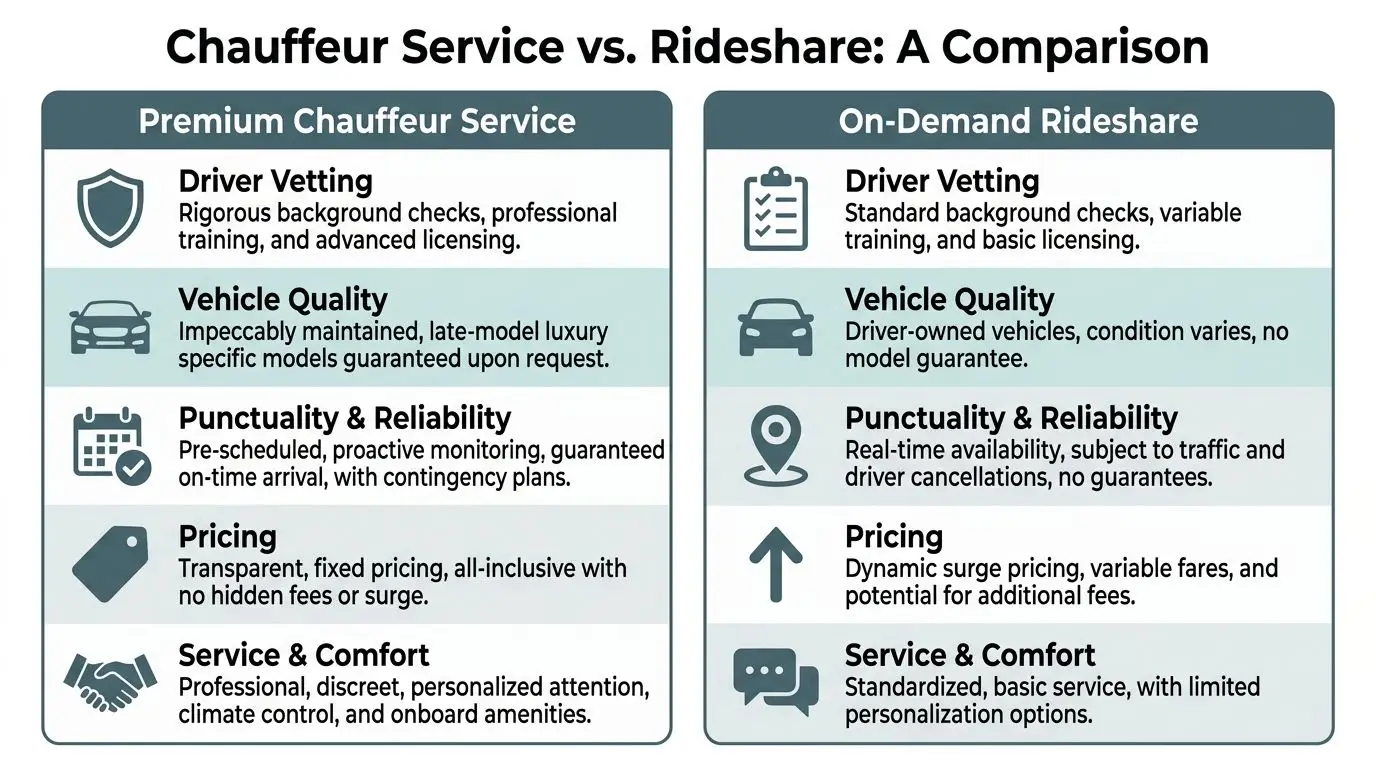
The real split is certainty versus chance
A rideshare works when the trip is low stakes and flexible. The app looks for availability near the moment you need it. That can be fine for casual movement around town.
Executive airport travel is different. The ride has to connect with a schedule that already exists.
| Premium chauffeur service | On-demand rideshare |
|---|---|
| Assigned responsibility for the trip | Driver availability decided close to pickup |
| Planned airport process | Reactive pickup flow |
| Vehicle category and service standard are more controlled | Vehicle quality varies by driver |
| Professional discretion is part of the job | Standards differ from one driver to the next |
What tends to fail with app-based rides
The problem isn't that apps never work. The problem is that they are built for volume, not for certainty.
When airport traffic shifts, pickup zones get crowded, or flights arrive off schedule, the traveler often has to do the repair work.
❌ Driver changes create avoidable stress. The person expected to arrive may disappear from the app.
❌ Communication gaps become more serious at LAX, where terminal pickups are already noisy and crowded.
❌ Pricing volatility can turn a simple delay into a more expensive and more frustrating ride.
❌ No built-in ownership means there is often nobody managing the whole journey from dispatch to drop-off.
One useful side-by-side breakdown appears in this comparison of chauffeur service and rideshare, especially for airport-focused travel.
What works in a planned chauffeur model
A premium chauffeur service doesn't depend on algorithmic luck. It depends on process.
✅ The ride is scheduled in advance. That sounds basic, and it changes everything. The trip exists before the moment of stress.
✅ The operator plans around the airport. LAX, SNA, and LGB don't move the same way, and a planned service accounts for those differences.
✅ The traveler is not the dispatcher. The passenger should not be coordinating timing, tracking the driver, and solving pickup confusion while also managing luggage and messages.
When a system is built well, the traveler can pay attention to the trip itself instead of the mechanics around it.
Why this matters in Orange County
Orange County creates a lot of mixed-purpose travel. One ride may start at a home in Newport Coast, stop at an office in Irvine, continue to LAX, and then reverse days later with a hotel or Disneyland destination added in.
That kind of movement exposes weak systems.
A rideshare can handle a single simple request. A premium chauffeur service is better suited to a chain of obligations where timing, discretion, and consistency all matter. That is the core difference in luxe transportation. One model reacts. The other prepares.
Common Use Cases for Planned Transportation
The need for planned transportation becomes clear in ordinary high-pressure situations. Not glamorous ones. Real ones.
In Orange County, the same pattern comes up again and again. The day has several moving parts, and the car can't be one more unknown.
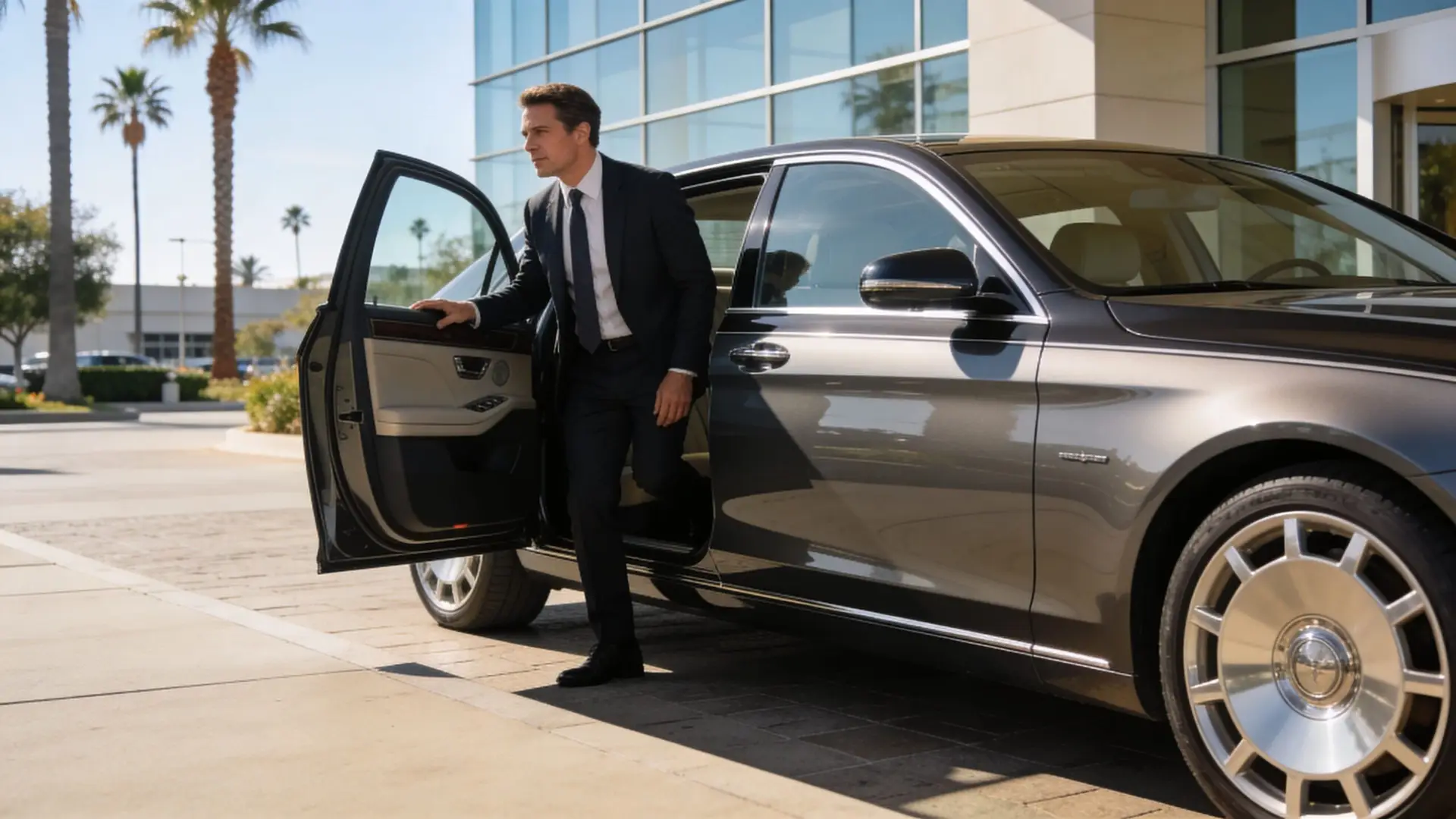
Airport runs that can't drift
A morning departure from Orange County to LAX is a good example. The road can slow down. Terminal traffic can stack up. The traveler may already be answering messages before sunrise.
A planned ride helps because the transportation side is settled before the day starts.
The same applies on arrival. A traveler landing at SNA or LGB usually wants the simplest possible handoff. No guessing where to stand. No repeated app messages. Just a clear pickup and a quiet ride home or to the hotel.
Work between stops
Some airport transfers are not really transfers. They are work blocks on wheels.
Recent 2025 data shows that 72% of C-suite travelers prioritize productivity-focused amenities like reliable Wi-Fi, charging ports, and quiet cabins during airport transfers, according to this report on black car travel expectations. That matters in Southern California because transfer time often becomes prep time.
A trip from John Wayne Airport to a meeting in Orange County can be the last clean window to review notes, answer email, or reset before walking in.
The best executive vehicle is often just a quiet room that happens to move.
Disneyland without the parking spiral
Families and hosts going to Disneyland often think transportation will be the easy part. Then parking, drop-off zones, group timing, and end-of-day fatigue start to pile up.
That is where planned service makes more sense than it first appears.
- Arrival stays organized when one vehicle handles the full group plan.
- Pickup is calmer at the end when nobody has to sort out tired children, bags, and multiple app cars.
- Timing is easier to control for dining reservations, hotel check-in, or an evening return to another Orange County stop.
Cruise terminal departures with luggage
Cruise days punish loose planning. Bags are bigger. Departure windows matter. Group members move at different speeds.
For Orange County travelers heading to a cruise terminal, a scheduled car or executive van reduces one of the biggest risks, which is fragmented arrival. One missed rideshare or one overpacked vehicle can throw off the entire departure rhythm.
This is also where a provider such as Luxe Elite Transportation fits as a factual example. The service covers private airport transfers, executive travel, and select special-occasion routes across Southern California, including common Orange County connections to airports and cruise departures.
The pattern is simple. The more important the day is, the less sense it makes to leave the ride to chance.
The Simple Mechanism Behind a Calm Journey
A calm ride isn't magic. It comes from a short chain of decisions.
First, the trip is scheduled in advance. The route, pickup time, airport, and vehicle are set before the day gets noisy.
Second, a real person monitors the variables that usually cause trouble. That means flight timing, traffic flow, and airport changes are watched as part of the service, not handed back to the passenger.
Third, the chauffeur works from a clear plan. The expectation is early positioning, a defined pickup process, and professional follow-through.
❌ Weak systems wait for trouble and then react.
✅ Strong systems assume travel will change and prepare for that from the start.
That is the mechanism behind luxe transportation. The peace of mind comes from structure.
What to Expect from a Premium Chauffeur Service
A premium chauffeur service should feel clear before it feels luxurious.
The traveler should know what kind of vehicle is coming, what standard the chauffeur works under, and what the ride is meant to support. In Orange County, that usually means airport service, executive transfer work, Disneyland transportation, and longer runs that start or end at LAX.
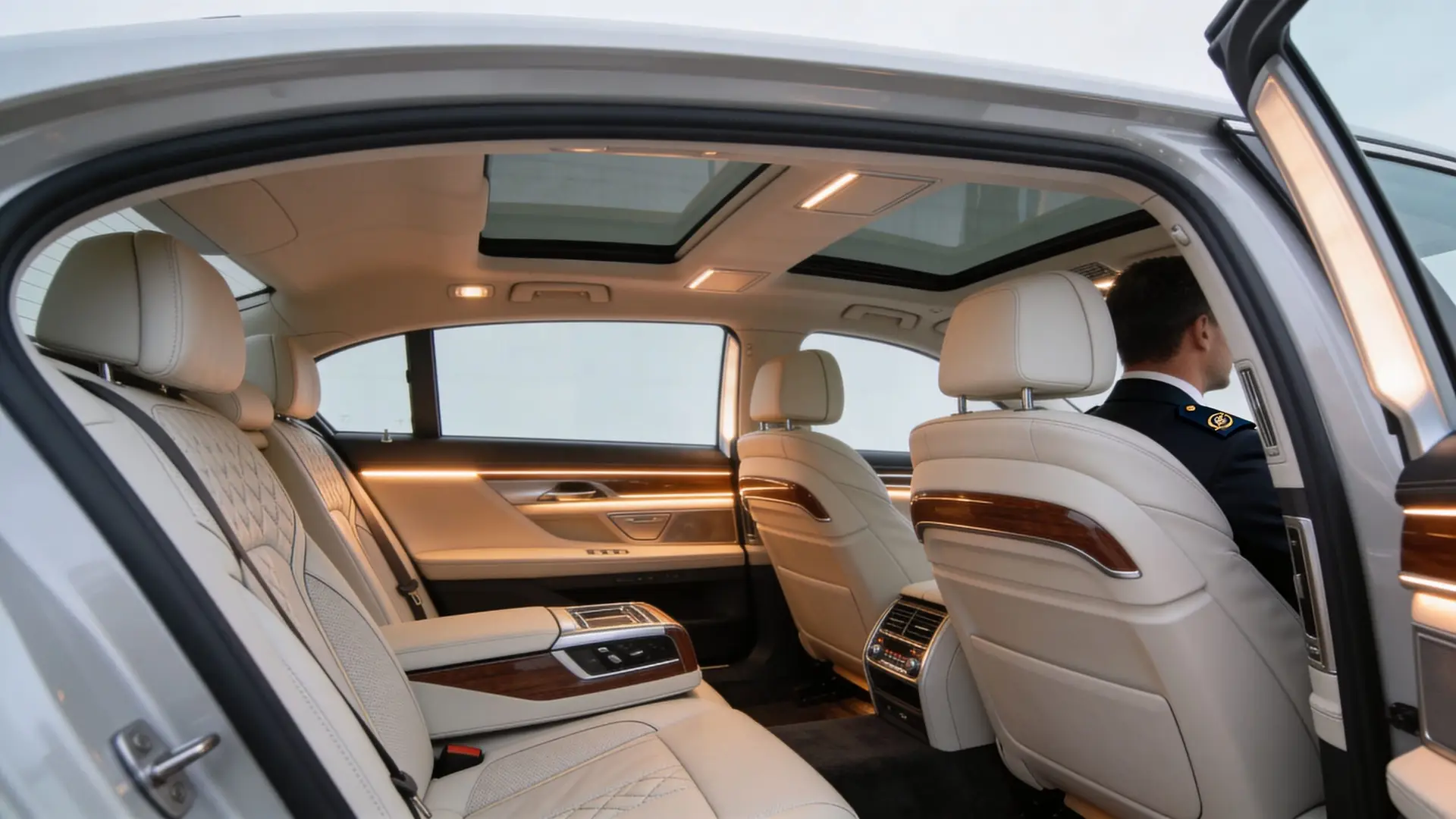
Vehicles should match the job
A solo airport run may call for a luxury sedan. A small executive party may need an SUV. A group transfer to LAX, SNA, LGB, Disneyland, or a cruise terminal often makes more sense in a Mercedes Sprinter executive van.
That vehicle matters for a reason. Mercedes Sprinter executive vans are commonly set up with leather captain's chairs, Wi-Fi, and device integration, which allows passengers to work while moving. The same source notes that standard services have pickup issues 20% to 30% of the time when flight changes are not tracked, as outlined in this explanation of executive transportation and Sprinter use.
The chauffeur standard should be visible in the details
Professionalism isn't a slogan. It shows up in behavior.
A proper chauffeur arrives prepared, keeps communication simple, respects privacy, and understands that the ride is part of the client's workday or personal schedule. The traveler should not need to explain why discretion matters.
A few signs usually tell you the standard is real:
- Clear appearance and conduct that fit executive or family travel
- Comfort with airport procedures so pickups don't become improvised
- Calm communication when schedules shift
- Respect for quiet when the passenger wants to work or rest
Useful amenities should support the trip
Luxury features only matter if they solve a real need.
For executive travel, that often means Wi-Fi, charging options, and a quiet cabin. For airport pickups, it may mean luggage space and a smooth loading process. For family or group rides, it means enough room so nobody feels compressed before the day even starts.
A premium ride should support the purpose of the trip, not distract from it.
The same rule applies to cleanliness, climate control, and vehicle condition. These are not extras. They are part of a dependable standard.
The invisible parts matter most
The strongest premium chauffeur services are usually judged on things the passenger never sees.
That includes flight monitoring, internal dispatch coordination, early vehicle staging, and a pickup plan that accounts for the airport rather than hoping the curb will cooperate. In practical terms, these are the hidden parts that keep the ride quiet.
That is what clients are really looking for when they ask about luxe transportation. They want a service that handles the details before those details turn into stress.
The Booking Process and Final Reassurance
A good booking process should lower stress, not add more choices than the traveler needs.
The basic flow is usually simple. Choose the route or the hourly format. Choose the right vehicle for the passenger count, luggage, and purpose. Confirm the details, and receive the trip information clearly.
What a sensible booking flow looks like
The strongest services keep the process direct.
Route and timing are defined early
Airport pickup, airport drop-off, Disneyland transfer, cruise terminal run, or hourly executive use all require slightly different planning.The vehicle fits the actual trip
A sedan, SUV, or executive van should be chosen based on who is riding and what the day requires.Confirmation closes the loop
The traveler should know the ride is in the system and that changes like flight movement will be handled within that system.
This kind of planning is part of a larger industry shift. The luxury shuttle bus market was valued at $4.12 billion in 2024 and is projected to reach $9.065 billion by 2035, signaling rising demand for premium fleets and professional chauffeur services, according to this luxury shuttle bus market report.
Why the booking step matters so much
Most transportation failures begin with weak setup.
If the reservation process is vague, the ride often becomes vague too. If the booking captures the key details properly, the trip has a stronger foundation from the start.
That is why a clear reservation path matters for Orange County airport travel. LAX, SNA, and LGB each create different demands, and the system should account for those differences before the day arrives. Travelers who want a direct example of that process can review this transfer booking page.
Final reassurance
There is no perfect travel day. Flights move. Roads slow down. Terminals get crowded.
The useful question is simpler. When the day changes, is the transportation built to absorb that change?
❌ Chaos-based systems push the work back onto the traveler.
✅ Planned systems carry the work quietly in the background.
That is the practical value of luxe transportation in Orange County. It gives executives, families, and travel planners a calmer way to move through LAX, SNA, LGB, Disneyland trips, and cruise terminal departures. The point isn't extravagance. The point is control.
If having your airport or executive travel handled with more clarity matters, you can explore Luxe Elite Transportation and review the options at your own pace.