

SEO title: Luxe Car Service: 5 Reliable Signs of Quiet Control
Meta description: Luxe car service in Orange County means planned airport transfers, real flight tracking, vetted chauffeurs, and calm control for LAX, SNA, LGB, Disneyland, and cruise terminal travel.
URL slug: /luxe-car-service-orange-county-reliability
You land at LAX. The phone says your driver changed.
Then the pickup point changes.
Then the app shows a car moving the wrong way while the curb fills up, the battery drops, and your next call gets closer.
That kind of stress feels personal, and it usually isn’t. It’s a system problem. The app model was built for volume, not for executive timing, airport coordination, or quiet control.
A true luxe car service solves a different problem. It isn’t there to offer a nicer seat alone. It’s there to remove the gamble from Orange County travel to LAX, SNA, LGB, Disneyland, and cruise terminals.
The Unspoken Anxiety of Executive Travel
The usual failure starts before the ride begins.
An executive lands at LAX after a long flight from the East Coast. The meeting is in Orange County. The first car cancels. The second driver takes the wrong terminal loop. The third message says, “I’m here,” and the car isn’t. Nothing is clear, and every minute now belongs to the curb, not to the traveler.
At SNA, the problem looks smaller and still creates the same pressure. The airport is easier to move through, and the handoff can still go sideways if no one is watching the flight, no one owns the pickup, and no chauffeur has been assigned in advance. The traveler did nothing wrong. The bad system ultimately handed a critical job to chance.
Where the stress really comes from
Most executives don’t mind paying for transportation. They mind uncertainty.
They mind not knowing who is arriving. They mind having to text a stranger while collecting bags. They mind wondering if the car will be clean, quiet, large enough, and on time. In a normal personal errand, that may be an annoyance. In business travel, it becomes operational noise.
Practical rule: If the pickup depends on a phone refresh and a nearby stranger accepting the fare, it isn’t a transportation plan.
This is why the language around premium transport often gets confused. People hear “luxury” and think leather seats, tinted windows, and bottled water. Those details matter, and they are not the core issue.
The core issue is control.
A proper luxe car service is a managed system. It starts with a reservation, not a request. It works from assigned responsibility, not shifting availability. It assumes flights change, terminals get crowded, traffic tightens near Disneyland, and cruise terminal timing can turn messy fast.
Orange County travelers feel this more often
Orange County travelers deal with a wide spread of routes and pressure points. One day it’s a simple transfer from Newport Beach to SNA. The next day it’s a late evening pickup from LAX to Irvine, a family transfer to Disneyland with luggage, or a timed departure to a cruise terminal where missing the window creates a much larger problem.
Those trips don’t fail because the passenger picked the wrong curb.
They fail because algorithms guess. Human operators verify.
For executive assistants, travel managers, and principals, this is the point that matters. If the ride to LAX or the return from SNA has to work, the vehicle matters less than the operating model behind it. Quiet success comes from planning that no one sees.
That’s what clients are buying when they move from an app to a true luxe car service. They’re buying fewer moving parts, fewer surprises, and less mental drag on the day.
Why On-Demand Car Services Fail at Critical Moments
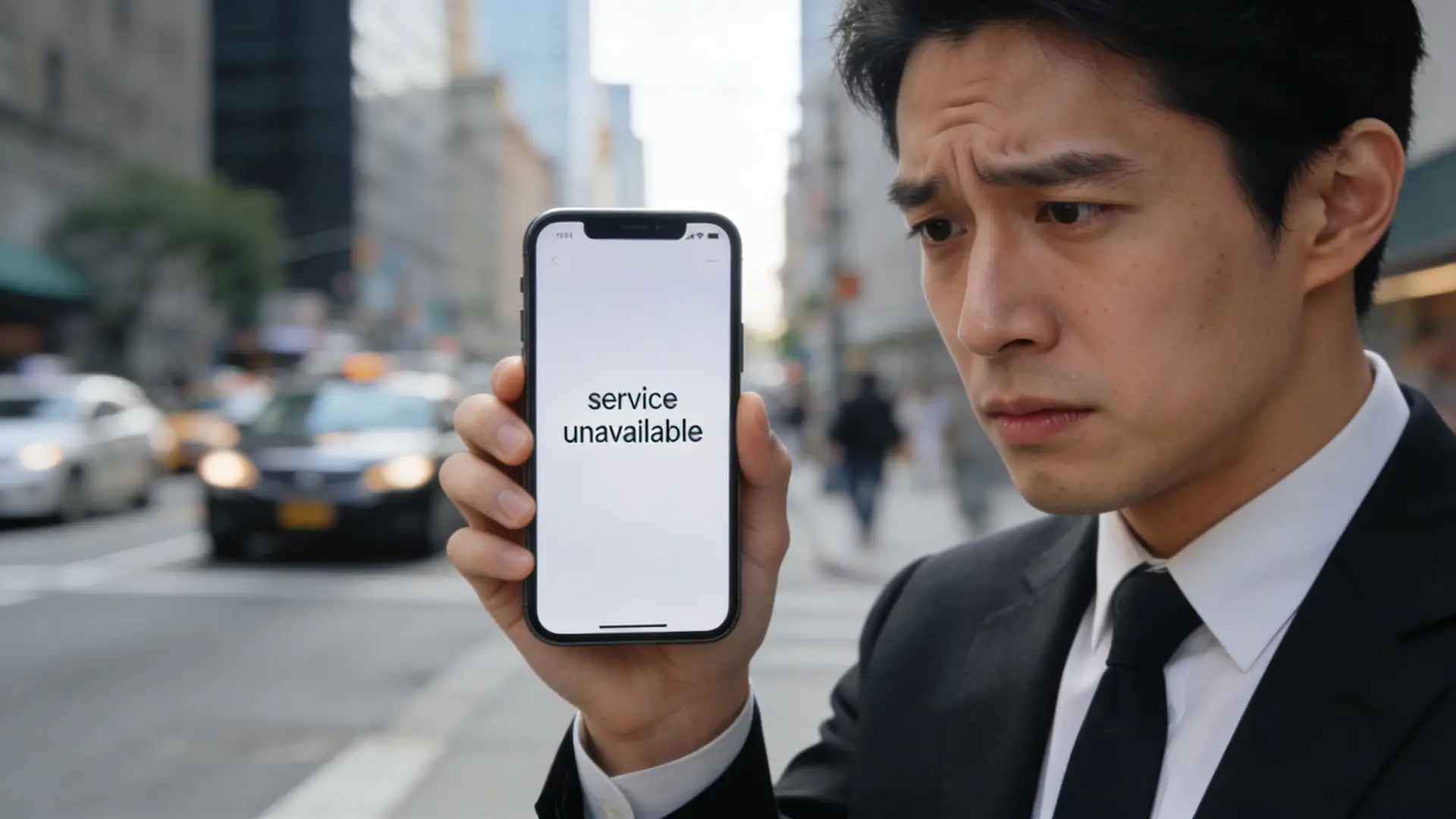
On-demand services aren’t broken by accident. They work exactly as designed.
They are built to match available drivers with incoming demand at scale. That model can be fine for low-stakes local trips. It starts to fail when the trip has a hard arrival window, a flight variable, luggage complexity, family needs, or executive consequences.
The app model creates fragile pickups
When a traveler uses an app for an airport transfer, the ride often looks planned on the screen. Behind the screen, it may still be unstable.
❌ No dedicated chauffeur means the driver can change with little notice.
❌ Algorithm dispatch means the trip is assigned by availability logic, not by accountability.
❌ Weak airport context means the driver may know the airport in a general way and still miss the exact pickup flow at LAX, SNA, or LGB.
❌ No owned responsibility means there may be no dispatcher actively managing the ride from start to finish.
That’s why the most important airport trips often feel oddly improvised.
Flight changes expose the weakness
Airport pickups need active monitoring. Flights land early. Flights sit on the tarmac. Bags take longer. Terminal traffic closes lanes. None of this is unusual.
Premium luxe car services utilize real-time flight tracking integration that can ensure chauffeur arrival precision within a 15-30 minute window of the actual landing time, and industry benchmarks suggest up to 70% of rides experience delays due to unmonitored flights and last-minute driver changes, according to White Glove Transportation OC’s overview of airport transfer operations.
That one detail changes the whole operating picture. If no one is monitoring the flight in real time, the pickup is already late in planning terms, even if the car eventually arrives.
The failure usually isn’t at the curb. The failure happened earlier, when no one was assigned to watch the trip like it mattered.
Why “cheaper” often means less stable
The lower upfront fare in an app can hide a larger risk. The system rewards speed and volume. It doesn’t reward patient staging near a terminal, careful communication with a client’s assistant, or route planning around Anaheim event traffic and Orange County freeway pressure.
A chauffeur-driven service works from a different standard.
| Decision factor | On-demand app | Professional scheduled service |
|---|---|---|
| Driver assignment | Variable | Pre-planned |
| Flight response | Limited or inconsistent | Actively monitored |
| Accountability | Distributed | Specific team ownership |
| Pickup communication | Reactive | Managed |
| Vehicle consistency | Mixed | Fleet standard |
This is the part many busy travelers already know in practice. They may not say it this way, and they feel it every time the phone starts throwing updates at them after landing.
For LAX curb pickups, Disneyland drop-offs, and early departures from coastal Orange County to SNA or LGB, the app model introduces one problem after another because it depends on last-minute alignment. That’s the logistical gamble.
A luxe car service removes that gamble by removing randomness.
The True Cost of a So-Called Cheaper Ride
The ride fare is rarely the most important number that matters.
For an executive, the significant cost starts when transportation begins taking attention away from the workday. A delayed pickup at LAX means calls get moved, arrival posture changes, and the first minutes of the meeting are spent recovering instead of leading. A rough transfer from Orange County to a cruise terminal means the vacation starts with avoidable tension. A bad Disneyland pickup with children and bags turns a simple handoff into a curbside problem.
Cheap on paper can be expensive in practice
The decision often gets framed the wrong way. People compare one fare to another fare. They should compare one risk profile to another.
A cheaper ride can carry hidden costs:
- Lost focus: The traveler spends mental energy tracking a car instead of preparing for the next commitment.
- Schedule damage: One late arrival can force changes across the rest of the day.
- Reputation strain: Important people notice who arrives composed and who arrives apologizing.
- Administrative cleanup: Assistants and coordinators spend extra time fixing a problem they shouldn’t have inherited.
Those costs don’t always show up on an expense line. They show up in friction.
The market is moving toward reliability for a reason
The U.S. Limousine & Town Car Services industry is projected to reach $6.6 billion by the end of 2025, driven by executives and discerning travelers who prioritize the reliability of scheduled, chauffeur-driven service over cheaper alternatives for important airport travel, according to IBISWorld’s industry outlook.
That matters because it confirms what experienced travelers already do with their own calendars. They pay for certainty when the trip matters.
The adult decision isn’t “What’s the lowest fare?” It’s “What failure can this day absorb?”
A CEO going from Newport Coast to LAX for a flight to New York isn’t buying a seat in a car. The executive office is buying punctuality, a quiet cabin, and a system that won’t need supervision. The same logic applies to a visiting client arriving at SNA, a family transfer to Disneyland, or a return from Long Beach after a cruise. The route changes. The need for reliability doesn’t.
Risk belongs to the transport model
Bad systems create confusion. They make people think every ride is basically the same and that the only difference is price. That outdated advice ignores how ground transportation operates.
A scheduled chauffeur service carries planning cost because it carries planning labor. Someone reviewed the route. Someone assigned the vehicle. Someone owns the pickup. Someone is watching for changes. That isn’t fluff. It’s the layer that keeps one delayed text from becoming a failed arrival.
When transportation has to disappear into the background, “cheaper” is often the more expensive choice.
The Operational System Behind a Luxe Car Service

At 5:40 a.m., the executive should be thinking about the board deck, not whether the driver saw the terminal change.
That difference explains what a real luxe car service is. It is an operating model built to remove variables before the client feels them. The vehicle matters, but the quiet success of the trip comes from dispatch discipline, chauffeur standards, route judgment, and controlled communication.
App-based transportation leaves more of the outcome to chance. A scheduled chauffeur operation does the opposite. The reservation is owned by a team. The pickup is planned against the actual trip conditions. If the traveler is arriving late, carrying presentation materials, or landing during a congested pickup window, those details affect the plan before the car reaches the curb.
Human planning changes the outcome
The main advantage is not luxury styling. It is human supervision.
A dispatcher can spot a weak handoff before it turns into a missed connection. An experienced operator can assign a chauffeur who knows the airport, the property, and the pickup constraints. That matters on routes that look routine but fail on details, such as hotel access near Disneyland, terminal congestion at LAX, or luggage-heavy transfers from a cruise port.
Good operators work upstream. They reduce avoidable failure points instead of waiting to react after something slips.
What a controlled operation includes
A dependable service usually has a few consistent traits:
- Pre-assigned chauffeur: The reservation is accepted internally, not left waiting in a queue.
- Active trip oversight: Flight timing, traffic conditions, and pickup changes are monitored by staff.
- Known vehicle standards: Cabin condition, luggage capacity, and vehicle class are confirmed in advance.
- Clear client communication: The traveler receives direct instructions without chasing updates.
- Local execution knowledge: Dispatch and chauffeurs understand airport procedures, hotel access, venue flow, and port timing.
For buyers comparing providers, this guide to airport car service features that actually matter is a useful filter.
Luxe Elite Transportation is one Orange County example of this scheduled model. The company focuses on prearranged chauffeur service for airport and executive transportation rather than app-style dispatch.
A strong transport operation feels quiet to the passenger because the noise was handled before pickup.
Why the vehicle is only one layer
A late black SUV is still late. A polished Sprinter with weak dispatch control still creates risk.
Experienced executive assistants and travel managers usually test the system, not the leather. They ask who owns the reservation after booking. They ask how flight changes are handled, when the chauffeur is assigned, and how pickup instructions are delivered at LAX, SNA, or LGB. Those questions reveal whether the provider is managing transportation or is limited to sending a car when the clock starts.
That is the true distinction in luxe service. The client sees a calm ride. Operations sees a chain of decisions that kept the day from becoming a logistical gamble.
The Anatomy of a Flawless Airport Transfer
A proper airport transfer starts long before the traveler sees the car.
The night before a morning departure from Orange County to LAX, the reservation should already be stable. The vehicle category is confirmed. The route has been reviewed. The chauffeur knows the pickup address, the terminal, and the baggage profile. If the trip is from a hotel near Disneyland, the timing accounts for lobby access and loading, not just freeway drive time.
What happens before pickup
The morning of the trip, the best operators are discreetly checking conditions. They’re watching traffic patterns, airport flow, and timing changes that could affect the route. If the traveler is landing at SNA or LAX, the incoming flight is being watched so the pickup doesn’t rely on guesswork.
A clean handoff usually includes a short message with the chauffeur’s name, vehicle details, and where the traveler should expect contact after landing. The client shouldn’t need to call three people or decode airport chaos from scratch.
For travelers comparing service standards, this guide on airport car service features that actually matter outlines the operational details worth checking before booking.
What the traveler experiences
From the client side, a flawless transfer feels ordinary. That’s the point.
The traveler lands. The phone shows one clear message. Bags are collected. The chauffeur is already positioned correctly for the agreed pickup method. There is no haggling over lane location and no surprise vehicle mismatch. The luggage fits without improvisation.
Luxe car service fleets prioritize executive SUVs and Sprinters with quiet cabins below 55 dB at highway speeds, and those vehicles offer 20-40% more luggage capacity, which is especially useful on trips to LAX or SNA, according to White Glove Transportation OC’s fleet overview.
That matters in practical ways. A quiet cabin lets an executive return calls without strain. Extra luggage room helps families moving between Orange County, Disneyland hotels, and airport terminals without stuffing bags into footwells or splitting the group.
Good airport transportation should feel uneventful. If the client is managing the process, the system already missed its job.
Why this works better than improvisation
Airport travel always contains variables. Flights move. Baggage timing shifts. Traffic around LAX can turn quickly. What changes the result is whether those variables are managed by a system or pushed onto the passenger.
The clean transfer works because the service accepts uncertainty as normal and plans around it. That’s very different from waiting to see which driver appears in an app queue.
For Orange County travelers, that difference becomes obvious on the routes that matter most. Early departures to LAX. Afternoon arrivals into SNA. Group pickups from LGB. Family transport tied to Disneyland check-in windows. Every one of those trips benefits from the same simple rule. Planning beats hope.
The Simple Mechanism of Logistical Silence
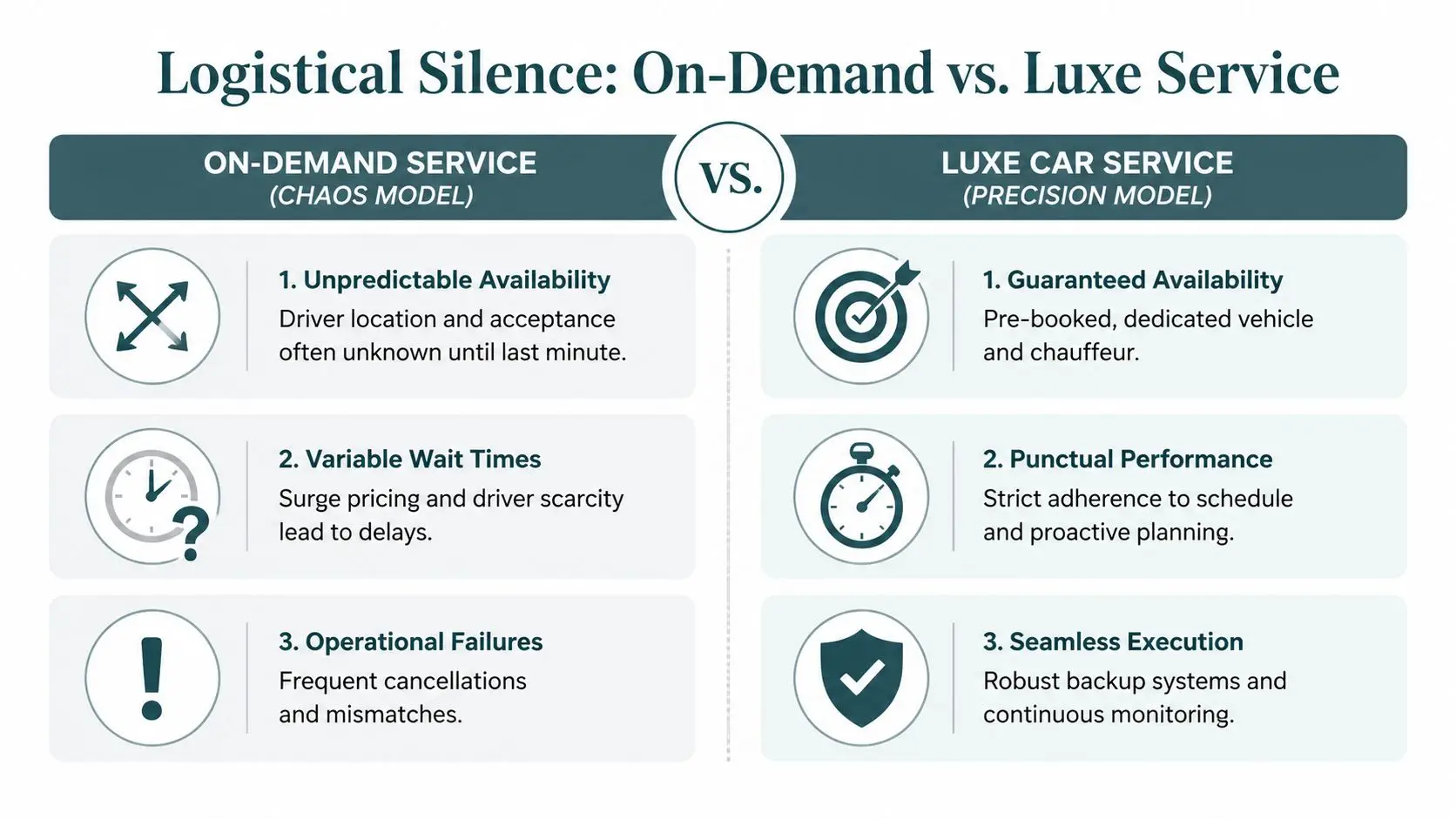
There are really only two models.
❌ The ride-hailing gamble
An algorithm sends a request into a pool of changing drivers. Timing depends on acceptance, proximity, airport familiarity, and a rough read of traffic. The rider absorbs the uncertainty.
✅ The professional system
A human team manages a reservation. A vetted chauffeur is assigned. Flight and route changes are watched in real time. The provider absorbs the uncertainty.
| Model | Input | Result |
|---|---|---|
| On-demand | Random availability | Variable outcome |
| Scheduled luxe car service | Planned responsibility | Predictable outcome |
That’s the mechanism behind logistical silence. Fewer surprises don’t happen by luck. They happen because someone removed the random parts before pickup.
A Buyer's Checklist for Executive Transportation

At the buying stage, the right question is not whether the vehicle looks premium. The right question is whether the provider runs a controlled operation that can absorb delays, access restrictions, luggage variables, and last-minute schedule changes without pushing that problem back to the traveler.
That standard changes the conversation. You are not screening for a car. You are screening for a transportation partner that can protect an itinerary.
The questions worth asking first
Use this checklist for airport transfers, Disneyland runs, executive roadshows, and cruise terminal travel from Orange County.
- Ask how trips are assigned: Is a chauffeur committed well before pickup, or is the reservation still being filled close to go time?
- Ask how schedule changes are handled: What is the exact process for delayed flights, early arrivals, and terminal updates at LAX, SNA, and LGB?
- Ask who communicates with the traveler: If plans shift, who sends the update, and how early does that outreach happen?
- Ask how vehicles are matched to the job: How does the team confirm passenger count, luggage volume, child seats, and vehicle type before dispatch?
- Ask about privacy controls: What screening, discretion standards, and service protocols apply for executives, families, and confidential travel?
- Ask about local execution: How does the provider handle airport pickup rules, Disneyland-area hotel access, and cruise terminal timing windows?
Strong operators answer these questions with specific procedures. Weak ones answer with general promises.
FBO knowledge belongs near the top of the list
Private aviation ground transportation has a different set of requirements than a commercial terminal pickup. The provider needs to understand access rules, ramp-side limitations, fixed-base operator procedures, and how to coordinate a discreet handoff without creating delays at the curb or confusion on the tarmac side of the trip.
That matters at SNA and LAX in particular. A company can do acceptable hotel transfers and still struggle with private terminal work.
If the traveler flies private, ask for the provider's process at the specific FBO being used. Ask how arrivals are confirmed, who communicates with the aviation side if needed, and how the chauffeur is positioned for pickup. Those answers tell you whether the company has done this work repeatedly or is improvising.
For a more detailed planning reference, this guide on how to choose executive car service gives a useful framework for comparing providers.
Checklist mindset: Ask, “What exact process do you follow when the flight changes, access rules shift, or pickup volume spikes?”
Signs of a strong answer
A capable provider usually speaks in operating terms. They can explain reservation review, chauffeur briefing, pickup procedures by airport, and what happens if the itinerary changes after dispatch. They can also tell you who remains responsible for the trip from booking to drop-off.
That is what buyers should listen for.
A polished vehicle is easy to arrange. A quiet, predictable result takes planning, dispatch discipline, and people who know the local environment well enough to remove problems before the passenger sees them.
Understanding Pricing and Value in a Luxe Car Service
Pricing gets easier to understand when you stop thinking of it as a car fee.
A luxe car service is usually priced around the type of trip being managed. Some reservations are point-to-point. Some are hourly. Some include airport coordination where timing is tied to flight activity, terminal flow, and waiting logic. The structure depends on the job.
What the client is actually paying for
The visible part is the vehicle and chauffeur.
The less visible part is the operating cost that protects the outcome. That includes reservation review, dispatch oversight, scheduling discipline, fleet maintenance, airport coordination, and the kind of communication that keeps a traveler from having to supervise the trip from a phone.
That’s why comparing a scheduled executive transfer to an app fare often leads to the wrong conclusion. The two services aren’t priced for the same task. One sells transportation access. The other sells a controlled result.
A practical way to judge value
A simple framework helps.
| Pricing question | Low-control ride | Managed luxe car service |
|---|---|---|
| What are you buying | A ride attempt | A planned transfer |
| Who handles changes | Mostly the passenger | The provider |
| What matters most | Fare | Reliability |
| Best use case | Casual trip | Important travel |
If the trip involves an airport, a client meeting, a family transfer with bags, a Disney schedule, or a cruise departure, reliability usually has more value than a small fare difference.
A useful cost reference is this overview of what limo service cost usually reflects. It helps separate surface price from the planning work behind the reservation.
Why certainty often costs more, and why that’s reasonable
A higher rate in this category usually means there is more control built into the trip.
The chauffeur’s time is reserved. The vehicle is held for the assignment. The operation leaves room for airport variables instead of pretending they don’t exist. That reserve capacity is part of the product. It’s what keeps the traveler from dealing with the chaos personally.
For executives and families in Orange County, this often becomes a simple judgment call. If the ride needs to work quietly the first time, price matters and outcome matters more.
Common Questions About Scheduled Transportation
What happens if my flight is delayed or arrives early
A scheduled service should be built for that. The provider monitors the flight and adjusts the pickup around actual arrival conditions. The traveler shouldn’t need to renegotiate the ride from baggage claim.
Can I request a specific vehicle or practical add-ons
Usually, yes. That can include choosing the right size vehicle for luggage, family travel, or a small group. It can also include practical requests that need to be handled in advance rather than improvised at pickup.
How is privacy handled for executives and VIPs
This starts with process. Professional chauffeur services use trained drivers, controlled communication, and discreet pickup methods. Privacy isn’t a mood. It’s a set of operating habits.
Is this only for airport travel
No. The same planning model works for Disneyland transfers, cruise terminal runs, corporate meetings, and evening events where timing still matters. The route changes. The value of control stays the same.
How far ahead should a traveler book
Earlier is usually better when the schedule is important. Advance booking gives the provider time to assign the right vehicle, review timing, and remove avoidable variables from the trip.
If having transportation handled with this level of detail matters, you can review the options at Luxe Elite Transportation.