

You land at LAX, turn your phone back on, and the noise starts.
Texts. Gate changes. Pickup instructions that don’t match the terminal. A rideshare app showing one car, then another, then none. Your day in Orange County hasn’t even resumed, and control is already slipping.
That strain isn’t in your head. It’s the result of a travel system built around reaction. LAX rewards whoever can absorb confusion fastest, and executives usually pay for that in time, privacy, and focus.
A well-planned lax to sna car service changes the job of ground transportation. The ride is no longer a guess after landing. It becomes part of the itinerary, handled quietly in the background so you can move from Los Angeles into Orange County without carrying the whole problem yourself.
Navigating the Arrival Anxiety at LAX
The hard part often starts after the aircraft door opens.
At LAX, people aren’t just finding baggage. They’re decoding pickup zones, sorting through app alerts, and trying to estimate how long the drive to Santa Ana, Irvine, Newport Beach, Disneyland, Long Beach Airport, or the cruise terminal will really take. For an executive, that mental load matters. It steals attention right when the next meeting, call, or family handoff is about to begin.
The stress starts before the curb
A typical Orange County traveler already knows the pattern.
You land. The plane taxis longer than expected. A message arrives from someone asking for your ETA. The app says the car is nearby, then the driver calls from the wrong level. By the time you reach the curb, you’re no longer traveling. You’re managing a broken handoff.
That’s why a planned lax to sna car service matters more than many people first think. The vehicle is only one part of it. The primary value is that someone has already solved the pickup logic before your flight touches down.
Practical rule: Airport transportation should remove decisions after landing, not create new ones.
This matters even more in Orange County because arrival points and end destinations aren’t all the same. A guest heading to a hotel near Disneyland needs a different timing plan than an executive returning to Newport Coast. A traveler connecting toward SNA or LGB has a different tolerance for delay than a family moving toward a cruise terminal schedule. The system has to fit the destination, not force every rider into the same template.
Why smart travelers still feel off balance
Many high-functioning people assume they should be able to “figure it out on arrival.” That advice comes from outdated travel habits.
Reactive systems sound flexible, and they usually aren’t. They place the burden on the passenger at the worst possible moment. If the pickup point changes, the passenger has to fix it. If traffic surges, the passenger absorbs it. If the driver doesn’t understand terminal flow, the passenger becomes the coordinator.
That’s not a personal mistake. That’s what chaos looks like when it gets packaged as convenience.
A scheduled service works differently. It treats the LAX arrival as a controlled operation with known pressure points. The car is assigned with the route in mind. The pickup timing isn’t left to chance. The travel window into Orange County is approached like a live corridor, not a hopeful estimate.
The real loss is control
Many believe they’re protecting time by staying “flexible.”
In practice, they often give up certainty and then spend that lost certainty on calls, updates, and recovery. That’s especially costly when the destination is time-sensitive, like a board meeting in Irvine, a client dinner in Newport Beach, a hotel check-in near Disneyland, or a transfer tied to Long Beach Airport or a cruise departure.
A reliable lax to sna car service isn’t about drama or display. It’s the adult response to a noisy system. It restores one simple condition that modern airport travel keeps trying to take away.
You know who’s meeting you, where the handoff happens, and how the drive is being managed.
The Systemic Flaws of the LAX to SNA Corridor
The corridor itself is the problem.
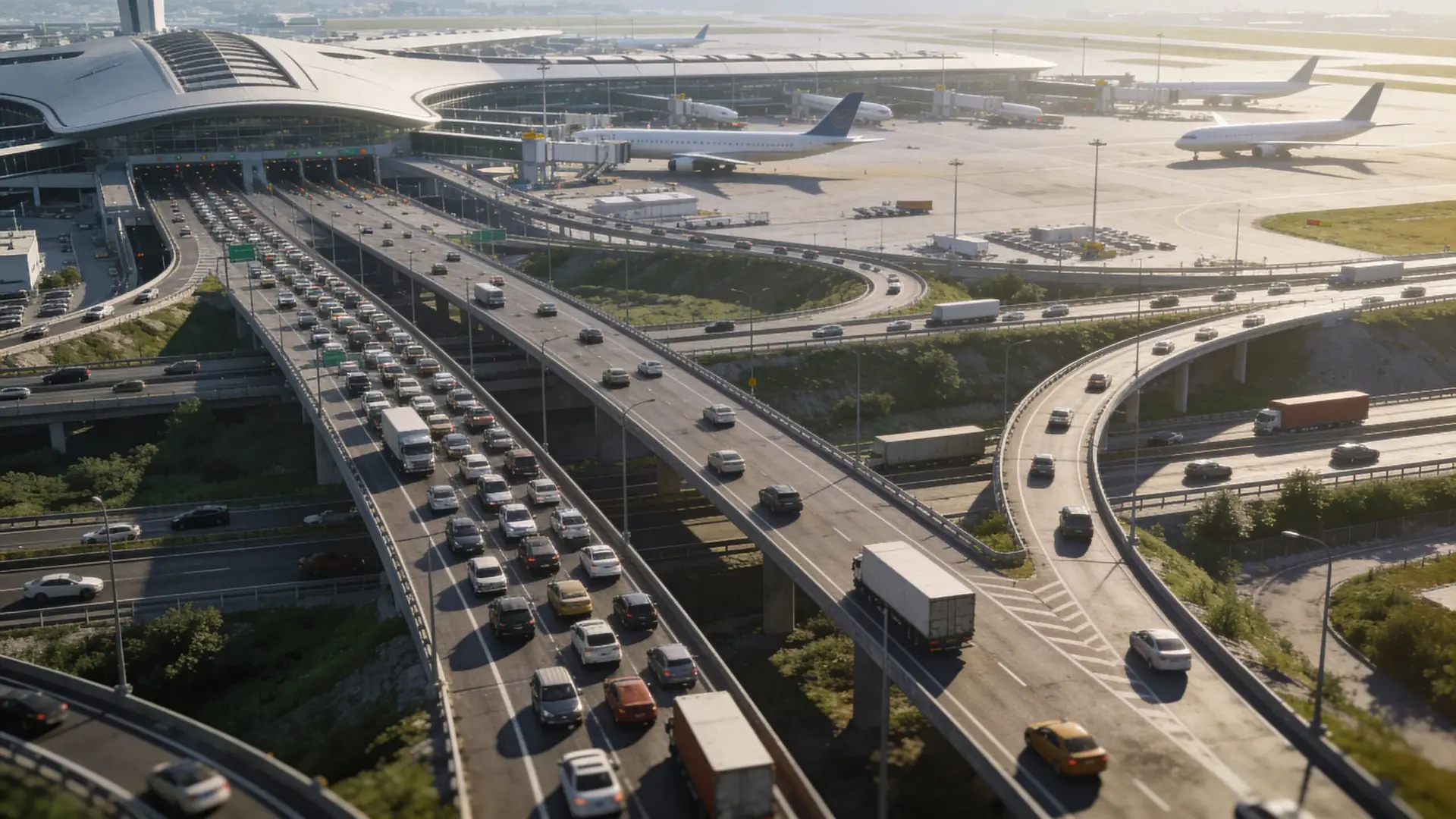
LAX handles around 88 million passengers annually across 9 terminals, while SNA serves about 11.4 million passengers through 3 terminals. LAX also brings 25 to 45 minute security waits, compared with 10 to 15 minute waits at SNA, and the 39-mile drive from LAX to Orange County can swing from 45 to 90 minutes depending on conditions, as noted in Luxe Elite Transportation’s Orange County airport time and stress comparison.
Why this route breaks weak systems
LAX isn’t difficult because one part goes wrong. It’s difficult because several moving parts fail at once.
A pickup can be delayed by terminal congestion. Then the curbside flow shifts. Then traffic on the route south tightens. Then the passenger has to update someone waiting in Orange County. Each problem seems small on its own, and together they create a long, expensive drag on the day.
That’s why random pickup logic performs poorly here. The route needs planning that starts before arrival and continues through the drive.
For travelers comparing options, Luxe Elite Transportation outlines the route logic in its page on car services from LAX.
LAX and Orange County move at different speeds
SNA feels compact because it is compact. LAX feels sprawling because it is.
That difference matters when you’re choosing where to absorb stress. If your destination is in Orange County, the question isn’t only where you fly. The question is where you want complexity to sit. At LAX, complexity sits at the terminal, at the curb, and on the road south.
A traveler headed to Santa Ana or Irvine is dealing with a corridor that changes shape throughout the day. A traveler going to Disneyland or Newport Beach still has to pass through the same broad system failure first. The route doesn’t care how important your appointment is.
LAX to Orange County works best when the transportation plan is built around volatility, not around hope.
The road network adds a second layer of instability
The corridor between LAX and SNA doesn’t offer one clean answer.
Some trips move quickly if timing is favorable. Others slow down through the I-405 and I-5 interchange pressure that regular Southern California travelers already know well. That means a car service on this route isn’t just providing a vehicle. It’s absorbing uncertainty with dispatch decisions, timing buffers, and route management.
A simple way to view the corridor is this:
| Corridor factor | What it creates |
|---|---|
| Large airport scale | More curbside confusion and slower exits |
| Multiple terminals | Harder pickups and longer communication chains |
| Orange County destination spread | Different timing needs for Irvine, Santa Ana, Newport Beach, Disneyland, LGB, and cruise terminals |
| Traffic volatility | Travel windows that widen quickly if no buffer exists |
What works and what doesn’t
Some systems are designed to react after the problem appears.
Others are designed to reduce the chance that the problem reaches the passenger at all.
❌ What fails: Waiting until touchdown to assign the driver, decide the route, or interpret flight changes.
✅ What works: Pre-assigned pickups, route awareness, and a service model that treats LAX-to-Orange County as an active logistics corridor.
The route itself isn’t broken in a dramatic way. It’s broken in the quiet, familiar way that steals time from busy people every day. The answer isn’t more hustle. The answer is a calmer system.
Why On-Demand Travel Fails High-Stakes Trips
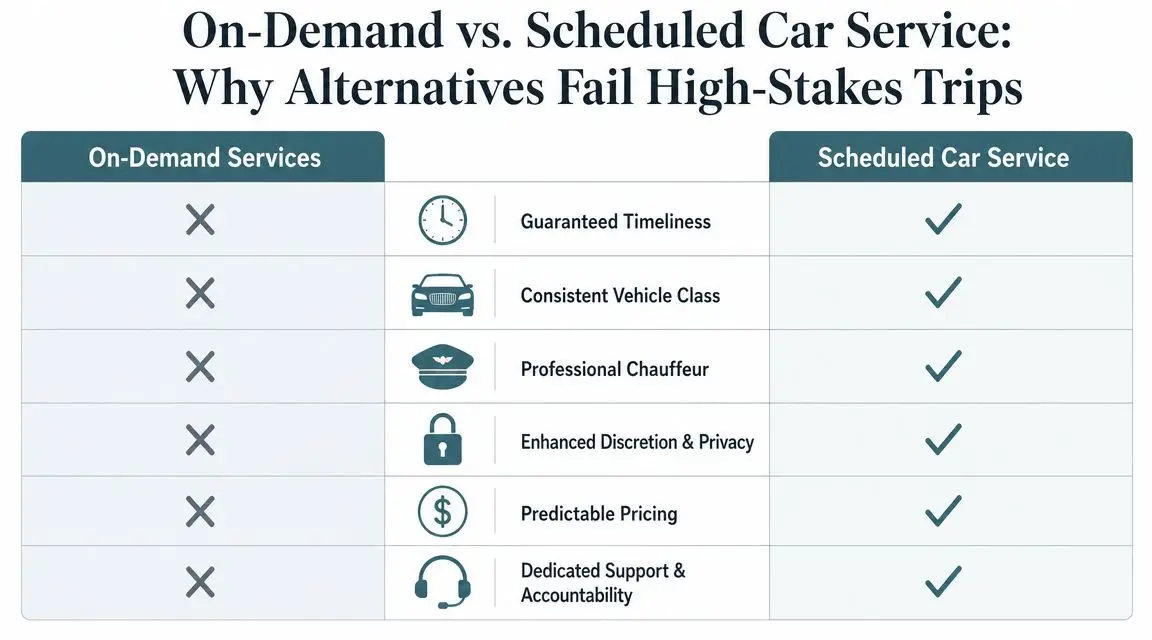
The main issue with on-demand travel is simple. It asks a reactive system to handle a route that punishes reaction.
For a casual outing, that may be acceptable. For an executive pickup from LAX into Orange County, it often isn’t. The stakes are different when the rider needs privacy, a dependable arrival, and a vehicle that fits the trip from the start.
Rideshare looks flexible and often isn’t
On-demand apps sell speed. The hidden cost is uncertainty.
On the 39-mile LAX to Santa Ana corridor, drive times can range from under 50 minutes before 5:00 AM to over 90 minutes during peak hours. That 40-minute variability is exactly where on-demand systems struggle, because they don’t build in the same pickup buffers that scheduled services use for the I-405 and I-5 corridor, according to this Santa Ana corridor timing analysis.
If the route can widen that much, the pickup strategy has to account for it in advance. Most app-based systems don’t. They assign whoever is available and let the passenger absorb the mismatch.
The driver lottery is real
One trip may be fine. The next may introduce friction at every step.
❌ Pickup confusion
The driver may know the airport generally and still not handle a specific terminal handoff well.
❌ Vehicle mismatch
You may request a class of ride and still get a cabin that doesn’t fit your luggage, your team, or the tone of the trip.
❌ No continuity
Each trip starts from zero. New driver, new communication style, new assumptions.
✅ Scheduled service advantage
The trip is planned around your route, your timing, and your expected handoff.
Shared shuttles fail in a different way
Shared airport transportation solves a different problem. It’s built to fill seats and group stops.
That model doesn’t fit most executive ground transfers from LAX into Orange County. If you’re going to Irvine for a meeting, Anaheim for a convention, or a hotel near Disneyland after a long flight, extra stops change the whole value of the ride. Privacy drops. Timing slips. Control disappears.
A shuttle may be perfectly reasonable for travelers who can trade time for lower cost. It isn’t the right tool for a high-stakes arrival.
The wrong transportation model isn’t a bad service. It’s a service solving a different problem.
Airport taxis remove one layer and keep others
Taxis can reduce some app-based confusion. They still leave major trade-offs in place.
You usually don’t get continuity. You often don’t get a known driver in advance. You may not get the cabin environment needed for calls, decompression, or focused work. And if your destination requires a precise handoff, such as a resort near Disneyland, a transfer to LGB, or a timed cruise terminal arrival, you still need planning that reaches beyond “a car is available.”
A simple comparison
| Option | Main weakness on this route | Better fit for |
|---|---|---|
| Rideshare | Reactive dispatch and inconsistent pickup flow | Low-stakes, flexible travel |
| Shared shuttle | Multiple stops and limited privacy | Cost-sensitive group movement |
| Taxi | Limited continuity and limited planning depth | Immediate short-notice transport |
| Scheduled car service | Requires advance planning | Executive and time-sensitive trips |
Why scheduled service holds up better
A proper lax to sna car service doesn’t depend on a lucky sequence.
✅ It accounts for route variability
The schedule includes enough structure to absorb normal corridor swings.
✅ It supports specific travel needs
A solo executive may want a quiet sedan. A family moving from LAX to Disneyland may need more room. A team transfer may call for an SUV or van.
✅ It preserves discretion
You don’t have to explain your preferences to a new stranger every trip.
✅ It creates accountability
Someone owns the pickup. That’s the difference many travelers feel immediately.
The broad lesson is simple. On-demand travel can work when uncertainty is acceptable. It fails when certainty is part of the job.
The Mechanism of Logistical Silence
A quiet trip doesn’t happen by accident. It comes from a few simple controls working together.
The first is an assigned chauffeur. One person is responsible for the handoff, the timing, and the route. That removes the usual app chaos where the passenger keeps adapting to a changing plan.
The second is active flight management. There’s an important difference between passive tracking and operational response. As explained in this flight monitoring and pickup coordination analysis, many services receive delay information and still leave the rider to sort out the consequence. A managed service recalibrates dispatch and route timing based on the live flight status.
The third is buffered scheduling. Time is held around the trip so normal traffic movement doesn’t break the arrival.
Three quiet controls that matter
Known accountability
The passenger knows who is handling the trip.Real adjustment
If the flight moves, the pickup plan moves with it.Protected timing
The schedule allows room for road variability instead of pretending it won’t happen.
A calm airport transfer is usually invisible. That’s the point. The system is doing the work so the passenger doesn’t have to.
That’s what logistical silence means. Fewer updates. Fewer corrections. Less mental drag.
A Walkthrough of a Scheduled Car Service Experience
A good airport transfer feels simple because the planning happened early.
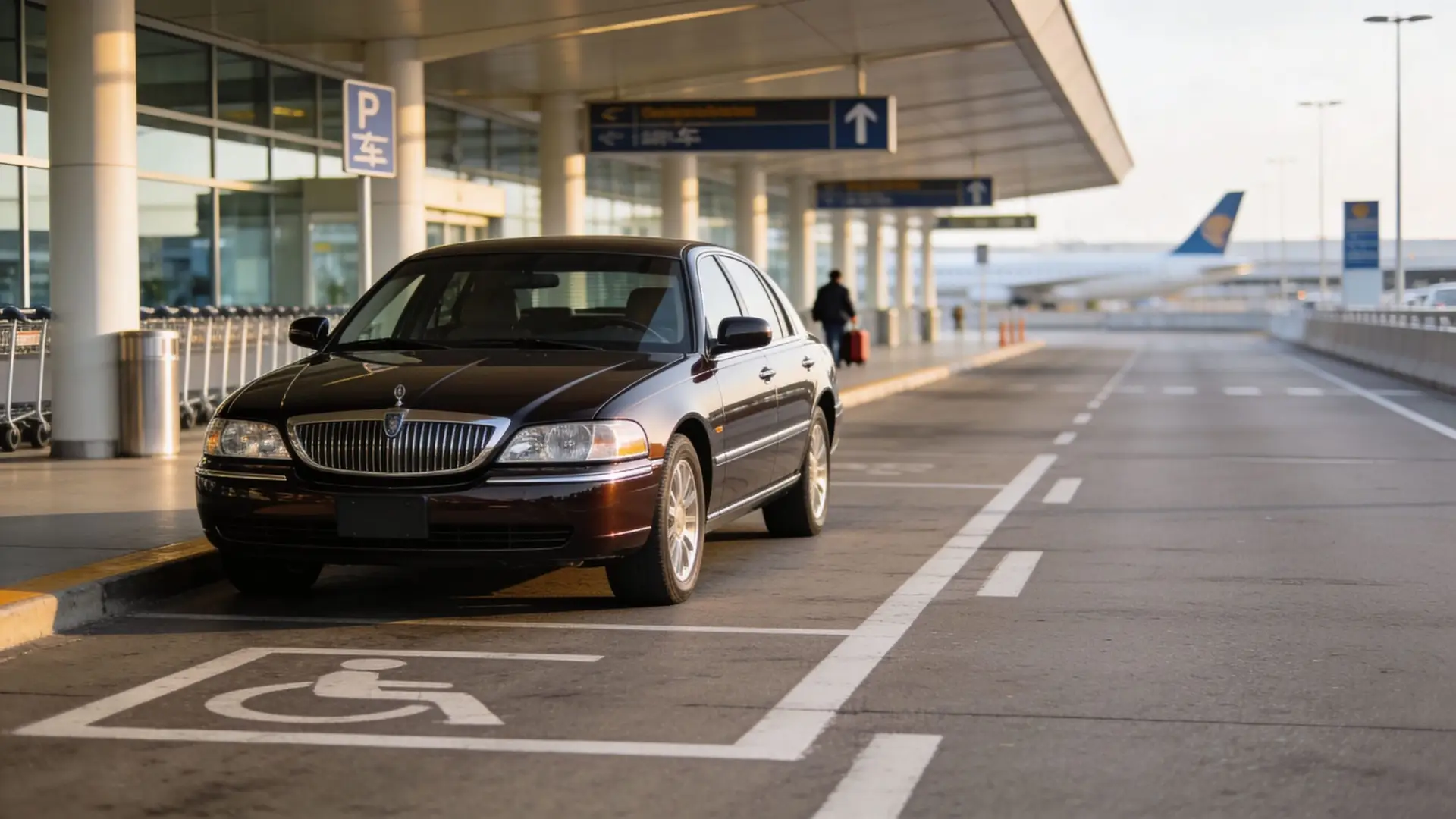
The process starts before departure day. The traveler or assistant books the route, confirms the flight, selects the vehicle class, and receives clear trip details. From there, the ride moves into monitoring and coordination rather than guesswork.
Before the plane lands
The strongest services remove ambiguity early.
You should know the reservation is confirmed. You should know the type of vehicle being sent. You should know whether the pickup is curbside or meet-and-greet. That way, once you land at LAX, you’re not starting a new logistics project from your phone.
For travelers refining this process, Luxe Elite Transportation’s article on executive car service mistakes in Orange County outlines the common planning errors that create friction later.
The handoff should feel clear
After landing, communication should be direct and light.
A well-run service provides simple arrival guidance rather than a chain of changing texts. If baggage claim is involved, that’s handled as part of the timing. If the pickup is curbside, the rider gets a clean meeting instruction and the chauffeur is already aligned with the terminal flow.
Many weak systems falter at this point. They ask the passenger to become the dispatcher. A proper service doesn’t.
Vehicle choice matters more than people think
The vehicle should match the work of the trip.
According to this executive vehicle class overview, a Mercedes S-Class sedan is oriented toward discretion and a quiet cabin, while a Cadillac Escalade offers more luggage capacity. That difference matters. Travelers with specific expectations often need more than a broad vehicle category.
A simple decision guide looks like this:
| Travel need | Better fit |
|---|---|
| Solo executive, quiet ride, calls or decompression | Luxury sedan |
| More bags, family transfer, extra room | Executive SUV |
| Small team, coordinated group movement | Sprinter-style van |
What the rider actually notices
The details that matter most are rarely dramatic.
✅ A quiet cabin
Space to work, make a call, or just reset after landing.
✅ Charging access and basic connectivity
Useful when the airport has already drained your battery and patience.
✅ Luggage handling without confusion
The transition from terminal to car stays orderly.
✅ No surprise vehicle changes
The ride aligns with what was booked.
The vehicle is visible. The real service is the planning around it.
From LAX into Orange County
Once the car is moving, the experience should get quieter.
That applies whether the destination is Santa Ana, Irvine, Newport Beach, Anaheim near Disneyland, Long Beach Airport, or a cruise terminal transfer. The route may still require adjustments, and those adjustments should happen in the background. The passenger shouldn’t be hearing every operational decision unless there’s a reason.
That’s one of the clearest signs of a mature service. You’re not being dragged through the mechanics. You’re being carried by them.
Arrival should not create a second problem
A proper airport transfer doesn’t end with the highway exit.
Drop-off needs to be as deliberate as pickup. Office tower, hotel porte-cochère, private residence, terminal entrance, or cruise handoff. The final minutes matter because a messy ending can erase the calm of the ride itself.
When the service is planned well, the full experience has one quality that travelers remember.
It stayed quiet.
Special Considerations for VIP and Corporate Travel
Executive travel has a second layer that standard airport transportation often misses.
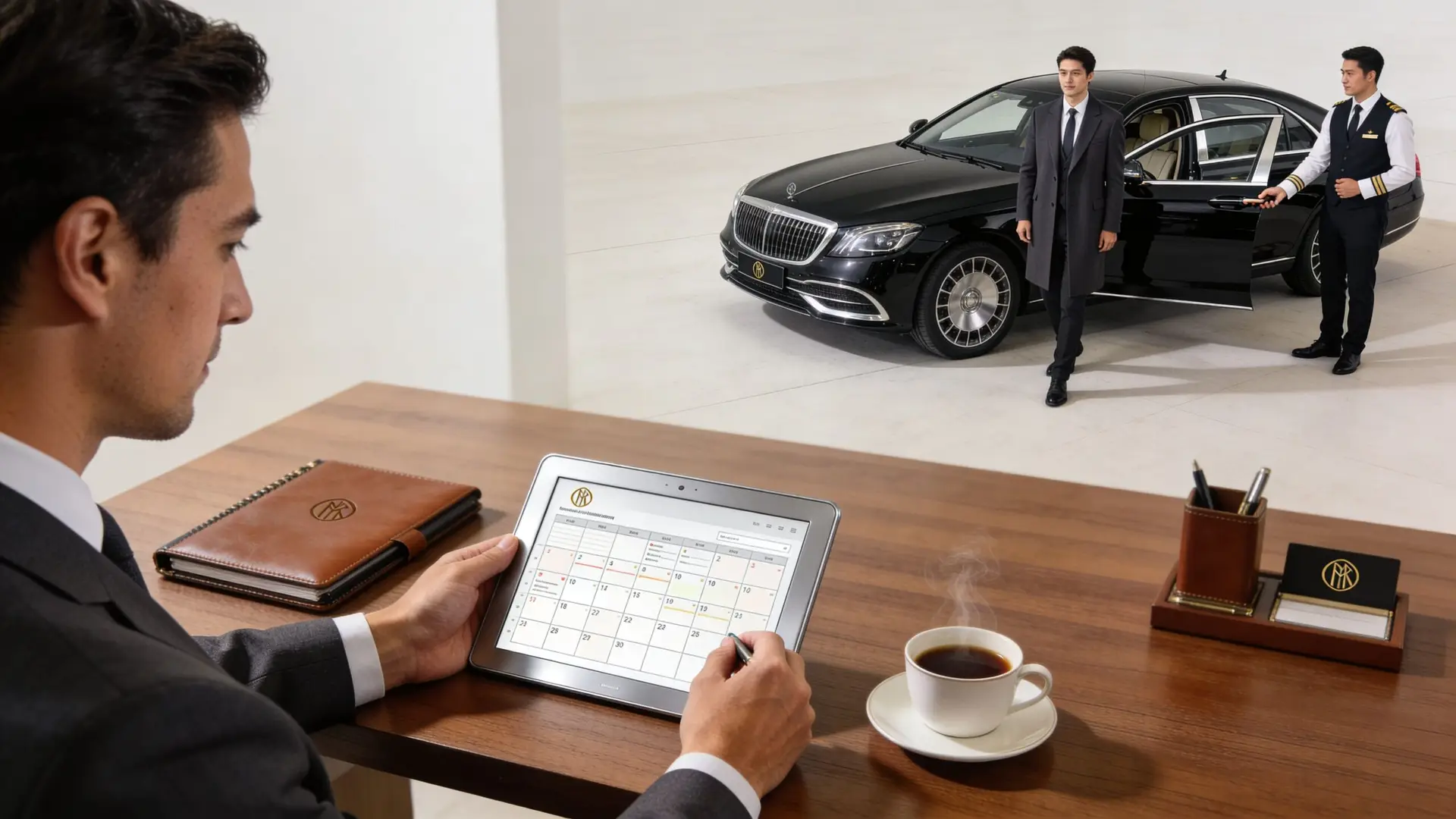
The trip isn’t only about moving from LAX into Orange County. It’s also about privacy, continuity, and reducing the amount of coordination that spills onto the executive, assistant, or travel manager. When those pieces are ignored, the ride may still happen, and the system still fails.
The invisible handoff problem
One of the least discussed issues in executive ground travel is the changing driver.
This executive transportation analysis on continuity and discretion describes the problem well. When a different driver appears each trip, continuity weakens and confidentiality can erode. Preferences have to be repeated. Protocols have to be restated. The executive loses the benefit of familiarity.
That may sound small. It isn’t.
For high-level travelers, repeated handoffs create friction in places where there should be none. A trusted assigned chauffeur understands how the traveler prefers communication, what level of conversation is welcome, how pickups should be handled, and how to maintain a discreet environment.
What corporate travel managers need
The assistant or travel manager often carries the burden of weak transportation systems.
If a service doesn’t provide continuity, clear communication, and stable billing, someone inside the company ends up doing repair work. That usually means checking status, relaying updates, confirming arrivals, and smoothing over gaps that shouldn’t exist in the first place.
Corporate transportation works better when those tasks move back to the transportation provider. Luxe Elite Transportation outlines that model in its page on corporate transportation planning in Orange County.
The needs change by traveler type
A good executive service adapts without making the client rebuild the trip each time.
C-suite traveler
Usually needs quiet, timing discipline, and a driver who understands discretion.Family office or VIP client
Often expects a relationship-based service style and a low-profile handoff.Corporate team arrival
May need coordinated group movement, more luggage space, and aligned billing.Event or convention travel
Requires precision across multiple arrivals without forcing the client to chase updates.
Fleet choice affects operations too
Vehicle class is not only a comfort decision. It changes how the trip functions.
A sedan is useful when privacy and a quiet cabin matter most. An SUV helps when the passenger count or luggage load grows. A Sprinter-style van becomes useful when a corporate team arrives together and needs to stay together from terminal to hotel, office, Disneyland-area venue, LGB connection, or cruise terminal handoff.
That’s where many generic services fall short. They treat every assignment as a simple ride request. Executive transportation usually isn’t simple. It’s a chain of responsibilities that needs one accountable owner.
For VIP and corporate travel, the best outcome is often the least noticeable one. Nobody had to step in and fix anything.
Your Blueprint for a Controlled and Quiet Journey
The choice on this route is rarely about luxury alone.
It’s about whether you want to manage the LAX-to-Orange County handoff yourself, or whether you want a system built to carry it for you. The road, the airport scale, and the timing pressure don’t disappear. The difference is who absorbs them.
A reliable lax to sna car service is a planning decision. It replaces reactive app logic with assigned accountability. It replaces passive updates with active coordination. It replaces arrival noise with a route that has already been thought through.
That matters if you’re going to Santa Ana, Irvine, Newport Beach, Anaheim near Disneyland, Long Beach Airport, or a cruise terminal. These are different destinations with different demands, and the adult approach is to match the transportation model to the reality of the trip.
A few final principles usually help:
Book for the route, not the hope
Assume the corridor needs structure.Choose the right vehicle for the job
Quiet sedan, roomier SUV, or group van. Specific needs should be decided early.Protect the handoff
Pickup clarity matters as much as drive quality.Value continuity
For repeat executive travel, familiarity lowers friction.
If your current method feels noisy, it’s probably because the system behind it is noisy. That isn’t something you need to solve with more effort. It’s something you solve with a calmer structure.
The trip can feel orderly. It just needs to be handled that way from the start.
If discretion in handling this matters, you can review Luxe Elite Transportation and decide whether that level of planning fits the way you travel.