

The plane lands. The phone comes on. Three messages are waiting. The executive is already behind, and ground transportation is either handled or it becomes the first problem of the day.
That is why experienced assistants and travel managers pre-book airport transfers services instead of gambling on curbside availability. The job is not to find a ride after arrival. The job is to protect timing, privacy, decision-making capacity, and a calm handoff from air travel to the next obligation.
The ERNIE framework matters here because executive travel stress is rarely about one dramatic failure. It builds from exposure, randomness, noise, interruption, and uncertainty. A weak pickup plan adds all five at once. A scheduled car removes them before they show up. What the traveler gets is logistical silence. No hunting, no guessing, no avoidable friction at the curb.
Southern California makes this even more obvious. One principal lands at LAX and needs to reach Irvine without losing an hour to confusion. Another departs from SNA before sunrise and cannot afford a late driver. A client arrives at LGB and expects a discreet ride to Newport Coast. A family office guest heads from Disneyland to a cruise terminal and wants the driveway handled cleanly. Different itineraries. Same standard.
Use a managed service when the traveler matters and the schedule matters. If you need a quick comparison of chauffeur service versus rideshare for airport transportation, the difference comes down to control and accountability.
The ride is not the point. Protecting focus is the point.
The Unspoken Anxiety of 'We'll Grab an Uber'
You hear it all the time.
“We’ll grab an Uber.”
It sounds easy. It sounds modern. It sounds flexible.
At LAX, it often means the executive lands, opens the app, walks to the pickup zone, checks the driver plate, watches the ETA shift, gets a new driver, drags a bag to another curb, and starts the meeting day already irritated. The system creates work right when the traveler should be recovering focus.

That stress isn’t a character flaw. It’s the predictable result of using a volume tool for a precision task.
What goes wrong
The app isn’t built for executive travel. It’s built to move as many rides as possible.
That means the traveler is often left dealing with:
- Changing drivers who accept, cancel, and reassign without warning
- Crowded pickup zones where even local travelers lose time
- Inconsistent vehicle standards that don’t fit the client or the luggage
- No real ownership when something slips
For a casual dinner ride, people tolerate that. For a board member arriving from an international flight into LAX, it’s bad planning.
The hidden cost isn’t only delay. It’s the loss of calm before a high-value day.
Southern California makes this worse. LAX is large, noisy, and procedural. SNA is easier, though timing still matters. LGB is simpler, though VIP travelers often care more about discretion than speed. The app treats all three as the same basic task. They’re not.
Why the system fails
Algorithms chase availability. They don’t protect context.
An executive landing from New York into LAX for a meeting in Irvine doesn’t need “a car soon.” That person needs a known driver, a defined pickup plan, luggage support, and a route already thought through. The app doesn’t care that the rider is reviewing a term sheet in the back seat, fielding a legal call, or trying to arrive composed.
The bad system creates noise, then asks the traveler to solve it.
That’s why many experienced coordinators move away from app-based airport pickups after one or two painful handoffs. They stop treating ground transportation like a minor detail. They treat it like a control point.
A practical breakdown of that difference appears in this Luxe Elite guide on chauffeur service vs rideshare.
The problem is uncertainty
When people say they want convenience, what they usually mean is this.
They want the trip to stop demanding decisions.
They don’t want to stand outside Terminal B at LAX refreshing a screen. They don’t want a guest texting, “Where exactly am I supposed to go?” They don’t want to explain to a CEO why the assigned ride vanished and now the fare changed.
❌ On-demand tools create one more live problem to manage.
✅ Scheduled service removes the problem before the flight lands.
That’s the difference.
Not luxury. Not image. Control.
Evaluating Your Southern California Ground Transport Options
Most bad airport plans look fine on paper.
They seem cheaper. They seem simple. They seem good enough.
Then the trip hits real conditions at LAX, a hotel curb in Anaheim near Disneyland, a pickup after a meeting in Newport Beach, or a transfer to a cruise terminal. Weak systems show themselves under these conditions.
Here’s the comparison most new coordinators need.
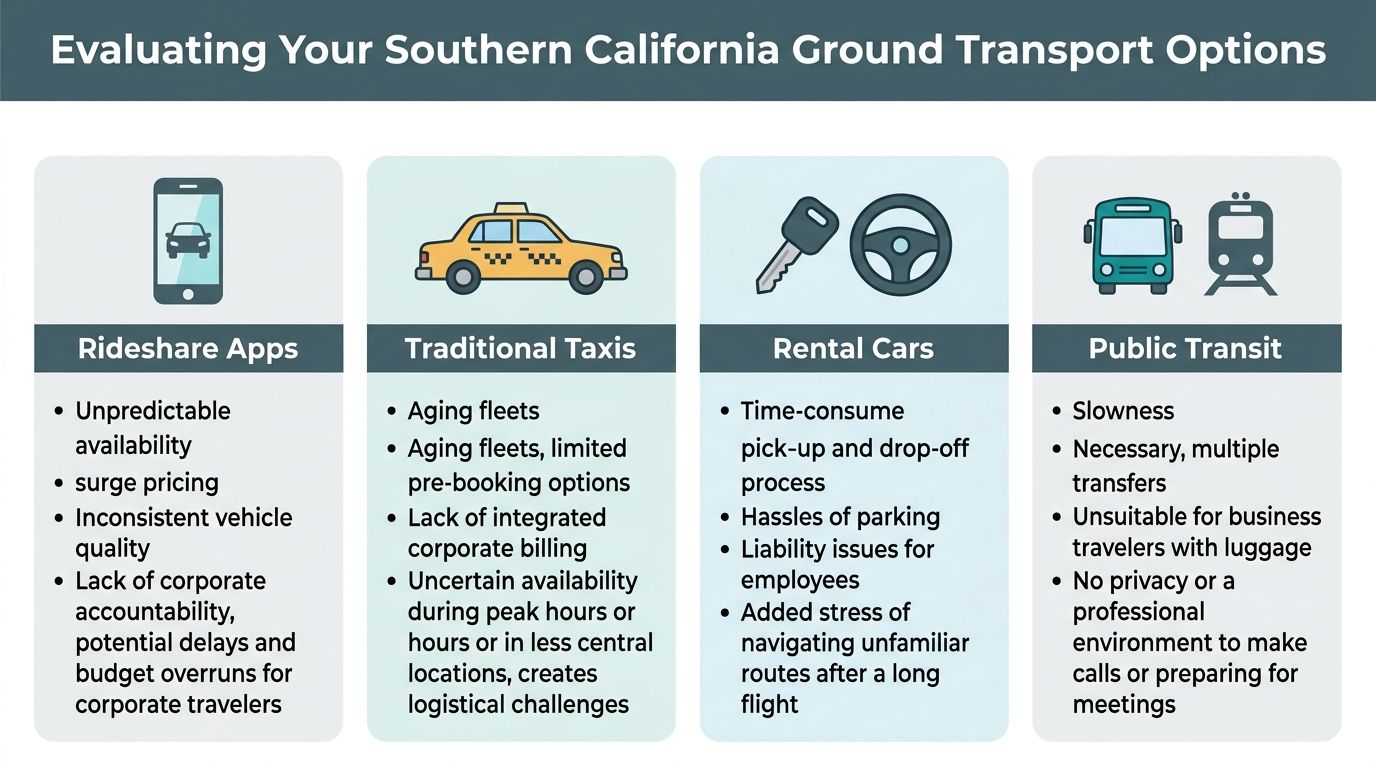
Rideshare apps
At first glance, rideshare looks efficient. Open phone. Request car. Go.
For executive movement, that logic falls apart fast.
❌ Reliability is unstable
Drivers can change. Pickup instructions can shift. Busy airport zones add confusion right when the traveler has the least patience for it.
❌ Cost isn’t steady
A trip that looked reasonable during planning can stop looking reasonable when demand changes.
❌ Accountability is thin
If a ride goes sideways, there usually isn’t one person fixing it.
Industry reports cited by Blacklane show 95%+ on-time rates for pre-booked black car services versus 70-80% for on-demand apps during peak hours, and 30-40% of app-based airport rides face driver changes or timing issues at airports like LAX. That comparison appears in Blacklane’s airport transfer page.
✅ Use rideshare when the trip can absorb failure
That means low-stakes travel, flexible timing, no guest impression risk, and no need for privacy.
Traditional taxis
Taxis solve one problem. They exist outside the app.
They create others.
❌ The experience is uneven
Vehicle condition, billing process, and pickup clarity vary.
❌ Advance planning is weak
For coordinated executive movement, “find one when you land” is still a hope-based system.
✅ They can work for simple point-to-point local trips
If the traveler knows the airport, has no presentation to prep, and doesn’t need a polished arrival, a taxi can be workable.
Rental cars
Rental cars look practical to people who don’t manage executive schedules.
For business travelers, they often push admin work onto the wrong person.
❌ The traveler becomes the operator
Counter, keys, garage, navigation, parking, return process. None of that helps them prepare for a meeting.
❌ Fatigue becomes risk
After a long flight into Southern California traffic, asking someone to drive from LAX to Orange County is avoidable stress.
❌ The car solves transport and creates logistics
That’s not a good trade for C-suite travel.
✅ Rental cars fit longer independent stays
If someone will remain in one area for days and needs autonomy, there’s a case. For airport arrival management, they’re usually the wrong tool.
Public transit and shared shuttles
These options have a place. That place usually isn’t executive airport movement.
❌ They add transfers, waiting, and exposure
That’s the opposite of a controlled arrival.
❌ Privacy disappears
Calls can’t happen. Sensitive conversation can’t happen. Focus usually can’t happen.
❌ The traveler works around the system
A serious airport plan should make the system work around the traveler.
✅ They serve budget-first movement
That’s valid. It’s a different goal.
What a private car service changes
A proper airport transfers services plan replaces live uncertainty with assigned responsibility.
That means:
- A booked time and route
- A named provider
- A known vehicle class
- A communication path if the flight changes
- A service standard that fits executives, clients, and families
That’s why many coordinators default to a professional airport car service for LAX, SNA, LGB, Disneyland hotel pickups, and cruise terminal transfers.
Cheap options often cost attention. Attention is the expensive asset.
Quick comparison
| Option | Good for | Fails when |
|---|---|---|
| Rideshare app | Flexible, low-stakes local rides | Timing, privacy, accountability matter |
| Taxi | Simple solo trips | You need planning, consistency, or polished service |
| Rental car | Longer self-managed stays | The traveler is tired, late, or high-value |
| Shared transit | Budget-first movement | Luggage, confidentiality, or schedule control matter |
| Scheduled service | Executive travel, VIPs, airport coordination | Poor provider selection |
The adult choice isn’t flashy.
It’s just the one that removes preventable problems before they happen.
How Professional Airport Transfers Services Eliminate Chaos
A managed ride works because the process is simple.
Not fancy. Simple.
Four parts of a controlled transfer
First, the chauffeur is assigned before the trip. That changes the whole tone. You’re not waiting for a random acceptance after landing.
Second, the flight is monitored in real time. According to Yelowsoft’s airport transfer automation overview, real-time flight tracking reduces no-show incidents by 70%, and 70% of passengers consider this feature essential. The value is obvious. Delay moves. Pickup adjusts. The traveler doesn’t need to negotiate with the app.
Third, dispatch stays involved. A real operation watches the trip and handles changes before they reach the passenger.
Fourth, the route is managed for the day’s conditions. That matters in Southern California, where a normal plan can age badly in a short window.
Why other systems fail
❌ On-demand systems react after the problem appears.
❌ Shared systems optimize for volume.
❌ Casual providers often promise “flight tracking” and leave the traveler to sort out the details anyway.
✅ Professional service works because one party owns the outcome.
That’s why scheduled providers are worth using for airport work. For example, Luxe Elite Transportation operates as a pre-booked chauffeur service with assigned drivers, flight monitoring, and managed pickups for LAX, SNA, and LGB.
Good transport feels quiet because someone else absorbed the friction.
A Checklist for Vetting Your Airport Transfer Provider
Most providers sound reliable online.
That doesn’t mean they operate reliably when LAX gets crowded, a flight shifts, or the passenger is a client who should never have to ask where the car is.
The fix is simple. Vet the service the same way you’d vet any mission-critical vendor. Ask plain questions. Listen for clear answers.
The airport transfer category is large. The market sees 460-555 million bookings annually, which is 7 times the volume of on-airport car rentals, and real-time tracking has produced a 30% improvement in customer satisfaction ratings, according to CarTrawler’s airport mobility report. In a crowded market, polished websites aren’t enough. Operations matter.
Ask how they confirm the trip
A real provider should give clear confirmation, not vague acknowledgment.
Look for:
- Named trip details that match the airport, time, and destination
- A firm communication method for updates
- Pickup instructions that don’t depend on last-minute improvising
If their answer sounds loose, the operation is loose.
Ask what happens when the flight changes
A lot of companies say they track flights. Fewer explain what that means in practice.
Ask direct questions:
- Do you monitor flight status automatically or manually
- Who updates the chauffeur
- What happens if the flight is early, delayed, or moved
- How does the passenger get notified
A good answer sounds boring. That’s good. Boring means they’ve done it before.
Practical rule: If the provider can’t explain the delay process in one calm paragraph, don’t hand them an executive arrival.
Review the vehicle standard
Vehicle class isn’t only about looks.
It affects luggage fit, privacy, client impression, and whether the traveler can work in the back seat without distraction.
Check for:
- Late-model vehicles with clean interiors
- Quiet cabin expectations
- Charging access and Wi-Fi if your travelers need to stay connected
- Enough luggage space for airport realities
If they avoid specifics, assume variation.
Verify the chauffeur process
Many buyers get too trusting at this stage.
Ask whether chauffeurs are:
- Background-checked
- Professionally trained
- Used to executive and VIP etiquette
- Prepared for meet-and-greet or precise terminal instructions
A provider doesn’t need theatrical language. They need a stable process.
Get clear on pricing
Airport transportation gets messy when the invoice tells a different story than the booking conversation.
You want clarity on:
| Question | Why it matters |
|---|---|
| Is the rate fixed in advance | It protects budget control |
| Are airport, wait, or stop charges explained clearly | It prevents surprise billing |
| Can the provider support corporate receipts and organized records | It helps finance and assistants |
| Are policy changes explained before travel day | It avoids curbside disputes |
Check local fit for Orange County travel
A provider can be competent and still be wrong for your use case.
Ask if they regularly handle:
- LAX to Irvine, Newport Beach, and Anaheim
- SNA departures for early flights
- LGB pickups requiring discretion
- Disneyland resort transfers
- Cruise terminal drop-offs or pickups
The right service should sound familiar with these patterns, not curious about them.
Watch how they answer
This part gets overlooked.
The sales page matters less than the clarity of the reply. If they answer slowly, vaguely, or with canned phrases, expect the same under pressure.
A calm operator usually writes and speaks in calm detail.
That’s the one you keep.
Your Journey from Pre-Booking to Final Destination
Your executive lands at LAX at 9:40 p.m., phone at 12 percent, inbox full, driver unknown, pickup point unclear, and three people texting conflicting advice. That is not transportation. It is cognitive drag at the exact moment the traveler needs control.
A managed airport transfer prevents that spiral before it starts. Under the ERNIE framework, the win is psychological as much as logistical. You remove uncertainty, protect attention, and give the traveler what high-stakes ground movement should provide. Logistical silence.
Before the travel day
The trip should be set up once, correctly, with the flight number, terminal, destination, passenger name, service level, and a true contact path.
Then the traveler gets a confirmation that answers the obvious questions before they become stress points. Who is handling the ride. What car is assigned. How changes will be communicated. Where support lives if the itinerary shifts.
Pre-booked transfers keep gaining ground for a simple reason. They give companies more control than improvised pickup decisions.
If you are arranging repeated Orange County airport runs, a dedicated SNA airport car service for executive and frequent business travel usually fits better than treating each trip like a one-off errand.
On the day of travel
A good provider tracks the flight and handles the background work without fanfare.
That matters because executive stress rarely comes from one dramatic failure. It builds from small unanswered questions. Is the driver still coming. Did the delay break the booking. Do I need to call someone. ERNIE is useful here because it explains the true value of managed transport. You are reducing noise before it turns into fatigue and bad decisions.
After landing
Arrival is where weak systems show themselves.
The traveler should get one clear instruction path, not a guessing exercise. Name of the chauffeur. Vehicle details. Pickup location. Backup contact. At busier airports, that precision protects the traveler from curbside confusion and time loss. At quieter airports, it still protects focus.
No executive should step off a flight and become their own ground coordinator.
During the ride
This is the part many people undersell. The ride is not dead time. It is protected transition time.
In a properly handled transfer, the passenger can review notes, send final messages, reset after a long flight, or stay silent and arrive composed. That quiet matters on routes where the airport is only the first friction point, including:
- LAX to Irvine or Newport Beach
- SNA to hotels, campuses, or office parks
- LGB to private meetings or residential pickups
- Disneyland resort transfers
- Cruise terminal pickups and drop-offs
The benefit is not luxury. It is control of the traveler’s mental bandwidth.
At drop-off
The final minutes should be uneventful. Bags out. Timing intact. No billing surprise. No confusion about the stop.
That is how I judge airport transportation for executives. I want a trip that stays quiet from booking to curb, because quiet means the system held.
Planning Your Travel for LAX, SNA, and LGB
Airport planning gets easier when you stop treating all airport runs as the same task.
They aren’t.
An LAX international arrival into Orange County is one kind of problem. A predawn SNA departure is another. A discreet LGB pickup for a private traveler is something else again.
LAX to Orange County
LAX needs planning because the airport itself creates friction.
For an executive landing and heading to Irvine, Newport Beach, Costa Mesa, or Anaheim, I want a booked pickup plan with exact post-arrival communication. I don’t want the traveler navigating app instructions near a crowded curb after a long flight.
Bad systems become visible fastest on this route.
SNA departures and arrivals
SNA is calmer, which fools people into getting casual.
That’s a mistake.
Early departures still require a provider that treats timing seriously. If the pickup starts in Newport Coast, Laguna Beach, or Dana Point, the ride should already be confirmed and the chauffeur should already know the load, the neighborhood access, and the terminal plan.
For travelers using John Wayne often, this SNA airport car service page gives a practical view of how a scheduled service is structured.
LGB for discreet movement
Long Beach is often the right airport for people who value a quieter process.
That doesn’t remove the need for control. It increases the need for discretion.
For VIPs, family office travelers, and guests who don’t want a public curbside puzzle, the right approach is a pre-arranged car, direct communication, and a driver who already knows the handoff plan.
Small airports feel easy. That’s exactly why weak providers get lazy there.
Disneyland and cruise terminal transfers
Many people under-plan for this.
A Disneyland pickup might involve children, luggage, strollers, event timing, or guests who aren’t local. A cruise terminal transfer can involve strict embarkation windows, extra bags, and passengers who are already mentally in vacation mode.
Those trips need:
- A larger vehicle when luggage will sprawl
- Clear pickup instructions for hotels and resort entrances
- A provider who understands family and executive pacing
- No surprise handoffs
A simple planning rule
Use this rule for Southern California.
- LAX when complexity is high, over-plan.
- SNA when timing feels easy, still confirm every detail.
- LGB when privacy matters, prioritize discretion over convenience language.
- Disneyland and cruise terminals when luggage grows, size the vehicle early.
That’s how you keep airport transfers services from becoming the loudest part of the day.
Common Questions About Managed Airport Transportation
The last doubts usually sound practical.
That’s good. Practical questions are easy to answer when the service is built correctly.
What if the flight is delayed or changed
A managed provider should already be monitoring the flight and adjusting the pickup process.
The traveler shouldn’t have to land and renegotiate the ride. If the service expects the passenger to fix a delay after touchdown, it isn’t managed.
How does the traveler find the chauffeur at LAX
The answer should be precise.
Not “call when you land.” Not “we’ll figure it out.” A solid provider gives clear pickup instructions and a direct communication path. At LAX, vague instructions create avoidable stress very fast.
Can I add a stop in Orange County
Usually yes, if the provider supports it and the stop is arranged clearly.
The key is to settle that before the ride starts. Last-minute changes are where pricing confusion and timing drift begin.
Is scheduled service really worth it over an app
For low-stakes trips, maybe not.
For airport work involving executives, clients, families, Disneyland pickups, cruise terminal timing, or important meetings, yes. The point isn’t indulgence. The point is avoiding preventable failure.
What should be included in the quoted price
You want the answer in writing.
A useful quote should explain the ride clearly enough that the assistant, the traveler, and accounting all read it the same way.
Choosing Your Transfer Service
| Variable | Ride-Share App | Scheduled Service |
|---|---|---|
| Pickup certainty | Changes in real time | Planned in advance |
| Driver assignment | Often variable | Assigned ahead of time |
| Airport communication | Usually app-based and reactive | Direct and specific |
| Executive privacy | Inconsistent | Expected part of service |
| Accountability | Diffuse | Owned by the provider |
| Fit for LAX, SNA, LGB, Disneyland, cruise terminal | Situational | Strong when planned properly |
The calm answer is the right one here.
If the trip matters, the ground plan matters. If the traveler matters, the handoff matters. That’s all this comes down to.
If having this handled matters, you can review options with Luxe Elite Transportation. The right choice is the one that gives you clarity, calm, and control before the travel day starts.
One Response