

Your ride to LAX shouldn’t be the unstable part of the trip.
Yet that’s often where the stress starts. Not at the gate. Not in the air. In the hour before pickup, when you’re checking your phone to see if the car is still coming, if the driver changed, or if the app shifted the plan again without notice.
That strain isn’t personal. It comes from a travel system built for volume, not accountability.
An elite transportation service works differently. It replaces guesswork with planning, human oversight, and a clear chain of responsibility across Orange County, LAX, SNA, LGB, Disneyland, and the cruise terminal.
The Unspoken Stress of High-Stakes Travel
A lot of travel stress starts in silence.
An executive in Newport Beach has a morning flight from LAX. The bag is packed. The presentation is ready. The calendar is set. And the mind keeps drifting back to one small question. Is the ride handled?
That question drains attention before the day even begins. It pulls focus away from the work that matters and puts it on a task that should already be settled.
The real problem starts before the wheels move
This is common with airport runs from Orange County. A traveler leaving for LAX, SNA, or LGB often isn’t worried about the route itself. The worry sits around timing, assignment, and handoff. Has a real chauffeur been assigned? Will the vehicle fit the luggage? Will anyone notice if the flight changes?
Those are reasonable concerns. Modern travel systems train people to expect disruption.
Travel feels harder when the system asks the passenger to supervise the ride.
For families heading to Disneyland after a flight, the pressure looks different and feels the same. Children are tired. Bags are stacked. Plans depend on one clean transfer from airport to hotel. If the pickup stumbles, the whole day starts behind.
For cruise terminal departures, the margin feels even tighter. Port timing doesn’t leave much room for casual errors. A late pickup isn’t just annoying. It changes the tone of the whole trip.
Why capable people still feel out of control
Many smart travelers often face a particular challenge. They’ve handled far more complex decisions than booking a car. And still, they feel exposed when airport transportation is involved.
That’s not because they missed something. It’s because the common model leaves too many moving parts open until the last minute.
A ride can look confirmed and still feel unstable. The app shows a map. The dispatch system sends updates. And none of that tells you whether the plan has real accountability behind it.
The result is low-grade stress that keeps running in the background.
- Phone checking: You keep looking for driver updates instead of reviewing notes for the meeting.
- Mental backup plans: You start thinking about calling another car, driving yourself, or leaving much earlier than needed.
- Arrival uncertainty: Even if the ride works, you arrive mentally busy instead of settled.
That hidden cost shows up in performance. It’s part of the same problem discussed in the hidden cost of airport stress on executive performance.
What people actually want
Most high-stakes travelers aren’t looking for a flashy experience. They want logistical quiet.
They want to know the pickup is set, the chauffeur knows the route, the vehicle is right for the trip, and the system can absorb normal travel changes without turning the passenger into the dispatcher.
That’s the difference between transportation as a commodity and transportation as an operating system.
An elite transportation service starts from that reality. It assumes the trip matters. It assumes delays happen. It assumes timing, privacy, and predictability matter more than novelty.
When travel is important, peace of mind rarely comes from speed alone. It comes from knowing the weak points were handled before they became your problem.
Why Modern Transportation Systems Fail
Transportation failures usually start well before anyone calls to say there is a problem. The weakness sits in the operating model.
A passenger books an airport transfer from Orange County to LAX. The reservation looks confirmed. Then the assignment changes late, the chauffeur gets thin trip notes, the vehicle is not matched to the passenger count or luggage load, and a routine flight adjustment turns into a live coordination drill. No single error looks catastrophic on its own. Together, they create a system that depends on the traveler staying alert.

That is the core failure in modern ground transportation. Too many services are built to process rides, not protect outcomes.
The on-demand model optimizes throughput, not control
App-based transportation works reasonably well for low-stakes local trips. It struggles when timing, discretion, and continuity matter.
The reason is simple. The platform is designed around marketplace efficiency. It fills demand with available supply. That can produce a quick car. It does not reliably produce a controlled transfer.
For Orange County travelers heading to LAX, SNA, or LGB, that distinction matters. Airport service is not just a ride request with a nicer destination. It is a chain of dependencies: pickup timing, route selection, terminal flow, baggage assumptions, traffic conditions, flight status, and a handoff that cannot drift.
Common weak points show up fast:
- Rotating drivers: The assigned chauffeur may have no history with the passenger, household, or executive office.
- Thin trip context: Preferences, access instructions, security expectations, and schedule sensitivity often sit outside the driver’s view.
- Poor vehicle matching: A sedan may be dispatched for a party that needs cargo room, child-seat planning, or space for golf clubs and presentation cases.
- Diffuse accountability: When timing slips, the passenger often ends up texting, calling, and confirming details that should already be owned by operations.
That is not luxury. It is unmanaged variance.
Airport transfers expose every weak process
Airport work punishes casual systems because the environment keeps changing. Flights move. Terminals congest. Curb access tightens. A delayed departure can create a compressed pickup window on the return. An early arrival can leave a passenger standing outside while the ground side catches up.
If no one is actively managing those changes, the traveler becomes the backup dispatcher.
That is the difference between a consumer ride network and a scheduled service with real operational ownership. One waits for exceptions to happen and then reacts. The other expects exceptions and builds procedures around them.
Manual dispatch can fail too
Older transportation models have their own problem set. They may promise personal service while running on phone calls, memory, and ad hoc updates.
I have seen this pattern often. A reservation looks fine on paper, but the live operating picture is weak. Dispatch does not have clean location visibility. Chauffeurs are relying on partial notes. Timing updates move through too many hands. In a narrow airport window, those delays are enough to create missed connections, curb confusion, and unnecessary exposure.
Here is how the main systems tend to break:
| System type | What goes wrong | Operational consequence |
|---|---|---|
| On-demand app | Assignment shifts close to pickup | Continuity disappears |
| Manual taxi dispatch | Status updates lag behind live conditions | Pickup timing drifts |
| Loose black car operation | Premium branding hides casual execution | No one owns the trip end to end |
The branding may look polished. The process underneath often is not.
Technology only matters when discipline sits behind it
Apps, texts, and GPS alone do not fix transportation. Weak operators use the same tools.
What matters is whether the service runs on a controlled system: confirmed trip data, clear chauffeur instructions, active dispatch oversight, flight awareness, and a live view of vehicle position and timing. Technology supports that model. It does not replace it.
In practical terms, a strong operation reduces ambiguity before pickup starts.
✅ The right vehicle is assigned for the actual trip requirements
✅ The chauffeur has the trip notes before arrival
✅ Dispatch can see timing changes and respond early
✅ Exceptions are handled inside the system, not pushed to the passenger
That is why many modern transportation options feel efficient right up until they matter. Their convenience is real. Their control is thin.
For high-stakes Orange County and LAX travel, adult transportation planning starts with a different premise. The ride is not a commodity. It is an operational responsibility.
Calculating the True Cost of Transportation Chaos
A cheap ride can become an expensive failure.
Not always on the invoice. Often in lost focus, missed timing, weak first impressions, and private conversations held in the wrong environment. The car charge is only one line item. The true cost sits around the event the ride supports.
Failure cost matters more than ride cost
If a trip from Orange County to LAX carries no stakes, almost any ride might do. If that same trip leads into an investor meeting, executive pickup, family vacation, or cruise departure, the math changes.
In those cases, the primary question isn’t “What does the ride cost?”
It’s “What does a transportation failure cost?”
A late arrival can compress preparation time. A confusing pickup can affect a guest’s first impression. An anonymous driver model can create privacy concerns that weren’t present on the calendar.
Reliable transportation is a risk decision before it’s a purchasing decision.
That’s why experienced chiefs of staff and travel managers think in terms of exposure, not just fare.
Healthcare offers a useful analogy
One of the clearest examples comes from non-emergency medical transportation. 3.6 million Americans miss medical appointments annually due to transportation barriers, costing the U.S. healthcare system $150 billion, and every $1 invested in NEMT yields $11 in healthcare savings, according to documented NEMT industry statistics.
That isn’t an airport study. It shows something larger and very practical. Transportation failures create downstream losses far beyond the ride itself.
In business and personal travel, the same pattern applies qualitatively. One missed pickup or one unstable handoff can trigger a chain of secondary problems:
- Work disruption: Time meant for preparation gets spent on coordination.
- Reputation strain: You arrive rushed, scattered, or apologizing.
- Privacy exposure: Sensitive calls, names, or plans pass through a setting with weak continuity.
- Family friction: Children, older parents, or guests absorb the stress of an avoidable gap.
The hidden losses pile up quietly
Transportation chaos is costly because it steals from moments that are already important.
For an Orange County executive, the lost asset may be concentration on the way to LAX. For a family going to Disneyland, it may be energy and patience after landing. For a cruise terminal transfer, it may be the confidence that timing is under control.
Those losses don’t show up as a line item, and they still shape the day.
A mature travel system respects that reality. It doesn’t reduce the decision to sedan versus SUV or app versus phone call. It starts with risk. What can fail, who owns it, and what happens if it does?
That’s why an elite transportation service tends to make sense in higher-stakes settings. Not because it looks nicer. Because it reduces the cost of avoidable problems.
The System That Delivers an Elite Transportation Service
A reliable airport transfer is built before the vehicle reaches the curb. The difference is not the trim level or the amenities. It is whether someone designed the trip to hold up when traffic tightens, a flight shifts, or the passenger is unavailable for a quick round of calls.
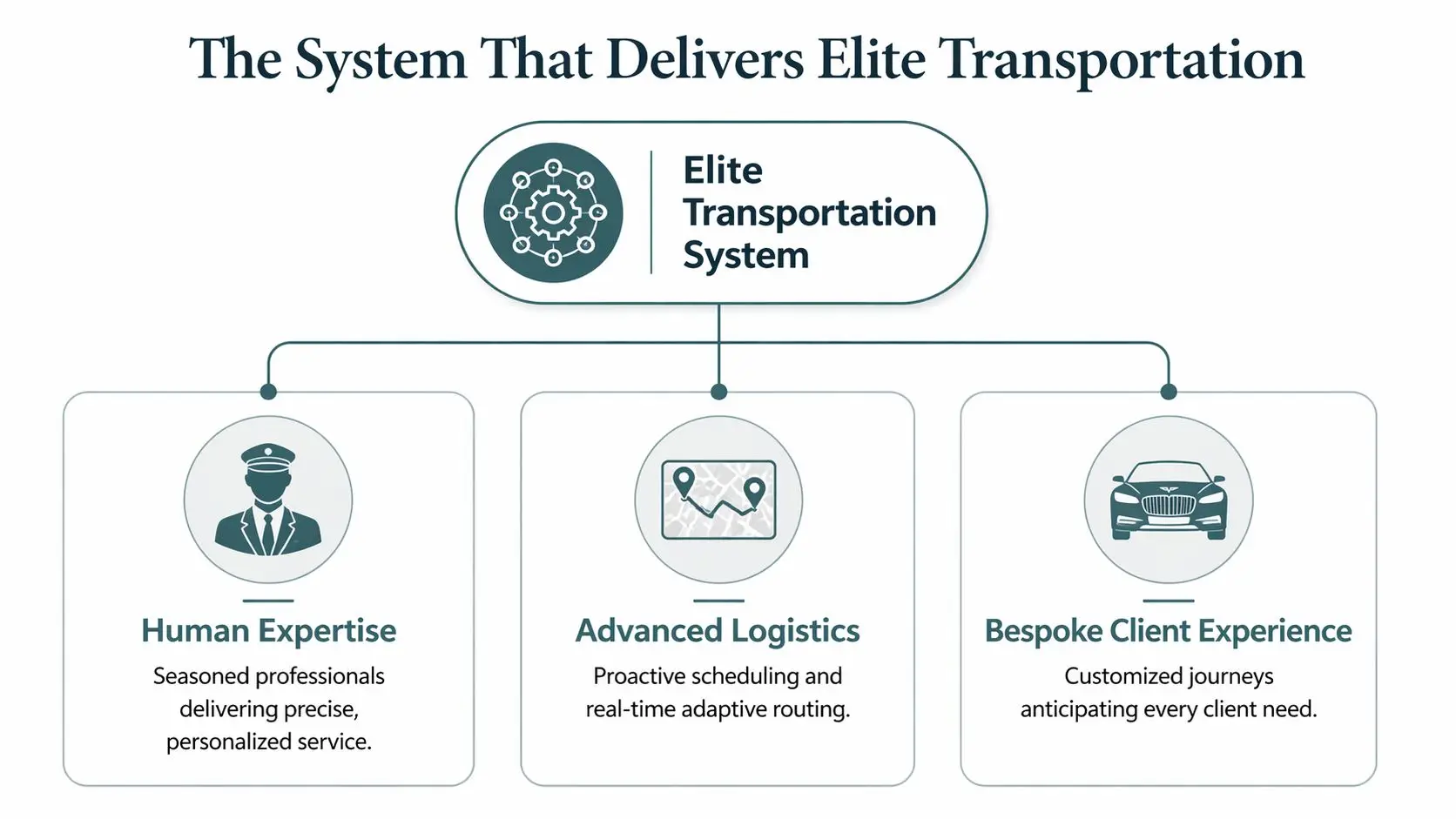
Four parts that actually matter
First, one chauffeur owns the assignment. That creates accountability. The driver knows the client, the pickup instructions, the terminal plan, and the service standard expected for that trip.
Second, the service tracks live flight activity and adjusts the schedule around it. Airport work breaks down when the passenger has to announce every delay, gate change, or early arrival. A scheduled model closes that gap by monitoring the movement and updating the handoff before the traveler starts chasing the ride.
The other two parts sit behind the scenes, but they are what keep the day stable.
- Pre-trip planning: Pickup timing, route choice, terminal details, stop sequence, and luggage profile are confirmed in advance.
- Active dispatch oversight: A real operations team watches the trip and intervenes early if conditions change.
Those pieces matter because they assign responsibility before anything goes wrong. They reduce avoidable calls, vague handoffs, and last-minute improvisation.
What disciplined service looks like
On-demand transportation usually treats each ride as a fresh event. That works for low-stakes errands. It fails for Orange County to LAX runs, executive airport pickups, family arrivals, and any schedule with a real cost attached to delay.
A disciplined chauffeur system treats transportation as an operation. The route is planned. The timing has margin. The vehicle matches the passenger and bag count. The driver is briefed. Dispatch is watching.
That is the model behind scheduled chauffeur service for airport and executive travel. Luxe Elite Transportation is a useful example because the structure is clear: assigned chauffeurs, preplanned service, and live trip oversight in Southern California. The brand matters less than the operating method.
In practice, that method gives the traveler fewer decisions to make under pressure. It also gives the principal or family office a cleaner system to trust. Control comes from preparation, ownership, and fewer points of failure.
An Elite Transportation Service in Action for Orange County Travel
At 4:40 p.m., a principal clears a final meeting in Irvine and needs to make an evening international departure at LAX. That is the point where weak transportation systems start asking the traveler to solve operational problems in real time. Which car is coming. How much buffer is left. Whether the driver understands the terminal. Whether the bags will fit. A scheduled chauffeur system removes those questions before the pickup ever happens.
A good Orange County transfer should feel uneventful because the decisions were made upstream. The chauffeur already has the itinerary, the access notes, and the expected load. The vehicle is matched to the trip, whether that means a sedan for one executive, an SUV for a family with checked bags and child gear, or a Sprinter for a group moving between Orange County, LAX, and the cruise terminals.

A normal airport run done properly
Orange County creates a specific kind of transportation risk. Distances look manageable on paper, but the operating conditions are unstable. School traffic in Irvine, event congestion near Anaheim, late-day compression on the 405, terminal crowding at LAX, and timing shifts from SNA or LGB can all break a loosely managed ride.
An elite transportation service handles that by treating the trip as a controlled movement, not a casual booking. The client receives a defined pickup time and vehicle assignment. The chauffeur arrives prepared for the passenger count and luggage profile. Loading is quick because the vehicle was chosen correctly. The traveler does not spend the first ten minutes of the ride correcting the plan.
That matters on ordinary trips as much as high-visibility ones. A hotel pickup in Newport Beach, a John Wayne arrival heading to Laguna Niguel, or a same-day run from Costa Mesa to LAX all benefit from the same discipline. The route is considered in advance. Time margin is built in where the risk justifies it. If the schedule is tight, the service says so early instead of pretending every departure window is equally safe.
The support system stays in the background
The car is the visible part. The operating model is what keeps the trip intact.
Dispatch oversight, live trip visibility, and documented trip records give the service team a way to correct problems before they reach the passenger. If a flight moves, pickup timing can be adjusted. If traffic conditions deteriorate, the route can be changed with intent instead of guesswork. If there is a question about arrival or wait time, the record is clear.
For the traveler, the benefit is simple.
- Vehicle fit is not left to chance: the right class of vehicle is assigned to the actual trip.
- Pickup details are traceable: time, location, and trip status can be verified.
- Adjustments happen cleanly: delays and route changes are handled through dispatch, not improvised at the curb.
- Billing is easier to reconcile: the trip has a documented timeline instead of vague recollection.
That is why scheduled service works better than the on-demand model for Orange County and LAX travel. The goal is not luxury for its own sake. The goal is a transportation system that holds up when the day gets tight, the road conditions change, and the passenger has better things to manage than the ride itself.
The Pillars of Trustworthy Service Safety Discretion and Quality
Trust in transportation comes from process.
A polished vehicle helps. So does a courteous chauffeur. And neither one is enough on its own. High-trust service rests on safety discipline, discretion, and a consistent quality standard.
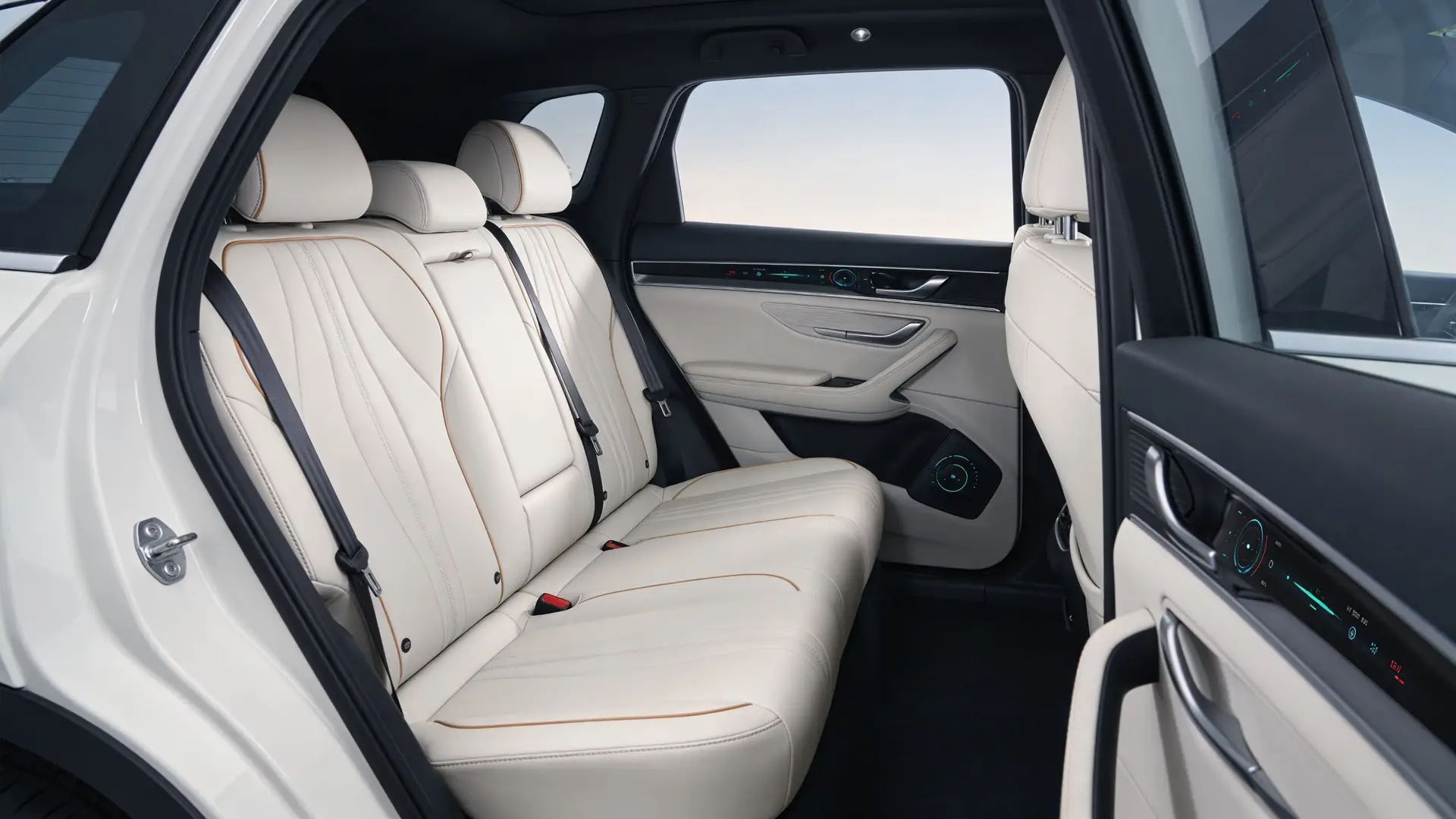
Safety starts long before pickup
Safe service is built upstream. Vehicle care, clean interiors, proper readiness, and chauffeur vetting all belong to the operating standard, not the marketing layer.
When a ride is planned properly, the traveler shouldn’t need to wonder whether the car is suitable, whether the driver is prepared, or whether the route has been thought through. That confidence comes from consistency.
Discretion depends on continuity
For executive travel, privacy often matters as much as timing.
Driver rotation in on-demand systems can undermine confidentiality. For VIP and high-net-worth clients, the value of an assigned chauffeur who understands preferences, travel patterns, and security requirements is a meaningful risk-mitigation measure, as described in this overview of executive transportation services and supported by Elite AMB’s discussion of continuity and confidentiality.
That continuity changes the feel of the trip.
- Less re-explaining: Preferences don’t need to be repeated each time.
- Better privacy habits: The chauffeur already understands the client’s expectations.
- Lower exposure: Fewer handoffs mean fewer chances for details to drift.
Quality is an operating standard
Quality isn’t a mood. It’s the repeatable discipline behind the ride.
A trustworthy service keeps the cabin clean, quiet, and ready for actual use. That may mean room to work on the way to LAX, space to settle children after landing at SNA, or a composed arrival for a dinner, hotel, Disneyland transfer, or cruise departure.
The adult choice is usually the one with fewer variables. In transportation, that means using a system that treats safety, discretion, and vehicle readiness as fixed parts of the job.
How to Plan Your Transportation for Predictable Outcomes
Good transportation planning is simple when the service model is sound.
You don’t need more alerts. You need a clearer setup. Start with the route, the schedule, the passenger count, and what has to fit in the vehicle.
A simple planning method
For Orange County travel, three steps usually cover it.
Define the trip clearly
Is it point-to-point from Newport Beach to LAX, an SNA pickup to Irvine, a Disneyland hotel transfer, or a cruise terminal drop? If the day includes meetings or multiple stops, hourly service may fit better than a single transfer.Match the vehicle to the specific load
Many weak systems cut corners on vehicle specification. Properly specified vehicles matter. Executive fleets may support 599 lbs per load in an SUV and up to 1,900 lbs per load in a cargo van, which helps avoid luggage and equipment problems, according to Elite Transportation Systems vehicle specifications.Confirm the operating details
Make sure the service has the flight, terminal, timing, passenger count, and any notable luggage or privacy needs. Clarity early prevents curbside improvisation later.
Planning note: The right vehicle is part of reliability, not an upgrade decision.
Common questions
| Question | Answer |
|---|---|
| Should airport travel be booked as point-to-point or hourly? | Point-to-point works well for direct transfers. Hourly service fits better when the day includes waiting time, multiple stops, or shifting meeting plans. |
| What vehicle should I choose for LAX or SNA travel? | A sedan works for a solo traveler with light luggage. An SUV fits more passengers and larger bags. A Sprinter helps with groups, event travel, or family airport runs. |
| Why does vehicle specification matter? | Under-specced vehicles create curbside delays and mid-journey problems. Proper load capacity reduces those avoidable issues. |
| What should be confirmed before travel day? | Pickup time, airport, terminal details, passenger count, luggage profile, and whether the trip is direct or hourly. |
| What matters most in a high-stakes ride? | Clear responsibility, advance planning, and a service model that reduces last-minute variables. |
Predictable travel usually comes from one decision. Stop using systems that treat important rides like casual errands.
If having this handled discretely matters, you can review options through Luxe Elite Transportation.