

The final invoice for your private jet charter is often much higher than the initial quote. You’ve felt that sinking feeling when the numbers don’t match. This isn’t because you planned poorly. It’s because you were given incomplete information by a flawed system. The real cost to charter a private jet is often hidden behind outdated quoting practices designed to show a low number first.
That last-minute surprise doesn't just create financial anxiety; it breaks trust right when you need it most. It makes you feel like you've lost control over the one thing that was supposed to be predictable.
You’re not failing at budgeting. The system is failing you. Many charter platforms use algorithms that simply spit out a base hourly rate, ignoring the mandatory fees that are a real part of every flight. They give you an attractive number, and the true cost only appears later, leaving you to deal with the fallout. This chaos is built into the process.
Why Initial Quotes Can Be Misleading
This problem, sometimes called "quote shock," is a symptom of how the private charter market works. It’s an industry that grew quickly, and its quoting systems never caught up. The global charter market is projected to reach $45.43 billion by 2030, according to analysts at StratosJets.com. This growth created complexity, and with it, more places for costs to hide.
Chaotic quoting systems thrive in this environment, forcing you to guess the final price. These platforms are known for failing to include necessary operational costs from the start.
- ❌ The Flawed Approach: Accepting a low initial quote that ignores essential fees. This guarantees budget overruns and a loss of control.
- ✅ The Methodical Approach: Working with a system that provides a complete, all-inclusive price. This gives you certainty and peace of mind.
Understanding this is the first step to regaining control. It isn't about finding the lowest hourly rate. It's about securing a predictable, fixed price. When you know what to look for, you can evaluate a quote with confidence. This becomes essential when comparing private aviation to other options, like we discuss in our analysis of driving versus flying for executive travel.
When you have a complete picture of the costs, you can make a calm, informed decision. The price you agree to is the price you pay. No more surprises.
Understanding How Private Jet Charter Costs Are Calculated
The first price you see for a private charter is rarely the final price. This is by design. The system is often set up to present a low, appealing number upfront, and the real cost is a surprise you discover later.
At the heart of every quote is the base hourly rate. This number is based on the aircraft size you choose. It is the number most automated quoting systems show you first.
Think of it like the sticker price on a car. It's just the starting point. It never includes the mandatory fees and taxes needed to actually drive it home. A quote built only on the hourly rate is incomplete.
- ❌ The Common Mistake: Focusing only on the hourly rate. This ignores other required fees and almost always leads to a final bill that's 25-40% higher than expected.
- ✅ The Professional Approach: Demanding a fully transparent, all-in quote from the start. This gives you a reliable figure and puts you in control of the budget.
Relying on an hourly rate alone leads to budget chaos. A well-planned charter experience starts with understanding the complete cost breakdown. It's the only way to ensure the price you agree to is the price you actually pay.
Choosing the Right Aircraft to Manage Your Budget
Choosing a private jet is like selecting a tool for a specific job. You wouldn't use a heavy hammer to hang a picture. And you shouldn't charter a 14-seat heavy jet for a short trip with two people. The biggest factor in your charter cost is the aircraft itself. Getting this wrong is the fastest way to overspend.
Many quoting apps simply show you what’s available, not what’s logical. This is a common problem in the industry. It often leads to paying too much for a jet that's too big, or feeling cramped on a long flight because the right aircraft wasn't chosen.
True control over your charter costs comes from matching the aircraft to your specific needs: the number of passengers, the flight distance, and the comfort required. This isn't about finding the cheapest option; it's about finding the most efficient one.
H3: Light Jets for Regional Efficiency
For an Orange County executive, a light jet is the right tool for regional business. It’s perfect for getting from John Wayne Airport (SNA) to a meeting in Las Vegas or a site visit in Scottsdale. These jets are made for speed and efficiency on trips under three hours.
- Passengers: Built for small teams, typically seating 4-6 passengers.
- Purpose: Ideal for day trips and quick turnarounds, helping your team avoid commercial airport hassles.
- Example Scenario: You and three colleagues have a one-day conference in San Francisco. A light jet gets you there and back the same day. It’s a private, fast, and cost-effective solution when you consider the time saved.
Using a light jet for this trip means you’re not paying for the extra size and operating costs of a larger aircraft you don’t need.
H3: Mid-Size and Super-Mid Jets for Greater Range
When you need to travel farther, mid-size and super-mid jets offer a good balance of range, comfort, and cost. They are often used for corporate travel because they can handle longer domestic flights and more people without the high price of a heavy jet.
A mid-size jet is the right choice for a flight from Los Angeles (LAX) to Chicago. A super-mid can handle trips across the country, like Orange County to New York, often without stopping for fuel. You get more cabin comfort, with more headroom and better amenities for work or rest.
A common mistake is booking the same aircraft for every trip. The system works best when the jet is matched to the journey. This ensures you only pay for the capacity and range you actually use.
H3: Heavy Jets for International Travel and Large Groups
Heavy jets are in a different class. These are the aircraft for long international flights and large teams. They can fly non-stop from Southern California to Europe or Asia. They offer the most range, cabin space, and onboard amenities.
Think of them as flying boardrooms, ready for work or rest on flights of 10 hours or more. For a leadership team flying from LAX to Tokyo, or a family wanting maximum comfort on a trip to Hawaii, a heavy jet is the only logical choice. While they have the highest charter costs, their ability to fly long distances is unmatched.
Understanding how these categories relate to actual numbers gives you control. Before you look at quotes, it helps to know the general price ranges in the industry.
2026 Private Jet Charter Hourly Rates by Category
This table shows typical hourly rates, passenger capacity, and non-stop range for common private jet categories. Use it as a starting point for your budget.
| Aircraft Category | Typical Hourly Rate | Passengers | Approx. Range (Nautical Miles) |
|---|---|---|---|
| Light Jet | $4,000 – $6,500 | 4-7 | 1,500 – 2,000 |
| Mid-Size Jet | $6,500 – $9,000 | 6-9 | 2,200 – 3,000 |
| Super Mid-Size Jet | $9,000 – $12,000 | 8-10 | 3,500 – 4,000 |
| Heavy Jet | $12,000 – $15,000 | 10-14 | 4,000 – 6,000 |
| Ultra Long Range | $15,000 – $20,000+ | 12-16 | 6,500 – 7,500+ |
These rates provide a solid baseline. Industry data from leading operators confirms that hourly charter costs in 2026 for light jets are between $4,000 to $6,500, and mid-size jets are from $6,500 to $9,000. Heavy jets start around $12,000 and can go over $20,000 per hour for top-tier models. You can see a detailed pricing analysis from sources like Amalfi Jets to understand these numbers in real-world scenarios.
This knowledge lets you make a logical, data-driven choice. Just as you plan your ground logistics for efficiency, which we cover in our guide to understanding limo service costs, selecting the right jet class helps create a predictable travel budget.
Navigating the Additional Fees on Your Charter Invoice

The hourly rate is just the start. That feeling of losing control over your charter budget often comes from the extra fees that show up on the final bill. It’s a common frustration.
The problem isn’t the fees themselves—they are standard operating costs. The real issue is when they are hidden. A simple quote from an automated platform might look good, and it can create financial chaos later. By understanding these charges, you can look at any quote with confidence and avoid budget problems.
Federal Taxes and Segment Fees
One of the most predictable charges for any flight in the United States is the Federal Excise Tax (FET). This is a government tax that cannot be avoided.
For every charter flight, the FET is 7.5% of the flight cost. You will also see Segment Fees, which are small charges per passenger for each part of a trip.
- ❌ The Common Mistake: Thinking the base rate includes these mandatory taxes. This is why initial quotes from some platforms are misleadingly low.
- ✅ The Professional Approach: Knowing these are required costs. A transparent quote will always list FET and segment fees as separate items, giving you the real total from the start.
Think of these like sales tax. They are not optional. Any quote that leaves them out is incomplete.
Fuel and Operational Surcharges
A major variable in your final cost is the fuel surcharge. Your hourly rate includes a standard amount for fuel, and this surcharge covers unexpected price changes in the market. If fuel costs go up between booking and flying, that extra cost is passed on.
The core problem in charter pricing isn't the existence of fees, but the lack of transparency. A proper quote system anticipates and itemizes these costs, so you see the complete picture before you commit. This transforms a chaotic process into a predictable one.
You will also see a few other standard costs:
- Landing Fees: Airports charge for every landing. The fee depends on the airport and the aircraft's weight.
- Crew Overnight & Per Diem: If the crew has to stay overnight, your cost will cover their hotel and daily expenses. This is standard for any multi-day trip.
A professional operator won't hide these. They will be listed clearly in your quote because they are a basic part of the operation.
This infographic breaks down the most common aircraft categories, which directly influence the hourly rate and overall cost.
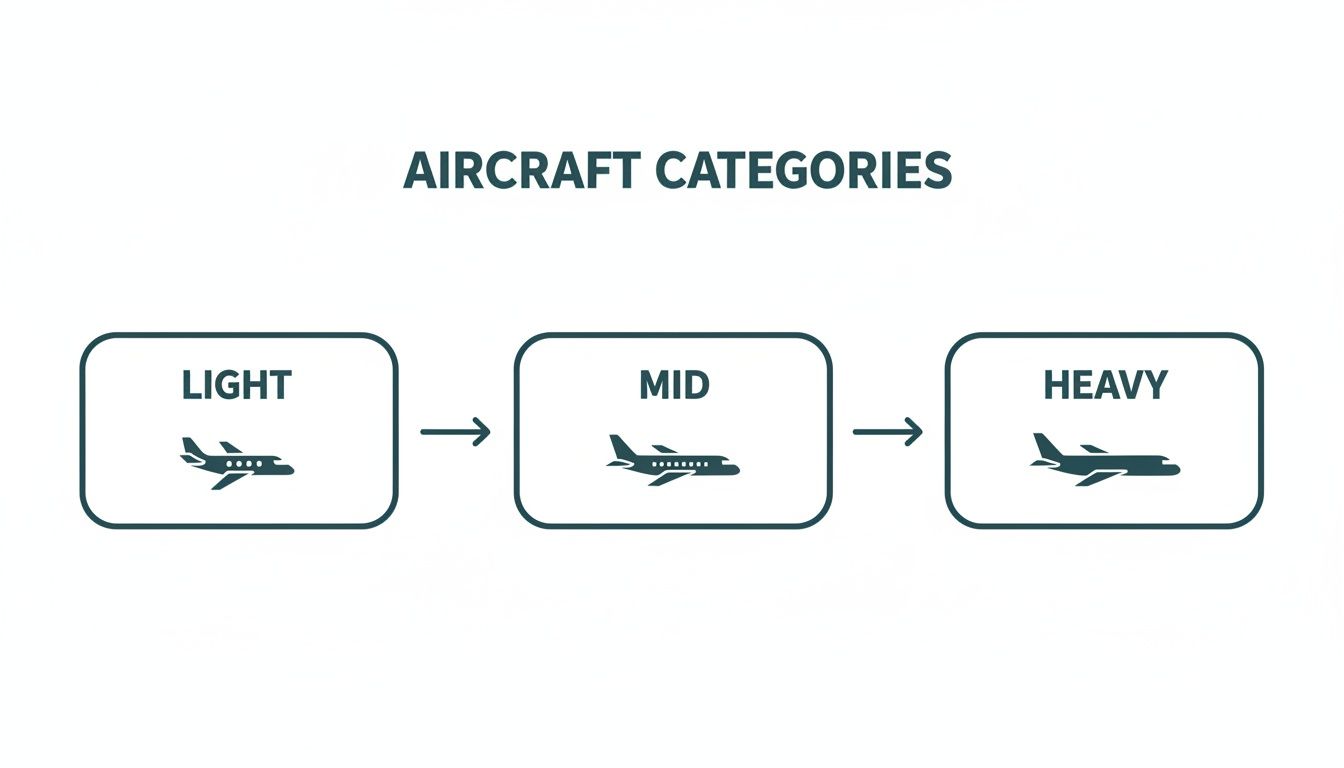
Understanding these categories helps you know not only the base cost but also how other fees, like landing charges, might change with the aircraft size.
Repositioning Fees Explained
The most misunderstood charge is often the repositioning fee, also called a "ferry flight." This is the cost of flying the empty aircraft to your airport before your trip or flying it back to its home base after.
Think of it like paying a taxi to drive across town just to pick you up. If the jet you need is based in Las Vegas but your trip starts in Orange County, you are responsible for the cost of that first flight from LAS to SNA.
This is where many automated quoting systems fail. They can't accurately calculate this cost based on real-time aircraft locations. It is often the biggest "surprise" fee on a final bill. A detailed, human-verified quote, like those discussed by aviation resources such as Jettly, will account for this from the beginning. This foresight is the difference between a controlled plan and a reactive expense.
How Trip Timing and Flexibility Influence Price
You can lock in your aircraft and operational fees, and one variable still remains: market demand. The cost to charter a private jet is not a fixed price. It changes with the calendar, responding to holidays, major events, and seasonal travel.
This is a common frustration for people new to chartering. A quote that seems good one week can be gone the next, just because of when you need to fly.
This isn’t a problem you can solve with a booking app. Those platforms are not good at pricing for real-time market changes. True cost control comes from understanding these patterns and planning your travel around them. The system rewards those who plan ahead.
Seasonal Demand and Peak Travel Windows
Private aviation has high and low seasons, like any other type of travel. Trying to book a last-minute flight for Christmas is chaotic, and the price will always be higher.
The winter holidays are the busiest time of the year for charter operators. Data shows that flights during this peak time can cost 15–25% more than average. That pricing pressure often continues into early January.
On the other hand, a month like March might see lower prices as operators compete for spring travelers. You can see a more detailed breakdown of these seasonal charter rate trends from Global Air Charters.
The lesson for any planner is simple: if your travel dates are flexible, avoiding major holidays and three-day weekends is the best way to manage your budget. Moving a trip from late December to February can lead to big savings.
The Truth About Empty Leg Flights
You have likely heard the term "empty leg." These are one-way flights an aircraft must make without passengers, usually to return to its home base or to get to its next client. They are often marketed as a huge cost-saving opportunity.
And sometimes, they are. You can sometimes book an empty leg for much less than a standard charter.
And building a travel strategy around them is a mistake.
- ❌ The Gamble of Empty Legs: These flights are unpredictable. They only exist because of another charter, which can change or cancel at any time, leaving you without a flight. You have no control over the schedule, route, or aircraft. It is the opposite of reliable.
- ✅ The Control of Strategic Planning: A booked charter gives you complete certainty. You set the schedule. You choose the airports. You select the aircraft. The peace of mind from a locked-in plan is the very reason people fly private.
Think of empty legs as a tool for the operator, not a reliable planning tool for you. They add risk and uncertainty that private aviation is supposed to remove. A well-planned charter during an off-peak time is a much smarter way to find value.
Achieving True Door-To-Door Travel Coordination

The conversation about the cost to charter a private jet usually stops at the airport. It's easy to focus on hourly rates, and that misses the real point. A successful trip isn't just a flight. It’s a smooth process from your front door to your final destination.
You may have experienced this breakdown. The flight is perfect, and the car is late. The landing is smooth, and your driver is at the wrong terminal. This isn't a small problem. It's a system failure that brings back the stress private aviation is meant to get rid of.
The real value of private travel is not just in the air. It's in the logistical silence that comes from a perfectly synchronized plan, where ground and air transport work together as one.
Moving Beyond a Fragmented Travel Plan
Most charter brokers and booking apps treat ground transportation as an extra—something they add if you remember to ask. This approach almost guarantees a communication breakdown.
The problem is simple: the flight operator and the car service are working from two different plans.
- ❌ The Disconnected Approach: You book a jet, and then you book a car. This creates two separate places where things can go wrong, and leaves you to fix it when a flight is delayed.
- ✅ The Integrated Approach: You plan the journey as a single system. One team manages both air and ground logistics, making sure they communicate and adapt to changes in real time.
For anyone flying out of Southern California's private terminals at John Wayne (SNA), LAX, or Long Beach (LGB), this integration is necessary. Navigating FBOs, tracking tail numbers, and arranging tarmac access requires coordination that ride-hailing apps cannot provide.
The Value of a Coordinated System
When your chauffeur service and flight operator are working together, a quiet efficiency takes over. Your chauffeur is not just given an address; they are actively tracking your flight. They know your tail number and the correct private terminal—often before you do.
If your flight from New York lands at SNA thirty minutes early, you don’t need to do anything. The system has already adjusted. Your chauffeur is already there, waiting, because they are watching the same data as air traffic control.
This is what logistical silence feels like. It’s the absence of worry. It's knowing that every detail is being handled correctly. This is especially important for private airport transfers where precise timing is essential.
True control isn't just about choosing your flight time. It's about knowing that every part of your journey—from your office in Irvine to your hotel in Manhattan—is managed by a system built for predictability.
Ultimately, coordinating your ground transport isn't an "add-on" to your charter cost. It is a key investment in the outcome you are paying for: a calm, controlled, and seamless travel experience.
By planning the entire journey as one event, you close the gaps where chaos and stress can enter. The final step is creating a plan that gives you complete oversight without demanding your constant attention. You set the plan, and the system handles it.
The Fine Print: Common Questions on Charter Costs
Even a well-planned charter can have confusing parts. When you are dealing with high-value travel, uncertainty is not an option. Getting lost in automated quoting tools or vague answers from brokers only creates problems where you need clarity.
The goal is to remove all surprises. Here are direct answers to the most common questions about the real cost of chartering a private jet.
What Is the Minimum Flight Time I Will Be Billed For?
Most operators have a daily flight minimum, which is almost always two hours. This is a standard rule in the industry.
So, even if your flight from Orange County to Las Vegas is just 60 minutes long, your bill will show two hours of flight time. This policy covers the operator's fixed costs for using the aircraft and crew for the day. A common mistake is to budget only for the time in the air, which leads to a surprise on the invoice for short trips. A transparent quote will always make this daily minimum clear.
Does the Hourly Rate Include Everything?
No. The hourly rate is only the cost to operate the aircraft itself. Think of it as the price for the plane, not the whole trip.
Other mandatory fees and variable costs are always added to get the final price. A professional and trustworthy quote will always list these as separate items so there is no confusion. You should expect to see:
- 7.5% Federal Excise Tax (FET) on all domestic flights
- Segment fees charged per passenger
- Fuel surcharges, which can change
- Landing and handling fees at each airport
- Crew overnight costs, if your trip requires an overnight stay
An itemized breakdown is the difference between a rough estimate and a firm price. Never move forward without one.
Can I Bring My Pet on a Charter Flight?
Yes. Bringing pets in the cabin is one of the best parts of private aviation. And this isn't automatic—it requires planning.
You must tell your charter provider ahead of time that a pet will be traveling with you. Some aircraft owners have specific rules, and others may require health documents. As travel experts at Jettly note, this flexibility is a main reason for choosing a charter. Giving your coordinator this information early ensures they can find a pet-friendly aircraft and make arrangements for a smooth flight for everyone.
If your priority is a travel plan built on precision and logistical silence, Luxe Elite Transportation ensures your ground transport integrates perfectly with your flight schedule.
For those who expect every detail to be handled correctly and without fuss, you can review your options for coordinated travel here: https://luxeelitetransportation.com